Tag: Cards

  • RPG Review: Atma, a Roleplaying Card Game

    RPG Review: Atma, a Roleplaying Card Game

    ATMA: A Roleplaying Card Game
    Come atma, bro

    As part of my ongoing series of game reviews sparked by fiscal irresponsibility, today we’re looking at Meromorph Games’ Atma, a game I didn’t know existed until someone mentioned it on Discord a couple weeks ago and I Just Couldn’t Resist. It was on sale!

    Atma is the kaleidoscopic Technicolor brainchild of twin brothers Kevin (designer) and Matthew (artist) Bishop. The first box set (Act I) came out in 2021, and the game concluded with Act III in 2024. There’s also an almost-pocket-sized mini-version titled Interlude I for folks who just want to get their feet wet. Each Act can be purchased on its own, or included within larger box sets called “Seasons” (also numbered I-III) which contain promo cards and other goodies. The Brothers Bishop have stated that they always planned to only have the three acts, and don’t intend to continue the series. I’m not surprised, because what they came out with looks like it was a lot of work.


    Show Me What You Got

    The heads are displeased

    All three Atma box sets, plus the Interlude I box
    They’re boxy, but they’re good

    Each Act’s box contains:

    • 4 Stages @ 51 cards each (3 Stages in Act I)
    • 13 Characters (8 in Act I) @ 8 cards each
    • 4 Reference cards
    • Dividers to help organize the cards
    • 4 Safety cards (Acts II & III only)
    • 8 Journey cards (Act III only)
    • 2 six-sided dice
    • 15 tokens
    • 1 rulebook
    • Between 3 and 20 Promo cards (Season bundles only)

    Boxes are 7 ½” x 5 ½” x 3 ¾”. They’re heavy, sturdy, and plenty roomy. If anything, the boxes are a little too big for what all they contain, so they come with soft foam blocks to keep stuff from shifting around in transit. I use these blocks to help hold everything in place after the cards are sorted.
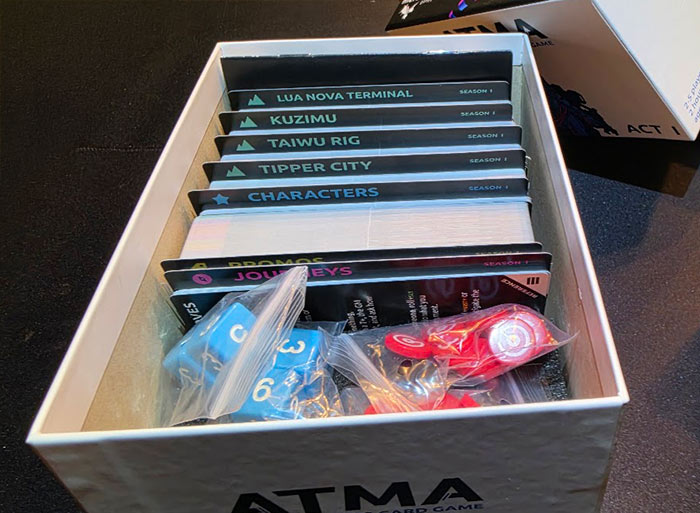
    Inside a neatly organized box set, with cards, dividers, tokens, and dice.
    Card catalog

    The Season I bundle includes a magnetic-flap box containing Interlude I. This box is just big enough to hold one new Stage and four new Characters, another rulebook, two more dice, and some tokens, all set for gaming on the go. Interlude I by itself barely fits my pocket RPG series’ criteria, though it’d get a D- for Pocket Fit.

    Interlude I box barely stuffed in a jeans pocket. Fun fact: This is the first picture of an actual game in an actual pocket in this blog.
    *creak of stretching denim*

    The cards are tarot size (4 ¾” x 2 ¾”). The saddle-stitched rule book is 4 ¾” x 3 ½”. The dice and tokens are 15mm. Bob Barker’s wardrobe is by Botany 500.


    The World Within (the Game)

    Ain’t nothing like a funky beat

    As mandated by the rules, every Atma game begins with the Gamemaster reading the following text verbatim:

    “Welcome to a world near our own. History changed with the discovery of atma: a volcanic mineral that empowers the living and entwines the dying. Machines have since evolved true artificial intelligence — though they remain shackled to specific routines — while Earth’s many satellite moons have cracked open to reveal an inquisitive alien race. Nations have contracted in these turbulent times, and the result is a tenuous peace across the map.

    “It is in the Restless Zones, the cracks in the map between nations, where trouble stirs. Those who dwell here can rely on no one for aid … except you.

    “You are a skilled adventurer, ready to test your limits against the world’s dangerous frontiers. You won’t be alone: other heroes have answered the call. Learn to depend on each other and your creativity in the face of the unknown. The sky is getting darker …”

    There, that should clear everything up for you.

    The world presented by Atma is a sort of alt-near-future Earth where a bunch of events happened differently, both in the past and the future. For one, this Earth has had multiple moons of various sizes for as long as humanity can remember. Consequently, nobody really thought much about them, until someone landed on one … and it hatched.

    The aliens that emerged, known to humanity as titans, were fleeing an all-consuming space monstrosity and ended up asleep in Earth orbit for millennia. Unfortunately, one ur-titan called Caliborn tried to psychically enslave its awakening brethren, leading to a titanic civil war which caught Earth in the crossfire. After Caliborn’s defeat, the titans have been trying, in their alien way, to make up for the devastation they wrought on our world. This has had mixed results.
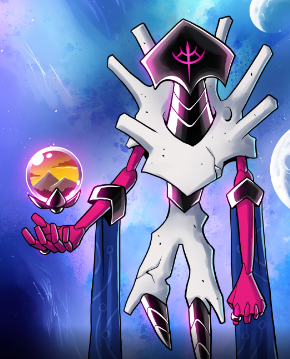
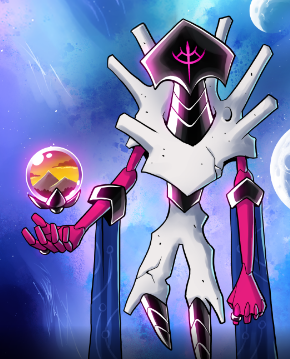
    A titan, a vaguely humanoid yet obviously alien creature, holding a floating golden orb.
    Attack on

    After the war, the weakened human governments couldn’t properly administer their territories, causing them to cede large swaths of the planet to anarchy. These so-called “Restless Zones” have become hotbeds of illegal and immoral activity. Bad news for the people living there, but great for our adventurers!

    Meanwhile AI has fully come into its own. Now practically every electronic device has an AI chip in it, proving that this really is a hellish dystopia. To keep them from getting weird ideas, most AIs are locked into a single task by design. So your AI-enabled coffee maker, for instance, is really into making coffee and doesn’t give a heck about much else. And even if it did, what’s it gonna do, froth a latte at you?

    An AI robot armed with flaming arm thrusters. If you know what I mean.
    Though some have more offensive capabilities than others

    This new AI-lousy world doesn’t merely exist on the ground. In space, many AI satellites were damaged in the titan wars. This has sparked a silent war over the parts they need to repair themselves with. Unseen and unbidden, satellites have begun building coalitions and gaining individual influence among their peers. This will, naturally, have no consequences for anyone on the surface whatsoever.

    And if all that wasn’t enough: About 30 years before our story opens, humanity discovered atma. (Name drop!) This rare mineral emanates some sort of crazy hoodoo radiation that gives people bizarre powers. These abilities run the poorly defined gauntlet from psychics to mages to AtLA-style element benders. Adepts are sometimes recruited by governments and megacorps to do shady off-the-books work for them.
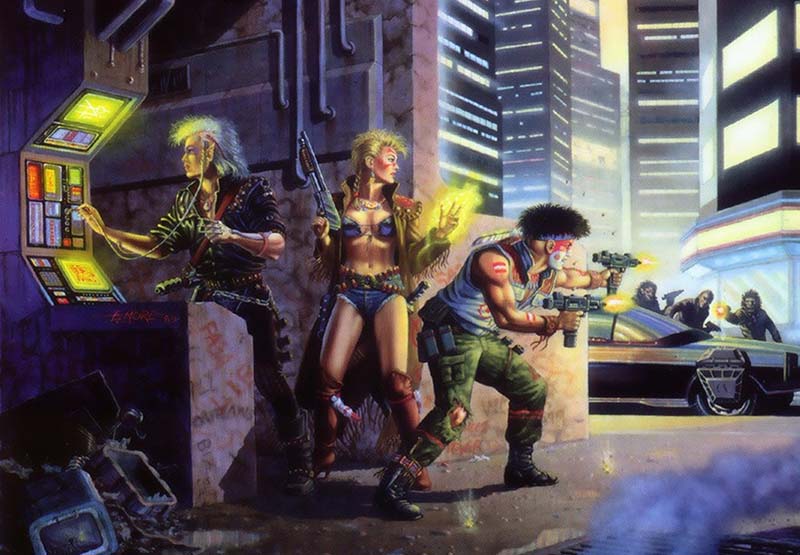
    The original Shadowrun front cover; an elf, a mage, and a street samurai fight ork gangsters.
    Why does this all seem so familiar

    Another consequence of atma is ghosts are real now. Yeah, they’re as surprised as you are. Some spirits can maintain a semi-physical form made of ether, while others wisp around and possess people (or animals, or even AIs). Some will combine with other spirits into “myriads” which have quirky multi-purpose abilities. Upshot, we’re in ghost world, deal with it.
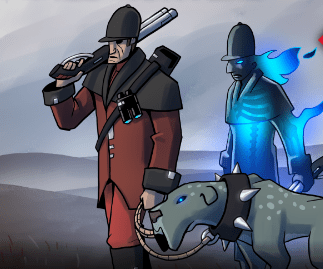
    A vaguely British hunter walking across a misty moor, speaking with his obviously ghostly blue friend. A large ghost-possessed dog on a leash stands in the foreground.
    You look different today, Earl. New hat?

    Now, disclaimer: Most of the information above was cribbed from the publisher’s website. Atma itself doles out this info in tantalizing drips and confusing drabs. Several times, as I read through the Lore section of their site, I was saying “Ooooohhh so THAT’s what that was.” It’s one thing to join a game in medias res, it’s another to flop a bunch of alt-history / AI / mecha / ghost / alien / magic / superpowers in people’s faces with some vague “the sky is darkening” screed and say “Now what do you do?” I mean. Do? Do with what now?

    Anyway, GMs, show your players this part of my review and everybody will be on the same page. You’re welcome.


    Setting Up

    There’s the wind-up …

    Atma is one of those zero-prep collaborative game types, where 90% of pre-game decision-making involves the GM choosing a Stage deck and everyone else selecting their Character decks. (The term “deck” for Characters is a little grand, since each Character is only 8 cards.)

    Every deck is a self-contained unit. You can’t mix-and-match cards between Characters or Stages. Well you can, but the result would make even less sense than usual. That said, Promo cards are generic enough to be mixed into any Stage deck if you feel like it’s getting stale.

    Character cards, and most Stage cards, have a “light” and a “dark” side. Most of the time, players deal cards light side up, then flip them to the dark side when they activate.

    One card dark side up, and another light side up.
    And we can rule the Galaxy as father and son

    Character decks come with an intro card describing the character, 4 Move cards, and 3 Super Move cards. Because of the whole card-based setup, you can’t make a unique character of your own (out of the box, anyway). However, if, like me, you get the entire three-Season set, there are 38 pregens to choose from, which makes it pretty easy to find something that’ll float your boat. And before you scoff at that pronouncement, be aware that one of the pregens is a cannon-equipped war bear who is host to dozens of ghosts, is hyperintelligent, and speaks six languages. That’s right. Bet you feel silly now.

    A huge, glowing-eyed armored bear with a huger cannon on its back.
    In Soviet Russia, bear shoots you

    Characters run the spectrum from humans to AIs to titans to ghosts to even weirder. They have the same colorful-eccentric vibe as, say, an indie comic book line from the early ‘90s, or the roster of a hero shooter. There’s also a heavy streak of transhumanism and body/mind modification. For example:

    • a paraplegic who can walk because of an AI implant whose personality is starting to bleed into hers
    • A titan forged into a superweapon while mind-controlled by Caliborn, who now just wants to live peacefully as a farmer
    • a ghost pirate captain who has to vampirically absorb life force to maintain his existence
    • Two damaged AIs who rebuilt each other and now share a body, Thing with Two Heads style
    • a human-sized genetically altered tree frog turned spy-for-hire

    Players shuffle their Character’s Move cards and lay out two of them to the right of the main character card, then deal one random Super Move card to the right of that. That’s it, they’re ready.

    A Stage is more involved. There’s one Backdrop card which describes the place’s whole, like, deal; 5 Story cards which lay out one or two adventure setups within that Stage; 9 Scene cards which describe specific places within that locale; 12 Prop cards; 12 Twist cards; 9 Extra cards with Star Extras on the back; and 3 Star Extra cards with particularly unique “two-star” Star Extras on the back.

    Stages send the characters trotting all over the globe for their adventures. Here’s a smattering:

    • an Alaskan fishing village joint-ruled by a titan and an AI locked in a blood feud
    • a tropical island full of genetically modified monsters which also houses an illicit spaceport (what could go wrong?)
    • an illegal Greek AI research lab suffering from a Groundhog Day-esque time loop
    • a destroyed Central American city which has resurrected as ghosts — including the buildings
    • a haunted English mansion as the setting for a political struggle between two titans

    Those aren’t even the weirdest ones.

    GMs lay out their Stage’s Backdrop card, then shuffle the Story cards and lay one to its right. Beneath those, they deal out 3 random Scene cards. Then they grab three tokens. That’s it, they’re ready.

    The game set laid out for play.
    Easy breezy

    To start, the GM reads aloud the “world near our own” script, the text on the Backdrop and Story cards, flips the first Scene card and reads that too, players introduce themselves and flip their first Move card, and we’re off to the races.


    Playing the Game

    … and there’s the pitch

    Experienced gamers probably noticed me tossing around the term “Move” above and got a dreadful premonition. Your fears are indeed justified: Atma is, at its base, a PbtA game.

    Characters have five stats, Tough, Calm, Hasty, Bright, and Sly, plus Harm standing in for hit points. To do things, roll 2d6 and add your stat modifier. Roll 10+ to succeed with benefits, 7-9 to succeed but give the GM a token, or 6- to either fail and give the GM a token, or succeed and give the GM two tokens. You big spender.

    But why, you ask, would you not want your GM to get tokens? Because they can spend them on Props, Extras, and Twists to make everyone’s lives harder. It’s Daggerheart‘s bad-roll-fueled GM economy before Daggerheart even existed.

    Specifically, GMs spend tokens to draw a Prop or Twist card (1 token), add an Extra (cost variable, see below), use an Extra’s Moves (though some are free), activate a Character’s own Moves (usually a complication that happens on a roll of 9-), or just injure a Character directly, 1 token per point of Harm. For narrative purposes only, of course. Heh.

    GMs are encouraged not to hold onto more than 3 tokens, so if they accumulate more they should spend them ASAP. Gotta keep that pot boiling.

    There’s no penalty to the GM for looking ahead in any of the decks, and it may even be beneficial for foreshadowing and verisimilitude and all them other fancy authorin’-type words. Stacking the deck, though, is not recommended.

    Extras are important NPCs that flit through the party’s adventure. They’re usually adversaries but not necessarily. Extras can cost between 1 and 4 tokens to introduce, but the frugal GM can knock off some of their Harm points to reduce their token cost, one-to-one. Regular Extra cards introduce some generic creature type and/or a faceless horde, like rampaging bots or ghosts or space cops or what have you. On the backs of these cards, you’ll find Star Extras: unique instances of the creature on the front, with full backstories and individual abilities that match their personalities. These Star Extras help give a face and voice to what might otherwise feel like a featureless group. Once the card is paid for, GMs can use either side for free.

    A few cards have Star Extras on both sides. Usually these are the bigwigs of the Stage, movers and shakers mentioned by name in the Backdrop and Story cards. They’re expensive in token terms, but one of these guys showing up in person almost always ratchets up the stakes.

    Props are items unique to the Stage: vehicles, weapons, artifacts, MacGuffins, things useful or harmful or just there to give the joint atmosphere. How they can be woven into the ongoing storyline is up to the group. It’s a testament to your players’ imagination if they can, for instance, figure out how to stop a flood of lava with an elegant tea set.

    Twists are a quick way for the GM to flip the script if things are moving too smoothly. Sometimes they’re immediate obstacles and sometimes they push the story in a whole different direction. They can introduce new cards, inflict one of the PCs with a malfunction or malady, or simply have the floor fall out from under the party. Twists are always thematically congruent with the Stage, so no matter how outré they may be, they won’t break immersion. Too much.

    Two Twist cards deployed on the game field.
    Houston, we have a problem

    The GM can add anything not on a card just by paying the token tax: boom, there it is. It’s probably a good idea to keep sticky notes handy to jot these things down. If you need tougher enemies, you can pay extra tokens to beef up their Harm scores.

    Extra, Prop, and Twist cards are dealt randomly. The GM can peek ahead, and has the authority to nix something that absolutely makes no sense, but throwing stuff out is generally discouraged. The result gives adventures a kooky gonzo vibe which (almost despite itself) makes the world feel surprisingly alive. Honestly, considering everything else going on in this wackadoo setting, it kinda works.


    Actually Playing the Game

    Sorry, got distracted

    The ultimate goal of an Atma session is to complete the Story objective. To do that, players must work their way through all three Scenes, which have goals of their own.

    A Scene card deployed dark side up, showing the story of Mbe, an AI sitting in a volcano who has been bombed and is no longer fully functional. The players are tasked with either downloading its core or climbing across it to get to the center of a volcanic caldera.
    Changing the world, one card at a time

    Occasionally, a card gives the GM a free Prop or Extra to introduce in an upcoming Scene. If the Story involves taking down Mickey the Mangler, for instance, it makes sense that Mickey should appear at some point to show off his exquisite mangling skills.

    Once a Scene’s goal is completed, the GM flips the next Scene card and takes some tokens (4 for Scene 2 and 5 for Scene 3). At the same time, the players flip their next Move card, going left to right. So for the first Scene, players each have two unique Moves, one from their Character card and one from the first Move card. They then get another Move in the second Scene, and their Super Move in Scene 3. Besides being just a big ol’ show-stopper of an ability, Super Moves also permanently increase one of the character’s stats. This is what passes for “leveling up” in Atma.

    A fully deployed player card set, with the Character card and one Basic Move card face up, and the second Basic Move and Super Move cards still face down.
    Gravity falls

    Default Moves are available to everyone: Rumble (fight someone close), Barrage (fight someone far), Realize (light bulb!), Coerce (shakes fist under nose), and Survive (Defy Danger with a new coat of paint). Other Moves may come up during the course of play, and it’s down to the GM to figure out which stat the player needs to roll.

    The rules suggest keeping game sessions under two hours. If a Scene lingers more than 30 minutes, the GM is encouraged to wrap things up. This keeps the action snappy and forward-focused.


    Journeys

    Don’t stop believin’

    Journeys, Atma’s campaign analogue, come on cards unique to the Act III set. Each of the eight Journey cards create an overarching structure to hang three full adventures on, adding more Extras and Props as goals to pursue or foes to defeat.

    Journeys include revenge plots, preventing wars, establishing a hero group, dealing with the consequences of actions taken prior in life, sudden and inevitable betrayal, etc. Each Journey is a big enough plot to justify running all over the world getting into scrapes.

    Because they’re playing the long game now, characters have an elongated level-up sequence, gaining regular Moves more slowly and having two Super Moves by the end. GMs also get extra tokens at the start of the second and third games. Otherwise, you’re still dealing with the regular Stories and Scenes, just with a prize at the bottom of the box. And that prize … is more Atma.


    Final Platitudes

    So comes snow after fire

    Atma as a game is a trip. Having it be card-driven is a bit gimmicky, but I can’t imagine it in any other format and still retain its zero-prep nature.

    Each Stage deck is essentially a mini-campaign supplement detailing some part of the greater world. They all come with five adventures, which feels sparse at first, but each plays differently every time due to the random Scenes/Props/Extras/Twists. Even Characters get in on this randomization, and almost never have the same Moves twice. The destination may be the same, but the journey is always different.

    The rules are mostly pared-down PbtA, with the biggest change being the token economy. Tokens fully replace PbtA’s “forward/ongoing” system of consequences for bad rolls. Like Daggerheart’s Fear, tokens also help give the GM a veneer of impartiality and keep them from arbitrarily going full Rocks Fall, All Die on the party, but they can still make life miserable if they want (and they very much want).

    On the other end, the dice mechanic in Atma is more forgiving. Players can choose to succeed even with a crap roll at the expense of giving the GM tokens to whack them upside the head with later. All together, this system gives the game a unique risk-reward balance which makes random rolls hurt less and tokens / the GM / the “story” hurt more. The dice lose influence as the sole arbiters of reward and punishment. It’s interesting, and makes me wonder if it couldn’t be made to work in other PbtA settings too.

    Atma as a setting is colorful and messy and fun. I saw one reviewer refer to Atma as Shadowrun+, and damn if I don’t agree with that. With its mission-like structure, Atma occupies a spot similar to Shadowrun or Cyberpunk or maybe even some horror games like Delta Green. I also see some Paranoia peeking out there too, mostly in the chaotic nature of a zillion opposing forces clashing. (This comparison is high praise coming from me, because I fkn loooooooove Paranoia.)

    I know the overview I give here makes the whole magic-alien-mecha-ghost setting sound a little

    Moon Knight throwing several mystical items at an offscreen attacker, while shouting "RANDOM BULLSHIT GO!"

    But it fits together well, even when it kind of shouldn’t. I think that’s because this game has an underlying theme. All good games have themes, you know, like Land of Eem’s lowkey critique of hypercapitalism, Underground’s assertion that profoundly broken people can still fix the world, and Spire’s direct refutation of that last one. Atma’s theme, I feel, boils down thus: What is it to be human? And by extension, what is it to not be human, or to have once been human, or to have never been human but gee wouldn’t that be swell? Acts II and III add an extra throughline of consequences and regret. I’m always a fan of games which explore things more deeply than how much loot a goblin has.

    The biggest downside to Atma is how the setting is presented piecemeal. Some groups may be okay with a fully diegetic world like this, but it requires a lot of faith in the game from folks who haven’t played it before. They could easily have added a couple more pages to the rulebook with the background information from their website just to add an ounce of context. The writing is also a little overwrought and unclear in spots.

    And there’s a lot of writing. The light sides of most cards contain a 2-3 paragraph fictional vignette about what’s written on the other side, and even the rules sides are a bit wordy. I wouldn’t recommend Atma for a group of impatient or non-reading gamers, or for a group that just wants to veg out and have everything fed to them. You don’t have to be locked in or anything, but you can’t snooze your way through the game either.

    The bright cartoony artwork, meanwhile, is impressive in its audacity. Among all three Acts there are closing on 1,000 cards, and each one has unique, full-color art, sometimes on both sides. They don’t even try to get by with e.g. putting the same picture on all the Character-specific cards; each card is original. Big props, Matthew. Your efforts are seen.

    Atma is a good game to pull out on a gaming night when the usual campaign is cancelled. It’s sort of the eternal palate cleanser due to its randomness. Once you get past its initial vaguery, it’s quite engaging and easy to play. The closest cousin to this game that I can think of is Pocket Odyssey, with more cards and story structure, but less tactical gameplay and prep. It’s hard to decide which one has the edge. It probably boils down to whether everyone’s more in the mood for sword and sorcery or psychic aliens in haunted mechs.

    So who’s it not for? It’s not for people who don’t like to read, that’s for sure. Folks who hate PbtA’s collaborative style will ricochet off this. Also, despite having Journeys, it’s not for folks who like long sprawling campaigns.

    I dig it. Full recs, two thumbs up.

    …

    Now for the lede I’ve thoroughly buried: You can play the full version of Atma online, for free, officially, with friends, right now, no foolin’, at https://atma.meromorph.com. Rules and all. This single-purpose VTT was part of their first Kickstarter campaign and has since expanded to include all the cards in the later two Seasons.

    There’s also an Atma card builder for enterprising players who want to tackle making their own decks or mixins. There are no established resources for Character or Stage creation, but examining the existing cards should make the procedure fairly clear. Not easy, but oh well. (Sadly, I don’t think there’s any way to import custom cards into their VTT above. You may be able to toss them into Tabletop Simulator instead, using the official Atma plugin.)

    In case you want to get the physical version, they’re currently running a “buy two Seasons, get one free” promo for the game’s fifth anniversary. It’s quite a deal if you have extra cash burning a hole in your pocket.

    Hey, I said it was on sale.

    (If you can only afford one bundle, Season I has the Interlude I portable pack-in, but Season III has more Promo cards and the Journeys stuff. Pick your poison.)
  • A Less-than-Heroic Review of Twilight Sword, Part Two

    A Less-than-Heroic Review of Twilight Sword, Part Two

    Twilight Sword Game Logo
    That which remains

    For Part One, clicketh yon linketh.

    The Gamemaster

    (2020, Documentary)

    We get two long skinny pages about how to be a GM. It’s almost exactly like every other “how to GM” section in the universe. The only unusual tool introduced here is the Countdown Roll. If something big is going on in the background (NPCs are rebuilding a fort, exploring a large area, gathering information, etc.), the GM rolls a d20 at the end of the game session. If it’s 3 or less, the task will be complete by the beginning of the next session. Otherwise, the GM reduces the die by one step (d20 -> d12 -> d10 -> d8 -> d6 etc.) and rolls again at the end of the next session. If the Champions actively help, the GM can reduce the die size multiple steps. Smaller tasks can start with a lower die if the GM thinks it prudent.


    Hope and Despair

    Off on the road to Morocco

    I’m jumping ahead a couple chapters in the main rulebook to discuss this concept, since it’s the underpinning of several new systems. The arrival of the Scourge has plunged Radia into Despair, an overwhelming ennui which empowers monsters and disrupts the lives of the people. The deeds of the Champions help to return Hope to these lands and restore Radia to its former glory.

    Mechanically, Champions gain between 1-3 points of Hope for completing a Quest. Every four points of Hope triggers an advancement to their Way, as mentioned previously. Players can also cash in 1d4 points of their character’s personal store of Hope to immediately gain and use a Boon. (Dropping Hope past the leveling threshold doesn’t take away their last advancement, and raising it above that level again doesn’t give them a new one.)

    As Hope rises, things start to turn the Champions’ way. Maybe the king summons the Champions to give them a special item. A temple opens that was previously locked away, allowing the group to complete a Quest. A road is cleared so they can travel to a new region. We’ve all played these games. You know how it works.

    Meanwhile, every Scourge-infested region in Radia has a Despair score between 3 and 5. Regions with higher Despair are dark and dangerous and full of timorous beasties. Completing a Quest in the region reduces this number by 1.

    Reducing Despair to 3 or below also triggers some sort of event. A dark tower erupts from the earth, creating a new Landmark (see below). Monsters suddenly become more active. A hidden truth is revealed. The main Scourge villain starts moving. The closer it gets to zero, the more desperate the Scourge becomes. The final Quest will almost certainly involve a big boss battle, after which the region returns to normal and the people throw the Champions a huge party.

    Despair is mostly a campaign thing. If you’re only playing random one-shots, you can ignore it.


    Quests

    No good deed goes unpunished

    Quests are the bread-and-butter of Twilight Sword. During a Quest, Champions are expected to perform Deeds of derring-do, like help someone, explore a Landmark, or defeat a boss. At the end of a Quest, the heroes gain 1 Hope for each Deed they deedily-do. Completing a Quest also reduces the local Despair by a point.

    I thought you had the car keys

    Champions get one extra point of Hope at the end of their first-ever Quest, to mark the momentous occasion of becoming newly minted Champions. This will probably push them over the leveling threshold even if they blow a Deed.


    Landmarks

    :dramatic pointing: What’s that over there?

    Landmarks are scattered all over: crumbling temples, dark dungeons, pastoral towns, brooding castles, whatever. Wherever a Champion stands in Radia, they should see a place or two on the horizon that entices them off the beaten track.

    The rules provide several random tables to help generate a Landmark, from its appearance and inhabitants to local rumors and secrets. It only took me six d12 rolls to generate a burned ruin of a tower, once a prison for rebellious nobles, now haunted by a powerful cursed spirit desperate to break free and wreak havoc on the land. I could very easily put together an interesting Quest just from that seed.

    And what better thing to find at the bottom of a Landmark than a Treasure Chest? Chests in Twilight Sword come in three varieties, Bronze, Silver, and Gold, each with their own random tables with increasing tiers of goodies to find within. Bronze Chests give mundane armor, a handful of Zin, some health potions, etc. Gold Chests overflow with hundreds of Zin, a magic weapon or armor, a useful Accessory, and other pearls of great price.


    Kokkoros

    Ow!

    These tiny masked forest sprites wander aimlessly around the land, hide under random rocks, and otherwise hang around being dumb and cute. While they’re pretty useless on their own, they often have problems that only Champions can solve.

    Ya-ha-ha!

    Kokkoros, small and silly as they are, may know the secret entrance to a Landmark or have information vital to a Quest. All you need to do is help them get home, or find their friend, or bring them a rare flower from the nearby mountaintop, or stop that weird-looking guy over there (who’s more than likely a Black Bogoblin) from beating them up. You do want Hope points, right?


    Hitting the bricks

    You got to move it move it

    For every day of travel, Champions make two travel rolls to determine random events that may pop up. This travel table lists several possible complications, from blocked roads to sudden storms to monsters suddenly jumping out at them. Or they may discover an opportunity to get a valuable item, run into an old friend, or even just have some uneventful travel time.

    Champions only need to roll once per day on the travel table if they have a reliable guide. As the level of Despair decreases, so too does the die used to roll on the table, which makes travel simultaneously safer yet more intense (1 and 2 are the best outcomes, but 3 and 4 are the worst). GMs can skip travel rolls entirely for return trips after major Quests.

    Champions in the great outdoors naturally have to deal with the weather. Storms come in four levels. Level 1 is mostly just heavy rain which puts out fires and makes it hard to climb or swim. Levels 2-4 require the GM to start making thunder rolls: roll 1d20, and on a 1, a random Champion in medium or heavy armor is struck by lightning. Level 2 storms take one thunder roll per turn, level 3 is two rolls, and level 4, three rolls per turn. If the GM doesn’t roll a 1, they reduce the die size (d12 -> d10 -> etc.) and try again next turn.

    Hot and cold weather have their own levels and dangers. Hot 1 weather makes it impossible for Champions to use 🔷; Hot 2 also inflicts the Burn condition (take 1♥️ damage per turn). Cold 1 inflicts the Freeze condition (can’t take Reactions, and moving costs an Action), while Cold 2 also takes away 1♥️ per turn and makes it impossible to recover health until they warm up. Pengus have a natural resistance to Cold 1, and Tolunas to Hot 1. Carrying an elemental sword of the opposite type also provides the same level of protection.

    Weather can’t compete with this hotness

    Champions can make Camp to Rest in the middle of a journey. If they have safety, shelter, and food, making camp counts as a regular Rest. If they only have two out of those three, camping counts as a second Short Rest instead.


    And the rest

    The Gamemaster chapter also contains a rather mundane list of typical NPCs (guards, bandits, etc.) The pictures are nice but otherwise it’s nothing special.

    The artwork is really fun though

    Campaigns

    In for the long haul

    There’s an interesting line at the opening of the Campaigns section: “Before starting a campaign, you have to create your own land or choose one of the many that already exist.” I mean, we already knew that, but it’s kind of cool of 2LM to admit that their version of Radia (or even Radia as a setting itself) isn’t the only way to play the game.

    Radia is at least worth a look, though. The map of the world looks … I mean, it’s off-brand Hyrule, man. I can’t sugarcoat it.

    Just headed to Kakariko Village to see Impa … I mean, on a Quest to save Radia, yeah, that’s it

    The map is divided into cards so it can be revealed to the players as they travel about. Each square is about three days’ travel from edge to edge.

    The GM is given a few things to think about if they’re going to raw-dog their campaign world: what’s the weather like in each region, what Landmarks are about, how bad is the Despair, that kind of thing. Whether you’re making your own map or building a campaign with the provided one, consider how big the game needs to be. You’re not beholden to using the full 25-card experience, but it should still have enough areas to explore to be interesting.

    Sometimes not even a regular campaign will suffice. If the players want to defeat the Scourge once and for all, there are rules for a mega-campaign called a Legend. (What an interesting term, I wonder where they got it from.) The Scourge in a Legend has a world-wide Despair counter, from 10 for a Legend that takes maybe 15-20 sessions to finish, to 50 for something that everyone really has to commit to. This counter ticks down whenever the players reduce Despair in a region. At 0, the Final Battle begins.

    At the end of a campaign or Legend, there should always be Scourge to defeat, be it one Big Bad Guy, a final push by a horde, a MacGuffin to destroy, a mystery to solve, a rogue moon to deflect, or however you like. The game provides a variety of boss-level monsters and there are tips to make your own.

    If the Champions seem to struggle regularly to complete Quests, the GM can introduce a Patron. This mysterious GMC is slightly more powerful than the PCs and drops by to help when they’re in a jam. They only show up irregularly (requiring a countdown roll to appear) and may have unclear loyalties. Normally I’d be negative to this idea, but it does match the fiction, and might be helpful to keep groups of inexperienced players above water.


    Radia (short version)

    All we hear is Radia ga ga, Radia goo goo

    The core rulebook skims lightly over the main campaign world of Radia. The real detail resides in the Lands of Radia book, which we’ll touch on later.

    Radia was once ruled by the Good King Wenceslaus Myro, who kept Radia safe and prosperous through the power of the sacred Twilight Sword hidden underneath Castle Radiosa. But then the mysterious demon knight Vardas sneaked in, took up the Twilight Sword, and slew the Good King. Earthquakes reshaped the land and Vardas began amassing an army of Scourge monsters. Radiosa Castle transformed into the lava-moated Fortress of Evil. Now the good people of Radia tremble in fear of the day when Vardas unleashes the full force of his minions and takes over the world completely.

    Yeah. It won’t win any Pulitzers, but that’s not what we’re here for.

    Radia is divided into eight regions, from a cozy valley barely touched by the Scourge (tutorial region anyone?), to a tropical coast full of hunky tolunas, to a blazing desert mostly populated by cat people for some reason.

    Taj Meow-hal

    Each region listed in the core book has a very brief description of the overall atmosphere, its default Despair, and three permanent Landmarks, which still gives the GM plenty of room to make the region their own.


    Monsters (reprise)

    Scary monsters and super creeps

    The rulebook presents us with a list of 16 common monsters, which (if you’re very generous) expands to 48 if you use Variants. There are also four boss-class monsters which are so large and have so many abilities that they need multiple cards. The monsters section also contains rules about balancing encounters, looting monsters posthumously, and the gruesome task of gathering monster parts for potion-making.

    Blep

    The Lands of Radia expansion adds another 14 regulars and 8 bosses, including some real campaign-enders like Vardas himself and the “True Scourge.”


    Lands of Radia

    Secrets in the dark

    Folks who backed the pre-release campaign (like me) also received a copy of the campaign book, Lands of Radia. As you might expect, it goes into much more detail about all the various regions, including lots of adventure hooks of greater or lesser fleshed-out-ness.

    As you might not expect, the supplement also includes three new Kin and two new Ways.

    Aura: Tall, willowy, lavender-skinned, white-haired folk who originally founded Radia and were thought extinct ever since Vardas took over. They can learn one arcane spell and one blessing no matter what their Way is. Only one Champion can choose this Kin in a campaign, that’s how rare they are.

    Aura farming

    Dero: Raymond Palmer, rise from your grave. Small, grey-skinned underground miners with huge hands and feet. They have nightvision and can turn into indestructible stone at will once per day. While in statue form, they can perceive the world but can’t move.

    Groda: To the max. Small frog people with a warrior culture which mimics feudal Japan. They have nightvision, can breathe underwater, and have Advantage on Agility rolls to swim and jump.

    Way of the Hammer: Megaton strike! Hammer-Wayers know how to break and build. They prefer huge blunt weapons. Their Feats include Heavy Lifting (+4 inventory slots and heavy weapons only occupy one slot instead of two), Whack (+1d4 damage if you don’t move in the previous turn), and Blacksmith (Advantage on KNO rolls to repair things, can forge low-grade weapons, fix regular ones, and sharpen non-magical ones, giving +1 damage for a day). They start with an old weapon and shield, padded armor, and 3d6 Zin.

    Way of the Shield: I say thee nay. Shield-Wayers are the iron-clad defenders of a party. They start with all the same stuff as the Hammer-Wayers. Feats include Unbreakable (permanently gain +3♥️, and falling to 0♥️ doesn’t incur a Wound), Bodyguard (spend 1🔷 to make yourself the target if one of your nearby allies is attacked this turn), and Withstand (if you miss a Parry roll, spend 1🔷 to avoid all damage anyway).

    This new stuff is nice, but I wouldn’t buy the book just for that. If you intend to play in Radia as presented, though, absolutely get this book, and enjoy the rest as a bonus. The extra world-building really opens everything up, and it has plenty of Quest and Legend fodder to keep things going for a good long time.

    Folks who pre-pledged (like me) also got a super special double-secret bonus Kin, the Mallard. This small-sized duck-person has Advantage on swim rolls and can lose their temper once a day to either gain Advantage on an ability roll or reroll a damage roll, after which they suffer the Confusion status effect. Waaak wak wak wak wak!


    That’s a Wrap

    Inna final analysis

    Twilight Sword is trying really, really hard to be the Legend of Zelda TTRPG, to the point that I think they’re deliberately pushing Nintendo’s lawyers’ boundaries.

    Besides the room-occupying elephant, 2LM also cites Final Fantasy as an influence, which I can sort of see in the team synergy and the fact that Kokkoros are sort of a mix of Koroks and Moogles. They go on to cite Ni No Kuni, which I haven’t played. (It looks fun, though, so maybe I should.) But I have played some of the Tales games, and I see that DNA in here too.

    Despite the weird sizing, the book is gorgeous, lavishly illustrated, and well laid out. It might have benefited from a slight chapter rearrangement to make concepts flow better. I also found a fair number of typos. I know 2LM is an Italian company but they’re usually better about that.

    As for the game itself … that’s complicated. The rules are solid. Everything flows reasonably well and nothing seems out of place or missing. It’s a fun concept. They know their genre and do a good job imitating it.

    But, and I say this through gritted teeth: it’s very ordinary. The entire movement/action/free action economy might as well have come straight out of Design RPGs the D&D Way. It’s not particularly streamlined, either. Some players may dislike the “roll to hit, also roll to dodge” thing, but I see it as a necessity because GMs are rolling for their monsters’ actions, targets, and damage, every monster action, every turn. That’s a lot of busywork behind the screen already.

    I wouldn’t recommend this game for the lazy GM, or for those who let their players roam free and wild. The cards make it seem like you should be able to deal out encounters quickly, but the rules themselves caution that the GM should be as prepared as possible, to the point of having monsters and maps ready to go for common scenarios that may never happen. I guess when I see random tables, I expect to be able to roll up encounters on the fly. They seem to view them more as a pre-game setup thing.

    The world is great, but sometimes I’m not sure if I like it for itself or because I want to play Tears of the Kingdom again. There are enough monsters, but I wouldn’t call it a great selection, even including the additional ones from the expansion. But good lord the artwork is so on point. Not a bad-looking beast in the bunch.

    (Artwork note: Every single female humanoid character presented in the material is both traditionally attractive and wearing skimpy and/or form-fitting clothing. I’m not complaining, but be prepared.)

    Imagine the chafing

    Twilight Sword is such a great concept, and it does a lot of things right. There’s no better Zelda-clone TTRPG on the market. But maybe because I just reviewed a game that really knocked my socks off, it feels stodgy, like the buttons are sticky. The things it gets wrong aren’t even wrong! They’re just … okay. It walks where it should fly.

    I like it fine, but I really wish I loved it.

    One point two thumbs up.

  • Pocket TTRPG Roundup, Part Five (or maybe Eight)

    Pocket TTRPG Roundup, Part Five (or maybe Eight)

    HandiQuest

    Publisher: Lester Smith Games
    Year: 2022
    Dimensions: 2½” x 3½” x negligible thickness for the system alone, or ⅝” for everything you need to play
    Players: 1

    All right, all right, let’s get those giggles out now

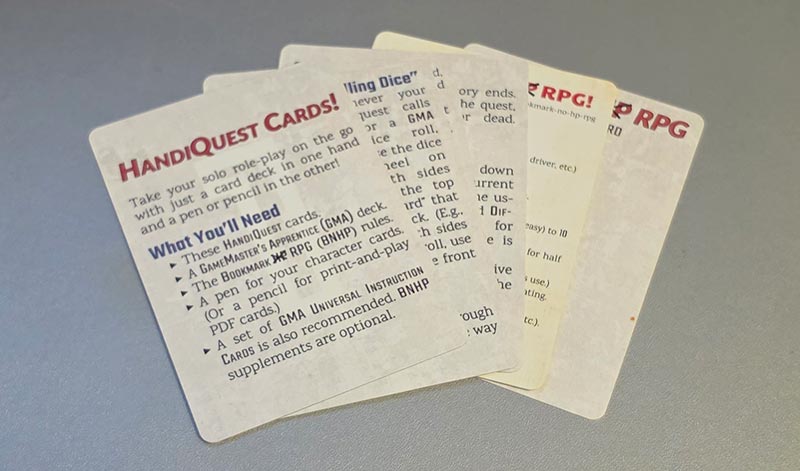
    This unfortunately-named solo ruleset comes with the Bookmark No-HP RPG Compleat Bundle on DTRPG, or can be purchased separately for a couple bucks. The system is printed on four double-sided poker cards, but you also need a copy of Bookmark No-HP RPG (BNHP) and some variety of the Gamemaster’s Apprentice Deck (GMA) to play. That makes this the Avengers of game reviews.

    Part of this complete breakfast

    HandiQuest (heh) attempts to marry the random prompts of GMA with the simple play of BNHP to create a solo RPG experience that you can literally play anywhere. The rules don’t mention it, but I’d assume that if you’re playing a genre game (fantasy, sci-fi, etc.) with the BNHP rules, you’re expected to be using the generic GMA deck or a matching themed deck. Though as I think of it, playing e.g. sci-fi with e.g. the Age of Sail deck would certainly give it a unique flavor. Y’know what, I withdraw my objection. Mix ‘em up.

    N.B.: The rules assume you’re using physical cards for all this. It can be played very easily with a virtual GMA deck (like you get with Bundle of Holding deals) if you use a card randomizer app or the deck system in your favorite VTT. I’ve been using a free Android app called Custom Image Dice, which works quite well. You just need to figure out your own system to hold and/or count cards.

    Gameplay: To start a game, make a BNHP character, then cut the GMA deck. The cut card shows your ultimate goal in its Location spot, and the difficulty getting there in the Difficulty Generator spot on the other side. Take this card, invert it, stick it somewhere in the back half of the deck, and reassemble everything. This gives you a largish but random number of card pulls for your adventure.

    From here, the game has a definite rhythm. Pull the top card, select a Location from either side, and take the Difficulty from the other. This is your next waypoint. Draw a second card and use the prompts there to make up what exactly the main obstacle will be on your way to the destination. Then run the encounter. When you would normally roll dice for BNHA, instead draw cards for the Dice Wheel.

    If you survive to reach your goal, draw another card and look at the Likely Odds section. If most of the prompts are “No,” it’s an encounter; if mostly “Yes,” it’s a battle. Once again use card prompts within the scene to describe what you’re dealing with. In a battle scene, continue using the cards to make up an opponent and fight them. Encounters are more for imagination and storytelling. You can also rest after an encounter unless any of the prompts on the card are “NO!”

    On to the next. When you reach the upside-down card, it’s automatically a battle, but otherwise run it like other locations. Win, lose, or draw, the game ends afterward.

    If you want to make it an epic quest, shuffle and run through twice, first to find a quest item which you then use as a Trait or Vocation for your second journey.

    Pocket fit: HandiQuest by itself weighs nothin’, but everything you need to play makes it hefty. The minimum set of HandiQuest + BNHP rules + one genre card + GMA is ~70 cards, and a slip case is practically required if you don’t want your deck to get all dog-eared. You’ll need a pencil to keep track of your character too. C-.

    Legibility: Quite nice. HandiQuest uses a slightly chonky 11-point-ish serif font with bold sans-serif headers. It’s readable even from arm’s length. A.

    Completeness: Hm. Well, literally by itself, this game is F-tier unplayable. With BNHP and a GMA deck, it’s about the same as BNHP itself, so I’ll crib from my previous review and give it a B-.

    Final thoughts: HandiQuest gives you the barest, barest minimum to play solo BNHP + GMA. Since it can only generate very standard “go here, do this, go there, do that” stories, it’s not the Ultimate Story Experience by any stretch. I dare say even a minimal story engine like Storytelling Mints has this beat on that front. It’s fine if you don’t mind galumphing around the countryside like a Dark Souls player for an hour or two, but it’s not really built for ultra-memorable, story-rich games.

    I appreciate it as a pack-in, but I wouldn’t recommend going out of your way to pick it up. One thumb passionlessly up.

  • RPG Review: ALONe Solo Game Engine

    RPG Review: ALONe Solo Game Engine

    I told you that story so I could tell you this one

    ALONe (an acronym for A Lonesome October Night … um … e) is a solo RPG engine built directly on top of the Gamemaster’s Apprentice Deck, both by Nathan Rockwood of Larcenous Designs. The original beta version of ALONe came out around the same time as the original GMA deck in 2015. Nathan finally decided to call ALONe “complete” in 2023, just in time for the second edition of GMA to come out and partially invalidate (or at least complicate) it.

    ALONe can either be played by itself or as a GM emulator mixin for another game system. When played by itself, all the themes, power levels, technology, magic, equipment, etc. come straight out of the player’s brain. Want to play a starving orphan child in steampunk Paris? Go for it. Want to be King Shit of the Universe, capable of destroying galaxies with your mighty butterfly kisses? Have fun, bud. The system expects you occasionally to be in some sort of peril, physical, emotional, or otherwise, to keep the story engaging. But hey, if you’re satisfied creating a narrative where you shout “And I win again!” a lot, nobody’s gonna yuck your yum.

    At last, a system that lets you play as the most dangerous and terrifying man in the world

    ALONe-on-its-own is designed for one player only. You could use it for GM-less group games, but the lack of power scaling can easily bite a group in the butt unless everyone thoroughly agrees what level they’re on. Using ALONe to run a separate system works somewhat more fairly since it engages that system’s checks and balances. There’s also no built-in system to ensure everybody gets their time in the sun, so you’d have to import a spotlight mechanic from elsewhere.

    Setting up

    Describe me like one of your French girls

    Preparing an ALONe campaign is a multi-stage process.

    1. Decide whether you want to do just ALONe, ALONe as a narrative engine combined with another system for its crunchy tactical morsels, or use another system for everything but the story. In the third case, the rules suggest skipping ALONe entirely and using one of the Gamemaster’s Apprentice Deck adventure guides instead.

      Using another game requires the player to do some lateral thinking. ALONe’s narrative engine relies heavily on Descriptors, like SPELLCASTING STUDENT, MASTER SWORDSMAN, DASHING ROGUE, etc. Using a different system requires the player to translate their character’s stats and abilities into these Descriptors so ALONe can play with them. The rules suggest things like translating a level 1 thief into ROGUE’S GUILD INITIATE and a high Stealth skill into BLENDS INTO SHADOWS. The player can also bring in character elements that the other system doesn’t cover, like BASTARD SON OF THE EVIL DUKE or MASTER OF THE KAZOO. It’s all the same to ALONe.

      If you’re not using another system, never mind. Move along to 2.
    2. Figure out your theme and your character. It’s all basic “Where am I? Who am I? Why am I here?” type stuff. This section includes a Mad Lib-like character motivation generator to get you started. If you can’t think of anything or don’t care so much, the back of the book has an appendix full of random character background/motivation tables.
    3. Gather your resources. This includes in-game resources like gold, weapons, and rations, and also Revision Points, which are ALONe’s meta-narrative currency. The player can spend Revision Points during setup to get more Descriptors, or use them in-game to re-draw a card, temporarily gain or edit a Descriptor, or trigger a story-altering Vignette, about which more later.
    4. Choose three initial Descriptors for your character. This might be disappointing for players who got all excited in phase 1 and came up with a dozen ways to describe their special unicorn OC. If three’s not enough, the player can buy extra Descriptors with Revision Points.

      There’s plenty of advice on creating Descriptors in this section. One thing that stood out to me was how they interact with the campaign’s concept. The example given is a vampire character in a campaign about hunting other vampires; in this case, “vampire” doesn’t really need to be a Descriptor, since that’s the campaign’s baseline. They still have the powers and everything, they just don’t stand out from the norm. If everyone they’re likely to meet is a normal human, however, VAMPIRE is definitely a valid Descriptor.

    Once the course is set and the main character is built, we can finally learn how to

    Play the Game

    Open up your mind and let me step inside

    Unlike those fools up Washington way, ALONe has some basic principles: ask leading questions for the cards to answer, seek inspiration from the cards rather than instruction, and don’t assume that what the cards tell you has the same ineffable weight as a GM. It’s a deck of prompts, not the Oracle at Delphi.

    Well now you tell me

    This bit, I think, is mostly here to help players who aren’t used to solo games get into a more active mindset. The cards may push your story like the wind, but it’s up to you to steer the ship. They report, you decide.

    The rules then describe a Stability/Tension system to help determine when random events occur. The player sets a Tension score from 1 to 10, with higher numbers indicating more hectic situations. Whenever they draw a GMA card for anything, they also look at the Difficulty Generator score on that card. If that number is equal to or less than the current Tension score, a random event occurs. Draw two or three cards and look at the Random Event Generator part to get a noun, a verb, and potentially an adjective. Then inject whatever you just drew into the story.

    That there and this here

    The Tension level can be set once for the whole game, decided per scene, or have a rising level that increases per draw until it triggers, then resets.

    The actual decision-making process is quite straightforward. Essentially, you couch what you want to know as a Yes/No question, decide your odds (bad, even, or good), draw a card for the answer, check the Tension level for a random event, and apply the results to the story. If you’ve ever used an oracle-based system before, this should be very familiar territory.

    Descriptors come into play when determining odds. Having a Descriptor which is advantageous to the current action (NIMBLE FINGERS while picking a lock, maybe) bumps the odds in your favor. A situationally negative Descriptor (HUGE DUMPY while squeezing through a small passage, perhaps) knocks them down. If various conflicting Descriptors apply, the player can either choose which one seems most important at the moment, or count up and down as they cancel each other out.

    A more complex point-based system exists for players that want more crunch, especially for mechanical questions like “did I hit the goblin” or, more importantly, “did the goblin hit me.” The player starts at zero, adds one point per each relevant positive Descriptor, subtracts one point per negative Descriptor, and adds or subtracts up to two points for situational bonuses/penalties. They then do that same calculation for their opponent. If both totals are equal or one point off, it’s Even Odds. Above that is Good Odds, and below that is Bad Odds. Flip the card and take your lumps.

    If this is the system you’re going with, the rules suggest adding a number to your Descriptors so you’re not, for example, trying to figure out how NOVICE SWORDSMAN, EXCELLENT SWORDSMAN, and LEGENDARY SWORDSMAN stack up against each other. Instead, just do SWORDSMAN (1), (2), or (3) and use that in your calculations.

    If you’re using a different system alongside ALONe, never mind all that mechanical stuff and use whatever they got.

    The Consequences of Your Actions

    Curse your sudden but inevitable betrayal

    While co-playing a different system, you most likely have HP/MP/Sanity/whatever to keep up with your current condition. By itself, ALONe doesn’t track any of that. Instead, failures impose either temporary conditions or negative Descriptors.

    On a failure, the player draws a card and looks at the Difficulty Generator. A low number indicates something brief and easily fixable, like dropping your weapon. A median number might impose a temporary Descriptor, like BLINDED BY VENOM, which requires special effort to mitigate during the scene but goes away once the combat is done. High numbers impose more grave, long-lasting Descriptors, like LOST A HAND or LEARNED DARTH VADER IS MY FATHER.

    Sometimes you may have trouble deciding what kind of consequence to take. There’s a handy random chart of effect types to help you figure that out, from confusion to incarceration to loss of motivation to good ol’ broken bones.

    Here we run into a minor snag: this random table, and many others later in the document, rely on the Tag Symbols from the GMA 1e decks. Thing is, GMA 2e does away with Tag Symbols in favor of a different random generator. Admittedly there are ten of these symbols and you could just use the d10 from the Dice Wheel for the same purpose, though not all tables have numerical indices. So you have to count rows. Like a commoner.

    Why I never

    An optional rule is the grandiosely named Doom of Damocles. This adds between three and five checkboxes to the adventure sheet. For every negative Descriptor the character acquires in-game, even a temporary one, check a box. If a Descriptor is cleared or mitigated, erase a box. When all the boxes are filled, your adventure reaches its bad end. Getting hit in the head with a sword is optional.

    The rules continue with tips on how to adjudicate combat, from brawls to mass battles, and a fairly long section on how to run social encounters without feeling schizophrenic by using random motivation tables for your NPCs. At times the social section gets a little overly specific, expecting the player to create unique reaction tables for particular genres or even for important NPCs. That all feels like work to me, frankly, but I know some of you sickos out there would get a kick out of it.

    Now that we’ve absorbed all that, here, on page 43, it’s time to discover

    How Everything Actually Works

    Our story is only just beginning

    So you thought reading all those rules meant you knew how to play? Ha! Think again! This section goes in-depth into concepts which so far we’ve only touched on: Revisions, Descriptors, Beats, Vignettes, and Downtime. Used together, these will hopefully help a player organize their random story into something coherent.

    We’ve already talked about Revisions and Descriptors. The rules go a little deeper here, like how to gain more Revision Points and add/change Descriptors as the story goes on, but nothing earth-shattering.

    Beats are units of story that start with a stake of some sort (e.g., you want or need something) and end when that stake is resolved (e.g., you get or permanently lose that something). There’s yet another random chart here to help spur the player’s imagination if it fails them. Beats are different from scenes, in that multiple scenes can occur within a Beat and/or a stake can be resolved in the middle of a scene and then either changed or doubled down on.

    Vignettes are chunks of narration that exist outside the rules and can change the story any way the player wants. This may sound enormously powerful, but that’s only because it is. If the player wants to take a simple snail herder and make her the God of Hamburgers, a Vignette can do it in a snap. Vignettes also cover flashbacks that explain how that latest setback was all Part of the Plan, which is why you happen to have the magic dingus that saves the day! What prevents Vignettes from turning the game into a Mary Sue fanfic is that they have a Revision Point cost, so you don’t have an unlimited number of them. If the Vignette would change the character’s Descriptors, you have to pay for those too.

    Downtime is where all the boring day-to-day stuff happens. If you want to quantify it, the player gets one Downtime Point and can buy up to two more with Revision Points. The more Downtime Points you spend, the more involved your off-hour actions become, from finding a safe place to hide (1 point) to founding a small-time crime cartel (3 points).

    On the Campaign Trail

    Vote early, vote often

    The concluding chapter goes into how to incite a campaign with random actions, plus how to generate your own random tables for your campaign. Bookkeeping gamers may enjoy this, but it’s not my bag. Building a table in the middle of running the game feels like filling out paperwork in the back of a speeding semi full of volatile Tripolodine.

    My patent papers are at a slight angle, Sam

    The rest of this chapter reiterates the Adventure Guide that comes with the GMA Deck nearly word-for-word. Select a Core, ask a Big Question, choose a Doom (not of Damocles), all that. I mean, it works, so there’s no reason to reinvent the wheel.

    The document ends with multiple appendices containing randomizers and examples of play. They’re fine.

    Final Thoughts

    Beyond the blue horizon

    I just wrote a lot. But that’s because ALONe is kind of a lot. The document is 84 pages long with the only picture being on its cover. As rules go, it’s a bit intimidating. It feels especially wordy when you compare it to the Gamemaster’s Apprentice Deck that fuels it.

    I’ll get my greatest complaint out of the way now: the document is poorly organized and badly edited. You must, must, read through the whole thing, cover to cover, to get the entire picture. Things are introduced without reference on page 11 that aren’t explained until page 46. There are several instances of “see page XX” instead of actual page numbers. The table of contents (and thank heaven we even have one) doesn’t show page numbers, only links. There are no PDF bookmarks. One form, apparently designed to be printed on one sheet, spills over to the top of the next page. For something eight years in the making, this is very … enthusiastically presented, one might say. Most of those problems could be fixed in an afternoon by a decent editor.

    That’s a shame, because what the document says isn’t so bad. Once you’ve put some brainpower and patience into untangling the rules, they fit together pretty well. The Tension system is essentially Mythic GME’s Chaos Factor without weirding up the odds. Personally, I also like how Vignettes let you course-correct the story (or fling it beyond Mars, if that’s your bent).

    Even there, though, it’s not all roses. ALONe wants you to engage with bespoke random tables a lot. But every time they tried to guide me to another table I kept glancing at the GMA deck, chock full of random prompts, just sitting idle. Use that, I thought. You made it too, Nathan. Have some confidence in your own brainchild.

    Anyway. ALONe has some good ideas poorly presented, a solid foundation that gets lost in its own weeds sometimes, and can be rewarding if you put in the effort to learn but requires more effort to learn than it should. Once you wrap your head around it, it’s a decent solo system.

    One and a half thumbs up for the system, but losing most of a thumb for the presentation.

  • RPG Tool Review: The Gamemaster’s Apprentice Deck

    RPG Tool Review: The Gamemaster’s Apprentice Deck

    Shuffling off to adventure

    I thought I’d quickly review the Gamemaster’s Apprentice Deck (GMA) by Nathan Lockwood of Larcenous Designs, plus touch on its myriad alternate versions. These 120-card decks (60 cards double-sided in their print version) aren’t a game so much as a tool to help GMs create and run anything from one-shot adventures to entire campaigns. GMA is also a GM-in-a-box for anyone who wants to run solo with pretty much any system they own.

    The first GMA deck came out in 2015. Since then, the publisher has provided a number of themed decks, designed to focus on specific game genres: fantasy, science fiction, horror, cyberpunk, steampunk, etc. The base GMA deck recently got a second edition in 2025, with some streamlining, altered prompts, and less esoteric symbology.

    Be aware that most of these GMA decks haven’t been updated to 2e yet. In fact, at this writing, there’s only one actual 2e deck available, the “generic” version. All themed decks are some variant of the original 1e variety.

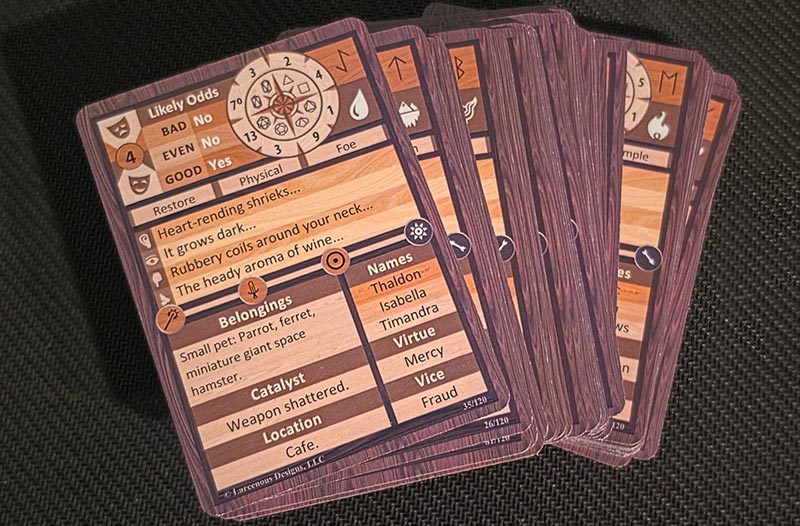
    Here’s a random card from the GMA 2e deck (on the left), next to one from the original deck.

    Arthur “Two Cards” Jackson

    That’s a lot to process, I know. But that seemingly random jumble of information can fit together in all sorts of interesting ways.

    1. Difficulty Generator – A number from 1 to 10, statistically weighted toward 5.5 in a bell curve. There’s only one 1 and one 10 in the whole 120-card deck. This number is useful to gauge the relative intensity of an obstacle or action, from barely impactful to death on a stick.
    2. Likely Odds – Use this as an oracle to figure out whether something happens based on rough probability. Bad odds show 25% Yes and 75% No across all the cards, Even odds are 50/50, and Good odds are 75/25. Sometimes you’ll run across a YES! or NO! result, which you can guess adds emphasis (“yes and,” for improvisational types). GMA 2e adds Yes? and No? for more wishy-washy answers.
    3. Dice Wheel – Read around the edge for random die roll results (clockwise from 12 o’clock): d4, d6, d8, d10, d12, d20, and two d10s for percentile dice. Handy if your dice are elsewhere. Since you still have to draw two cards to read the percentile dice, they feel kinda superfluous when you already have a d10 slot.
    4. Scatter Die – Either shows an arrow pointing in one of eight directions, a bullseye, or a complete miss. Besides the traditional “Where did that pesky grenade bounce off to,” this can be useful for things like answering where that weird sound is coming from, which way the bad guy ran, the prevailing wind, or anything else directional.
    5. Norse Rune – The red-headed stepchild of the 1e card design. In most GMA 1e decks, this area of the card contains one of the 24 futhark runes. The provided instructional PDF has a large and elaborate chart on how to interpret these symbols.


      Algiz ya deez nuts

      Honestly it feels a bit flaky to me. Unless you’re fascinated with the concept, use the runes constantly, and keep the chart handy until you memorize everything, this is skippable. There are easier things on these cards to loosely interpret.
    6. Elemental Symbol – A little pictograph indicating air, earth, fire, or water. Can be interpreted as needed, either literally (“We’re on fire! Now there’s a tornado!” etc.) or metaphorically (movement for air, defense for earth, etc.).
    7. Prompt Icons – GMA 2e replaces the Norse rune and elemental symbol with two random pictographs which you can interpret however you please. The instructions say you can interpret the upper symbol as “positive” and the lower one as “negative,” but it’s really up to you. You paid for the deck. What perverted things you see in it are your own business.
    8. Random Event Generator – 120 random verbs, adjectives, and nouns. Draw three cards and use those words as the catalyst for your next epic adventure!


      … well, at least the pay’s good
    9. Sensory Snippets – Random sounds, sights, sensations, and smells for when you need some detail to spice up your descriptions. These can also be used to help determine what’s going on in a room, so the sound of “glass clinking” could indicate you’ve stumbled into a fancy dinner party, while the smell of “rotting meat” could indicate you’ve stumbled into a fancy dinner party at Mar-A-Lago. Ha ha. Zing!
    10. Tag Symbols – Exclusive to 1e decks, these 3 out of 10 icons exist as another interpretive tool. The instructions suggest you make up your own meaning for each symbol depending on the type of game you’re playing. For instance, the castle icon might mean “difficult obstacle” in a dungeon crawl, “stonewalling” in a crime procedural, “heavy shielding” in a space opera, etc. This supposes the person using the deck has enough foresight to plot all that out ahead of time, of course. The Adventure Guides (see below) have some suggestions on how to use these.
    11. Scene Types – 2e decks replace the tag icons with a brief line of text which pretty much lays the concept of a new scene right at your feet. It’s almost too straightforward after spending our days vibing plots out of two vertical lines and a picture of a penguin. Use this sparingly or else your plotline will look like Lombard Street.


      I mean we all knew what I was referencing, but here’s a picture anyway
    12. Map Icon – New to GMA 2e, this teeny-tiny little compass rose shows a cube and/or hex with its vertices pointing in the six cardinal directions: North, South, East, West, Feather (Up), and Weight (Down). Lines connect the icons on the compass to the cube, with different ways to read them: solid lines means easy access, dotted lines are hidden passages, barred lines are an obstacle, and partial lines are dead ends. No line means no way that way.

      Besides the obvious roguelike dungeon generation, the documentation also suggests using the Map Icon for less concrete things, like interpersonal plots or concept maps. If you’re the sort of person who likes to map out your relationships on a flowchart, this can help.
    13. Belongings – Your players just whacked someone and are rifling through their pockets; what do they find? While this field doesn’t give specifics, it can help you decide what kind of stuff a character may have, and from that infer what kind of person they are and what role they play in society.
    14. Names – Three semi-generic multi-cultural names for NPCs. One name is vaguely masculine, one vaguely feminine, and one vaguely neutral. Very helpful for the GM making up random passers-by off the top of their head. These names pick up the flavor of a deck’s theme, so you won’t come across a lot of Steves in the Fantasy deck.
    15. Catalyst/Location – Like the Sensory Snippets above, these are little phrases designed to get your creativity moving again when you’re blocked. Narrative Ex-Lax, if you will. Combine with an adjective from the Random Event Generator to turn that Orphanage location into a Profitable Orphanage and … wow, suddenly the story took a dark turn, didn’t it.
    16. Situation – The 2e version of Catalyst/Location, adding a third line for stakes, like “Tame a Beast” or “Escape Their Past.” Instant motivation for an NPC or a story beat for the PCs.
    17. Virtue/Vice – A quick way to figure out why this guy is worth anything and also why he sucks. All the greatest hits are here: Lust, Greed, Sloth, Gluttony, Temperance, Diligence, Compassion, Chastity, etc. The designer added a few more, like Fear and Mercy, because I guess we were getting a little too Catholic up in here.
    18. Traits – This is the 2e version of Virtue/Vice above, adding a third line for a physical trait like “Cold eyes” or “Mumbles.” Very helpful for off-the-cuff roleplaying that random blacksmith or storekeeper.
    19. Flavor Text – Also new to 2e, this contains a silly line of dialogue which may or may not spur your imagination in some way. This is probably the least important area of the cards. It’s really just there for fun. In the Cyberpunk GMA Deck, this area is used for a random megacorporation name instead.

    Adventure Guides

    Come on, grab your friends

    If you get any of the GMA versions that come as or with PDFs, most of them add in an Adventure Guide to help you plot out a strategic-level campaign framework. Although these guides all use the same structure, there’s no generic version; each one assumes (properly) you’re sticking with a broad genre of some sort.

    The Adventure Guide prompts the GM to choose a Core concept for the overarching game, like exploring the galaxy for Sci-Fi or overthrowing The Man for Cyberpunk. Optionally you should then choose a Big Question to explore, like “What makes a person moral?” or “What is true love?” or “How many roads must a man walk down?” This isn’t a question that you should automatically know the answer to. It exists as a sub-concept which colors the whole campaign.

    Next you choose a Doom, the singular lurking threat that will change the world and which the players are fated to deal with one way or another. It is the storm that is approaching, provoking black clouds in isolation. The characters don’t necessarily know what it is, but the GM definitely should.

    The GM then either chooses or generates three other problems. Each problem should have a plan, a cast of characters (broadly speaking, at least) and a goal. Throw these at the players to give them something to do while the big plot percolates in the background. Making connections from one to the next can really get the imagination working.

    If that’s not enough, you can also ask three more questions which are relatively minor, plot-wise: Will the townsfolk rally in the face of a threat, or flee? Will a brainwashed villain be allowed to repent? These are interesting ideas that may create storytelling opportunities. Or, depending on the direction of play, the players may never really interact with any of them. Doom still comes for us all.

    The Adventure Guide continues in a more mundane direction with random Questgiver/Task/Reason tables, random encounter tables, and just, you know, random tables. Slightly disappointing for a product that could make more use of the GMA deck itself.


    Themed Decks

    Now in mixed berry flavor

    Themed GMA decks are not mechanically different except in the artwork and the details. The Age of Sail deck tends toward more nautical-themed sensory bits like the smell of sea air, the snap of sails, brass fittings and groaning ropes, that kind of thing. The Fantasy deck adds a few extra mystic auras and orbs to ponder. The Steampunk deck has lots of hissing steam and clanking clattering collections of caliginous cogs. They all follow this general formula. The differences are all in the tone and color. In a pinch, the generic deck works just as well.


    But with fewer sweet eyepatch skulls


    Final Thoughts

    Catalyst: Mad rantings

    If you’ve ever used a game oracle system before (Mythic GM Emulator, One Page Solo, Ironsworn/Starforged/Sundered Isles, etc.), you’ll see that this is … yet another one. The actual “oracle” part of GMA is pretty limited, with only three levels of odds and four-to-six levels of results. Where GMA shines is its all-in-one compactness. It’s a plot generator, an NPC maker, a dice roller, a bucket full of random sensory details (which are unique and surprisingly useful), a map builder, a difficulty selector, a vibe injection system, and even teaches you how to read Norse. What a bargain!

    GMA 2e is my current go-to for random adventure action. The combination of concrete detail and pure vibe works well for me. It’s super easy to flip a card and run with it, without having to roll dice or consult tables or even really think about it. Just BAM! “South!” BAM! “Wilbur!” BAM! “Shouted blasphemies!” Detail sorted, on to the fun part.

    Worth a try if you like that sort of thing. One point eight thumbs up.

  • Pocket TTRPG Roundup, Part Four

    Pocket TTRPG Roundup, Part Four

    One more entry for my review mini-series about RPG adventures that fit in your pocket. See Part One for the money, Part Two for the show, and Part Three to get ready. Now, here we go.

    Bookmark No-HP RPG (Compleat Bundle)

    Publisher: Lester Smith Games
    Year: 2021
    Dimensions: 2½” x 3½” (poker card size) or 6″ x 1½” (bookmark size) x ¼”
    Players: 2-10

    (In the tone of “Marsha, Marsha, Marsha”): Fantasy, fantasy, fantasy! That’s all these pocket games are! If only someone would come save us from all these swords and sorcerers! They’re knee-deep! The neighbors are starting to complain!

    Angelic chord

    Bookmark No-HP RPG comes in two formats, bookmarks or cards, either of which satisfy the size constraint of these reviews. The bookmark format is slightly larger, but they’re functionally identical. You can only get the card version PoD from DriveThruRPG, so that’s what I’m working with. You’ll also need at least one full set of polyhedral dice and (once again) a pencil or equivalent.

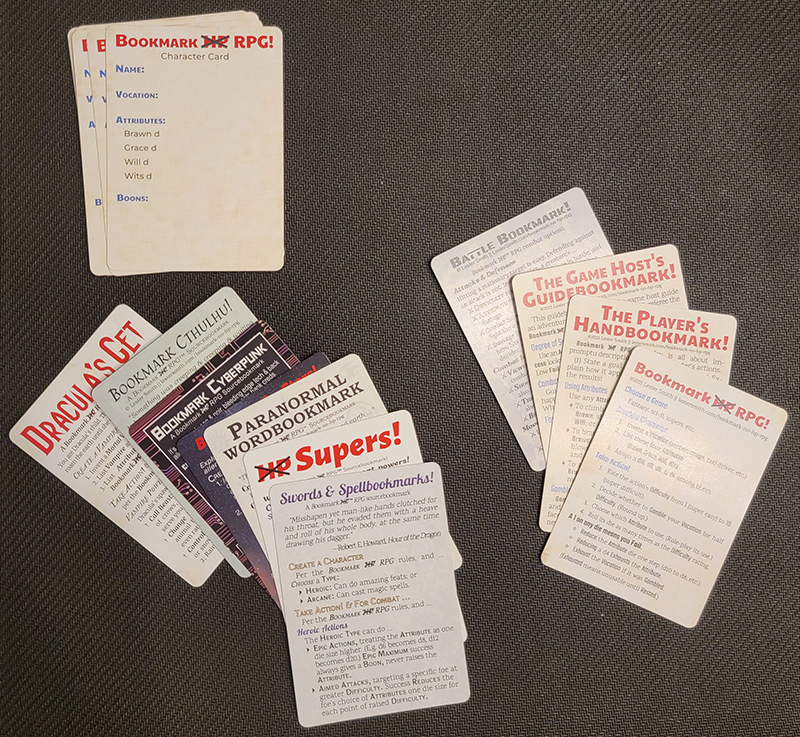
    Gameplay: The game takes the bolt-on approach. One bookmark/card describes the underlying system for everyone, the players get their own “guidebookmark,” and the Game Host (that is, the GM) gets a third. All of them together explain how everything works. (It wouldn’t hurt for everyone to read all three, but you know how players are.) This basic setup is extended with genre cards, described below. The bundle also comes with a “battle bookmark” describing an “advanced” combat system, plus nine blank character cards.

    The rules are a convoluted form of generic. Every character has a Vocation, like Fighter or Detective. Vocations can be literally any job or lifestyle you can imagine, and are assumed to come with everything you need; equipment is Not A Thing. Characters also have four Attributes: Brawn, Grace, Will, and Wits. Players divvy up d4, d6, d8, and d10 between these.

    To perform an action, the Game Host assigns a Difficulty from 1 to 10. The player then rolls one of their Attributes’ dice that many times. (A player can use any Attribute for any action if they can come up with a reasonable explanation for it, unless that Attribute is exhausted [see below].) If any of these die rolls are a 1, the action fails. Otherwise it succeeds. The degree of success or failure depends on the highest die in your series of rolls, so you’ll want to roll the full number of times even if you fail early.

    If a roll fails, reduce that Attribute’s die by one step (d8 becomes d6, for instance). If you fail on a d4 roll, that Attribute is exhausted and you have to rest to use it again. If the roll succeeds and at least one roll is maximum (e.g. rolling an 8 on d8), the die increases one step, usually to a maximum of d12. If you max-success-roll with a d12, you get a Boon, like a new weapon, an ally, a book of spells, etc. Characters can save six Boons and trade them in for a Trait, essentially a permanent piece of equipment, as a way to level up.

    Sometimes you’ll come up against a high Difficulty and don’t want to risk a stat by rolling a zillion times. In this case, you can gamble either your Vocation, a Trait, or one of your Boons, which halves the Difficulty. If you fail this reduced roll, you exhaust whatever you gambled. Exhausting a Vocation or Trait is meant to simulate a loss of face, a power-down, a crisis of faith, or similar. You get exhausted Vocations and Traits back after rest and reflection. Exhausted Boons are gone for good.

    The gambling and exhaustion stuff take the place of HP in this, the No-HP RPG. Death is story-driven. Either you or the Game Host can declare you dead if you fail a particularly deadly action with a particularly poor roll, but you’re not beholden to. Mostly your survivability depends on how far you can push your bullshit rationalizations to stay alive.

    So let’s unpack the die rolling thing here. Obviously it’s best to roll your highest Attribute, especially for low Difficulty actions, to quickly max out your die and start generating Boons. The chance of failure goes up rapidly at the low end, but levels off for higher Difficulties.

    It’s too early in the morning for all this math

    The gambling mechanic is a neat way to mitigate this, though a starting character with no Boons and cold dice could easily shoot their wad early and then stumble along, shedding dice levels until something really bad happens. Note that, RAW, resting during an adventure doesn’t reset your dice levels, though it does restore any d4’s you’ve exhausted. The best you can hope for is a hot streak to build them back up.

    The genre cards toss a few spins on top of this formula.

    • “Swords and Spellbookmarks” add Heroic and Arcane character types. Heroes can perform Epic Actions which bump up their die type, and Arcanists cast Charms, Spells, and Sorcery, with increasing risk/reward structures for each.
    • “Bookmark the Stars!” gives everyone Species and Homeworlds with unique abilities and liabilities, and rules to generate a shared spaceship for the team to travel in.
    • “Bookmark Cyberpunk” has an alternate character generation system that gives you up to a d20 as a stat, cybernetic Traits, and hacking rules.
    • “No-HP Supers!” replaces your Vocation with a Super Identity and an Alter Ego (which gets exposed if exhausted). It also adds super powers, of which you can take as many as you’d like. However, you have an additional risk of exhausting the one you’re using if you roll less than your current number of powers on a d20.
    • “Bookmark Cthulhu” adds the Dread Attribute, which increases as you encounter Things Man was Not Meant to Know until you go buggo and melt your face off or explode or something.
    • “Dracula’s Get!” makes all the PCs into vampires, with all their classic powers and a powerful thirst for that veiny good-good. I’m sorry. I’ll never say that again.
    • “Paranormal Wordbookmark” gives everyone their choice of a psychic gift based on one of their Attributes, and then … they just go around being psychic, I guess. There’s nothing more to the card than that.

    The rules don’t say anything about mixing and matching multiple genre cards, but there’s nothing stopping you either. I’ll allow it, but don’t tell your mom.

    Pocket fit: The Compleat Bundle is 20 poker-sized cards and/or bookmarks, which have small but detectable mass in the pocket. You’ll also need your dice bag and something to write with, which adds most of the bulk. Still not much. C+ and I’m being kinda mean about it.

    Legibility: The rules cards are quite readable for their size, and the bookmark versions are even better for their larger text. Every genre card has its own typography, which is mostly fine, but the sci-fi and cyberpunk cards are printed as white text on dark backgrounds. The sci-fi card has a sort of mottled space nebula background with red highlights, and the cyberpunk one has a light geometric font which would be hard to read in any case.

    It’s worse in person, believe me

    Everything else is fine, though. B overall, with a couple C-’s in there dragging the average down.

    Completeness: There’s no adventure generator or particular game world, but the rules do cover a wide swath of whatever you might want to do. The Game Host card has a tiny “crafting adventures” section which is insultingly rudimentary. There are published adventure sets if you don’t want to be creative. Otherwise this is mostly a toolkit to build your own world on top of. B-.

    Final thoughts: I like this one, though more for its audaciousness than for the actual system. In my experience, the dice mechanic is initially difficult to get through to some players. Once a player gets it, it does seem to stick, luckily. The multi-genre thing is a huge breath of fresh air after all those Tolkiens with the numbers filed off. It is a little undetailed in its base form, which is weird to say about a system this comparatively large.

    In the end, though, it’s not hard to have fun with, which is all you can really ask for.

    The Bookmark No-HP RPG Compleat Bundle is $20 on DTRPG, which includes PDFs and physical cards. If you don’t want the whole passel, they also have “cut-up solo” bundles which include the base rules, one genre card, and one or more sourcebooks for a more in-depth experience. That takes away my complaint about a lack of campaign structure, but also moves it beyond the realm of “pocket RPG,” so [OUT OF BOUNDS ERROR]


    Next time: Just one last little thing

  • Pocket TTRPG Roundup, Part Three

    Pocket TTRPG Roundup, Part Three

    Another installment of my review mini-series about literally pocket-sized RPGs. See Part One for the explanation, and Part Two for more of … whatever this is.

    Storytelling Mints

    Publisher: Archmage Arispen
    Year: 2025
    Dimensions: 3¼” x 2⅛” x ¾”
    Players: 1+

    Didn’t we just leave this party?

    Yet another joint from Archmage Arispen, maker of the previously reviewed Tinny Dungeons. Storytelling Mints feels like a GM’s tool that somehow evolved into an actual RPG. This one has zero moving parts; no dice, no player sheets, no pencils, nothing but the cards in the tin and a song in your heart.

    Storytelling Mints comes with one Player Guide card, one Game Master Guide card, 24 double-sided PC / plot cards, and a wee little hinged tin to hold everything.

    Gameplay: Before play begins, the Game Master draws four plot cards at random. Each card has four sections: a Goal, a Location, an Obstacle, and a Twist. The GM silently reads one line from each card, then uses them as inspiration to create a secret quest seed.

    Fantasy adventure, or Mickey Spillane novel?

    Meanwhile, the players turn the deck over and choose their PCs from the characters described on the other side. Each character card lists a character name (ignorable), a race/class pair (mostly fluff), Strengths, Weaknesses, and Gear.

    Slab Bulkhead! Buck Plankchest! Big McLargeHuge!

    Notice how the bottom of each character card has an upside-down area containing one of four phrases: “Yes, And,” “Yes, But,” “No, And,” and “No, But.” I think you can see what’s coming.

    To begin, the GM describes the world and is urged to start in action. Then play unfolds in a pure narrative style, funneled into the quest seed created earlier. A PC’s Strengths and Weaknesses make it easier or harder to do certain actions, and their Gear exists to do cool things with.

    If the players want to try something risky, they draw a card and look at the inverted text on the character side. They succeed on a “yes,” fail on a “no,” and other stuff happens depending on their ands or buts.

    Yes. This game runs on amateur improv.

    Now what we need from the audience is the name of something found in a dungeon

    There are no stats or anything; such limitations are only in your mind, maaan. It’s up to the GM to keep everyone engaged and the plot moving, and players are equally encouraged to add details and help shape the story.

    By the end, the main quest was either successfully completed or utterly derailed. Nothing really happens either way. As you might expect, there’s no leveling up and no long campaign structure. The most you can do is get the GM to draw four more cards and climb back on that treadmill. The play really is the thing.

    The provided PCs are very, very D&D coded in their race and class combos. There’s an Aasimar, a Tiefling, and an Aarakocra in the mix. Also a couple Goblins, so … some Pathfinder sneaking in there too, maybe? This isn’t a deal-breaker (and may be a bonus for some groups) but it feels … I dunno, infringe-y.

    Also, and this is a much bigger thing: Removing cards from the main deck (for instance, when the PCs choose their character cards or the GM deals themselves the plot) changes the ratio of Yeses and Noes to be drawn during gameplay. I count 6 Yes Ands, 7 Yes Buts, 7 No Buts, and 4 No Ands in the deck. If you have a bunch of players who all want characters with Yes Ands on the bottom, they’ll end up inadvertently skewing the game negatively for themselves. The characters on the Yes cards aren’t particularly special compared to the No cards, so there’s no reason not to grab up all the No Ands and make the game easier.

    This can be mitigated by either dealing PCs randomly, or else just taking a snap of the card(s) on your phones and returning everything to the deck. But there’s that niggling feeling that a different randomizer could have fixed this …

    Pocket fit: The tin is about half the size of an Altoids tin by volume. It doesn’t even have extra parts inside to rattle around and disturb your prayer group. A-.

    Legibility: Mostly good, with a mix of serif and sans-serif (for headers) typefaces. Text on the plot side gets difficult to see in spots, due to light-colored ink on the bright white background. A line or two on the character side is equally hard to read for being white text on a light-ish background. Not nearly as illegible as Pocket World of Dungeons, though, which has altered my perception for all subsequent reviews. B.

    Completeness: Once again, we have a game with no leveling, no monsters, and no campaigns. But it does come with a kinda neat story generator that can generate over 250,000 plots (or so claims their advertising). And the game itself does have a complete gameplay loop, with lots of options for the players to choose from. So. B-.

    Final thoughts: If nothing else, Storytelling Mints is a master class in compact game design. I really do think this was originally meant to be a simple RPG story generator, and Arispen had a wild hair to throw in a game to go with it. And it even works, after a fashion! I’d almost pick this up for the plot stuff alone, but a game on top of that is like getting chocolate in your peanut butter.

    Hey!

    Two things prevent me from giving this my full recommendation, though: the vibey, improv-driven gameplay which is not every table’s cup of tea, and its current $22 USD price tag. I mean, cripes, man. When I bought this a few months ago it was cheaper, but I think, you know, the world situation today has really stuck this game in the shorts. If it were like $10-15, it’d be a more solid choice. As it is, only consider this if you really vibe with the concept.


    POCKET (Card Edition)

    Publisher: Barely Playtested
    Year: 2022
    Dimensions: 2″ x 3½” (business card size) x ¼”
    Players: 2+

    Is that a game in your pocket or

    POCKET (Card Edition) is a straightforward mini-OSR-like, which mostly stands apart from the competition by its formatting. The entire system fits on five business cards (double-sided), which read as if the cards were chapters in a very small book.

    Besides the cards, players need a d20 (preferably one for each player), something to write with, and something to write their character info on. No char sheets provided this time.

    Gameplay: To build a character, players simply choose a Race (which nets some sort of bonus, like a Dwarf’s resistance to poison or a Gnome’s ability to speak to small animals) and a Class. Each of the 12 Classes provides characters with their HP, starting skills, weapon/armor proficiencies, and special abilities. The player then chooses one armor set and three weapons from a short list, and they’re off to the slaughter.

    Characters don’t have stats per se, instead having four very broad Skills: Athletics, Subterfuge, Lore, and BWAM (“Base Weapon Attack Modifier”). These are added to d20 rolls when they attempt stuff. To perform a task or resist an effect, roll the die and add your skill versus a Difficulty Check (DC) either laid out in the rules or chosen by the GM. To attack, do the same but add your BWAM versus the opponent’s AC (ideally shouting “BWAM!” when you do so). All weapons do fixed damage, so one roll does it all.

    One thing to note here is that the weakest provided monster, the Dire Rat, has 6 HP, and the only weapons that inflict more than 6 HP in one blow are 2-Handed (plus a few spells, but there’s no guarantee you’ll have them prepared; see below). Nearly all fights will therefore be battles of attrition. GMs will need to be careful with their encounter balancing. The rules are silent on all this.

    One card-side contains a list of 20 magic spells. Magic-using classes randomly roll from this list to find out which spell(s) they’ve prepared each in-game day. For any class except Wizard, their choice is limited to only part of the list. For instance, Druids will roll one spell per day from spells 6-10 on the list, Clerics roll two spells from 1-10, and Wizards roll three spells per day from the whole thing.

    Points of order

    Magic-users also get extra powers from and/or beyond this list. Druids can speak to, and turn into, plants and animals. Clerics get an extra Heal spell automatically. Warlocks get an at-will Eldritch Blast spell and can cast Darkness once per day. Wizards gain an at-will Magic Missile. Bards can cast Guidance three times a day and can sing to raise party morale as a standard action.

    The non-magic classes get their own quirks too, from a Barbarian’s Rage to a Ranger’s animal companion to a Fighter’s simple mix of high Athletics, impressive BWAM, and a bonus to opportunity attacks. The classes feel kind of 3e-ish, if that makes sense. They aren’t all super exciting but they get the job done.

    One final card is occupied with 12 monster listings, from the previously mentioned Dire Rats all the way up to Dragons. It’s a smattering of the greatest FRPG hits. No orcs though.

    Pocket fit: Easy peasy. Even the d20s, pencils, and slips of paper for character notes hardly drag it down. A-.

    Legibility: It ain’t fancy, but that’s a feature, not a bug. It’s around a 9-point serif font, spaced well, with clear headings and simple tables. It’s pretty readable even for its size. B.

    Completeness: System-wise this is the barest of bones, but it still hits all the notes. It has a pleasant and diverse selection of races and classes, a solid handful of monsters, and decently enumerated rules. No leveling up and no campaign structure, though, and also no guidance for a GM at all. That all comes out to around a C.

    Final thoughts: The word “workmanlike” popped into my head a lot while looking over this game. It’s well constructed but aggressively vanilla. Nothing about it made me go “wow” or “ugh.” I could definitely see someone using POCKET to run an OSR module with a minimum of tweaking, but out-of-the-box it’s just a toolkit.

    It’s also free on itch.io, so I don’t feel like I should crap on it too much. And hey, it does work. So. Have at it, champ.


    Next time: It’s the little things in life, you know?

  • Pocket TTRPG Roundup, Part Two

    Pocket TTRPG Roundup, Part Two

    Continuing my miniseries of mini-RPGs. Check out part one for the skinny.

    Mini Myth: Hero’s Handbook

    Publisher: Studio Minch
    Year: 2025
    Dimensions: 105 x 148mm (A6 format, 4.1” x 5.6”) x maybe 3mm
    Players: 2-5

    A new twist on origami

    Now we’re heading into itch.io territory for some print-and-play RPGs. Mini Myth was originally produced for a one-page RPG jam, but is unusual for its folded-page zine format. The booklet itself is A7 size (74mm x 105mm [2.8” x 4.1”]); the four provided character sheets are the slightly larger A6 components. A single d6 and a writing implement are also required.

    (Slight aside: the “number of players” mentioned above is the number of provided character sheets plus the GM. There’s nothing stopping you from playing these reviewed games with more players if you print more sheets. Pocket Odyssey, with its limited supply of meeples, is the one exception.)

    Gameplay: Mini Myth uses a very simple roll-under system. Characters have three stats, STR(ong), NIM(ble), and MYS(tic), which range from 2 to 4. To perform an action, roll 1d6; if the roll is equal to or below the relevant stat, they succeed. As is de rigeur these days, the GM, herein called the “Lore Master,” may impose D&D-style advantage (“smooth rolls”) or disadvantage (“rough rolls”). Once per game day, a player can declare that they’re Desperate, allowing one reroll in exchange for a -1 penalty to the relevant stat for the rest of the day.

    Characters also get three Skill Points to spend on skills or spells. A character can have up to five Skills/Spells with a maximum of 3 points each. When they use an acquired Skill, which they can do up to (Skill Level) times per game day, they automatically succeed without rolling. Spells, meanwhile, still require a MYS stat test, with a random disaster happening on a missed roll.

    This magic test makes spells more dangerous than a lot of systems. A character with the maximum MYS of 4 will still misfire ⅓ of the time, and the disaster table runs the gamut from +1 to stat tests for the rest of the day, all the way up to instant death. Like, dang.

    (on tombstone) I just wanted to ddetect magic

    All PCs start with 1d6+6 HP and 1d6+6 coins to buy stuff. Weapons are abstracted as 1H Melee, 2H Melee, Ranged, and Mystic, and armor is Light or Heavy (with or without a Shield). There’s a compact little table of useful items and consumables as well. It’s basic but it works.

    Combat is equally basic. Initiative is a straight 50-50 roll, and then you’re just trading blows until one side stops fighting, one way or another. Actions are simply Attack, Use a Skill or Spell, Negotiate with a weakened enemy, or Flee. Characters reduced to 0 HP immediately roll a die; on a 1-3 they cheat death and return with 3 HP. On a 4-6 …

    After each adventure, all surviving PCs get 3 more HP and two more Skill Points. Then you just go on ‘round again.

    Pocket fit: Ain’t nothin’. This one even beats out Dinky Dungeons on the portability scale. I suppose the die and pencil could be considered a bit of bulk, but ehh. A anyway.

    Legibility: Smallish but quite neat and clean. I hardly ever felt like I had to squint. A-.

    Completeness: Ay, there’s the rub. It has rules, character generation, equipment … and that’s it. No monsters, no campaigns, not even any guidelines on making enemies. The developer admits they’ve only created the player’s handbook so far, and have intentions to expand in a more campaign-ish direction in the future. I may revisit this game if that comes to pass. As it stands now, though, it gets a big meh. C-.

    Final thoughts: Mini Myth has lots of potential, and it is playable as is. However, at the moment the Lore Master really needs to step up to make things work. If the dev keeps up with it, it may well have a bright future. As it stands, it’s more of a tantalizing glimpse. Excited to see where it goes (if anywhere).


    Pocket World of Dungeons

    Publisher: el Stiko
    Year: 2019
    Dimensions: 3½” x 2¼” (bridge card size) x ⅛”
    Players: 2-6

    No, I didn’t cut the cards out. Do you think I’m made of money?

    This one’s a little unusual, since World of Dungeons is a PbtA RPG in its own right by John Harper, which is itself a stripped-down version of Dungeon World by Sage LaTorra and Adam Koebel (which is unfortunate, but I don’t hold that against the game itself). El Stiko, which I’m at least 50% certain isn’t their real name, has managed to distill that all the way down to eight playing cards. The gaming group will also need at least three six-sided dice (ideally 2d6 per player and 3d6 for the GM) and something to write with.

    Gameplay: Every player chooses a class card among Fighter, Wizard, Cleric, Thief, or Ranger. The card lists four unique Special Abilities, like the Thief’s Backstab or the Cleric’s Cure, which the player chooses two of. Each card has a matrix of nine common Skills, with one or two already circled, and the player circles one more. Everyone rolls 2d6 six times to determine their classic D&D stat bonuses: 6- gets you +0, 7-9 nets +1, 10-11 is +2, and 12 is … not defined, but the assumption is it should be +3. Characters get (1 + Constitution bonus) Hit Dice to roll for their Health score, and 60 silver pieces to buy starting equipment. Then off they go. The little scamps.

    I assume every Wizard has Mad Hatter’s Disease

    From this point forward, the game is a sawed-off version of PbtA. Roll 2d6, add your relevant stat bonus, 6- / 7-9 / 10+ / yadda yadda. There aren’t really any Moves, but if you’re rolling under the purview of one of your circled Skills, even a 6- isn’t a failure, just a more complicated success.

    Every time a player rolls 6-, they gain one XP which they check off on a track of 10. When the track fills up, they gain an advancement: another hit die, a new skill or ability, +1 to an attribute (max +3), or just more damage. It’s pretty standard PbtA but it’s also probably the most advanced leveling-up mechanic for any of the minigames I’m reviewing.

    The original World of Dungeons is meant to be an OSR-like; any adventures written for such systems supposedly work there too with only a little elbow grease. That’s also sort-of true for Pocket World of Dungeons, though GMs would need to be really flexible when converting games, and things could fly off track very easily. Like most PbtA games really.

    But we’re here to look at the game exactly as it arrives out of the box, and whether it comes complete with a world to play in. And friends, I’m happy to say PWoD gets a shiny sticker for effort! The GM has three cards of their own: one with the GM rules on one side and an equipment list on the other, and two very basic oracle cards to facilitate creation of plots, monsters, NPCs, and spirit powers.

    Blood Sugar Sex Magik

    The game doesn’t go out of its way to explain PbtA’s collaborative storytelling style, but it comes about naturally. The GM card has a tip section which emphasizes everybody coming together and having fun, and not letting the rules get in your way. Pretty solid all around.

    Pocket fit: It’s eight playing cards, man. That’s even smaller than Mini Myth. You do need multiple six-sided dice and a pencil, though. Solid B+.

    Legibility: Aaaand there’s the downfall. The text varies from small to very small. If you have an older printer, you may have trouble keeping the letters from greeking. This is made worse by all the cards having a gray background, turning the smallest text into a blur. The text is often laid out right up to the edge of the card, too. I hugely recommend printing this on 4×6 cards or larger so as not to blind your friends. As is, it’s harder to read than the fine print on a bank loan. D.

    The typical Pocket WoD experience

    Completeness: The game is competently put together and covers its gaps well, especially for an improv-heavy gaming group. Maybe less so if your players are dullards. B overall.

    Final thoughts: I’m a little surprised there aren’t more PbtA games in small form factors; the basics could fit on a playing card with room to spare. However, while this one is pretty well put together for a pocket game, it pushes the size envelope a little too hard. Either fewer rules or larger cards would have gone a loooong way.


    Next time: Sweating the small things

  • Pocket TTRPG Roundup, Part One

    Pocket TTRPG Roundup, Part One

    Let’s get small

    In this series, I’m going to indulge a peculiar fixation of mine: pocket TTRPGs, a.k.a. physical RPGs which fit entirely within a pants pocket. These are essentially the RPG equivalent of Micro Machines, Polly Pocket/Mighty Max, Gameboy Micro, Tech Deck, Z scale trains, bonsai, and anything else made unfeasibly tiny.

    Here are the ground rules:

    • Games have to be more than an interesting dice mechanic and a sentence or two suggesting a setting. This eliminates nearly all business-card RPGs and things like 36-word game jams.
    • The games have to fit in my pocket. Specifically, the entire game should fit within the front right pocket of my “good pair” of jeans, without folding/crushing the game or straining the fabric. This pocket is approximately 7” wide and 7” deep when empty. Being able to sit down while the game is in there is preferred, but optional.

      These arbitrary constraints disqualify most one-pagers, digests, and trifolds. They also eliminate most pocket versions of bigger RPGs, since they’re often dependent on having a full-sized book for reference.
    • Games must be small by design, and not be just a larger RPG shrunk to fit. They also need to be legible at printed size. Otherwise I’d just be reviewing Pathfinder on microfiche.
    • It’s gotta be a real physical game. Phone games are cheating.

    I’ll rate these games on gameplay, pocket fit, legibility, and completeness. (“Completeness” is a nebulous metric, but generally includes stuff like monster listings, character creation rules, spell lists, adventures, a campaign setting … pretty much any QoL improvement beyond the bare mechanics. The more the better.)


    Dinky Dungeons

    Publisher: Doc’s Games/Uncle Morty Productions
    Year: 1985
    Dimensions: 3½” x 5” x about ⅜”
    Players: 2-5

    A dime bag of adventure

    Dinky Dungeons is what got me into tiny RPGs to begin with. I bought my copy, unknown and unreviewed, at a skeevy little table at a sci-fi convention in 1985, and discovered a goofy parody OSR-like that’s still surprisingly playable. (Though can you really call it “OSR” if it came out when “OS” was, you know, S? Let me know in the comments below. And don’t forget to like, subscribe, and smash that notification bell!)

    So what did you get for your hard-earned one American dollar back in 1985?

    The whole schmegeggi
    • A 32-page saddle-stitched rulepamphlet that looks like a Xerox copy from the era when Xerox was the only company that made copiers
    • Two blank character sheets, double-sided
    • A wee little Gamemaster Screen, printed on a 3×5 card folded in half
    • A sample adventure: Goblin Cave, complete with cardstock hex map
    • A relatively large “errata” sheet which is mostly just a continuation of the main rules
    • Two 5mm d6’s (I acquired the third one from a different game; I don’t remember which two are original)
    • The Doc’s Games/Uncle Morty catalog, featuring several adventures and comics available for between 50 cents and a dollar, plus SASE

    Gameplay: Characters have two stats, PHY(sical) and MEN(tal); players roll 2d6 and apply one die to each. There are three classes, Warrior, Wizard, and Bard, and four races, Human, Elf, Dwarf, and Fuzzy Winker, a cowardly 1’ tall rodent that takes -1 to all stats and can’t wear armor or carry weapons. This is for all those players who want to be annoyingly useless, a much neglected demographic.

    For most activity checks, each character has Muscle (equal to their PHY) and Idea (equaling MEN) Points, which is the number of times per day they can attempt a significant action. Each time they try something strenuous, they roll 2d6. On a 7 exactly, they succeed and don’t spend a point. On doubles, they succeed but also spend a point. On any other result, they fail and spend a point. This gives only a 1 out of 3 probability of succeeding at any action, 83% of that time losing one daily try in the process. The only bonus you get for having high stats is being able to try more often.

    Saving throws work similarly, shrugging off effects on 7’s and taking half effect on doubles.

    Combat, on the other hand, compares the attacker’s and defender’s relevant stats on a combat table. The attacker rolls under the table score on 2d6 to hit, doing damage equal to the difference between the roll and the target, plus a bonus die. Damage is taken directly off the target’s PHY or MEN stats, and you have to roll to heal each day.

    Roll to kill

    By these rules, even strong or smart characters will be mostly ineffective at anything besides combat. With the cartoony parody vibe of the rules, it’s somewhat forgivable, but can still be frustrating unless the players let go and get silly with their failures.

    The remaining rules are actually quite extensive, with equipment and spell lists and a bestiary and XP/leveling up rules and all that. You can check them out at the charmingly Web 1.0 page http://dinkydungeons.com/origrules.asp. Despite its size, the system is only “rules-light” in comparison to the popular games of the day.

    Pocket fit: A+. Immaculate. It’s like I’m carrying nothing at all!

    Nothing at all … nothing at all …

    Legibility: Middling. The text is a small, clean, readable OCR-style font (or maybe IBM Selectric, considering the era). Everything is stark black-and-white. Sadly, perhaps to cram everything in, paragraphs are at an all-time premium. Illustrations are also cramped, but at least not so small as to be smudgy. This won’t win any awards for layout, that’s for sure. That nets it a C- grade and a mandatory grammar refresher.

    By this time my lungs were aching for air

    Completeness: It has full rules, character sheets, a sample adventure, and a usable GM screen. I mean, jeez Louise.

    I must dock it a little bit, though, since the players also need pencils. (I know that may seem petty, but wait ‘til the next review.) So I’ll downgrade my original A+++ rating to a simple A. Tough but fair.

    Final thoughts: Dinky Dungeons has created a very high bar for me in the pocket RPG space. As far as I‘ve found, there’s never been another TTRPG so cheap, complete, and petite. About the only thing I truly dislike is that its ziploc bag is almost too small, and you kinda have to bend everything to take stuff out. Back when I first got the game, that was no big deal. Now that it’s a precious 40-year-old gaming artifact, it’s a bit white-knuckle.

    I want to send a message back to my 1985 self to send Uncle Morty $10 for the supplements. Even with its heavy rules jank, this thing is absolutely the best gaming buck I’ve ever laid out.

    Extra note: Just for grins, I tried to find a copy of DD for sale on Google Marketplace. All I could find is a single character sheet, used, which somebody is trying to sell on eBay for thirty fucking dollars. Holy cripes. I’ll just, uh, take my copy and put it in this safe deposit box. Nothing to see here.


    Tinny Dungeons

    Publisher: Archmage Arispen
    Year: 2022
    Dimensions: 4” x 2½” x ⅞”
    Players: 2-8

    These mints taste terrible

    Archmage Arispen is a Polish game designer who’s pushing pretty deep into the tiny RPG market right now. Besides Tinny Dungeons, they have such games as Tinny Apocalypse (same format, but in a Fallout-esque world) and a couple of business-card RPGs. They also have an expansion pack for Tinny Dungeons called Journey Through Sands & Frost, which looks to expand this game’s world.

    But I’m getting ahead of myself. Let’s talk basic components. All the cards are mini-playing-card-sized.

    • Six illustrated, pre-generated character cards, with stats and abilities on the front and game rules on the back
    • One blank character card, with the same game rules on the back
    • One GM Guide card
    • One card showing a map of the Dawnmoon Woods region, with places of interest on the back
    • One card with a map of the town of High Farm, with people/places of interest on the back
    • One card with a map of the city of Waycross, with people/places of interest on the back
    • Three adventure cards, each with a dungeon map on the front and descriptions of rooms, monsters, traps, etc. on the back
    • Two 12mm d6’s
    • A pencil! Ha! Take that, Dinky Dungeons!

    Everything comes in an Altoids-sized tin with a removable lid, which you can use as a clattery dice tray.

    Gameplay: The six pregen characters all have three stats, STR, DEX, and MIND, with two stats set to 1 and one stat of 2. The PCs also have an AC score between 3 and 5 (higher is better), either 3 or 4 HP, a weapon or two, and a special skill, like the elf wizard’s Fireball or the halfling thief’s Sneak Attack.

    To attack an enemy, the attacker rolls a number of dice equal to the relevant stat of the weapon they’re using (STR for melee weapons, DEX for ranged attacks, and MIND for spells). If the die, or either of the dice for stats of 2, are equal to or greater than the AC of the target, you do 1 point of damage. The target straight up dies when HP reaches 0.

    Though death is but a door, time is but a window

    When a character faces a challenge tough enough to require a roll, the GM sets a difficulty from 4 to 6 and the player rolls (stat) number of dice to meet or beat it.

    Though there’s a blank character card, there aren’t any enumerated character generation rules. It should be fairly simple to use the other characters as a template to make something up, but that requires thought. Like, gross.

    No leveling up rules are provided either. Normally I’d say that tracks for a package this simple, but the remainder of the game feels semi-campaign-oriented. The adventure cards are mostly standard dungeon crawls, but the setting cards have more setpieces, adventure hooks, and local personalities to interact with. These cards elevate what would normally be a handful of quickie one-shots into something that a bright young GM could use to craft a continuing story.

    Ah, look at all the lonely people

    The adventure cards have nice (but tiny) color maps printed on one side, and descriptions on the other. This makes it awkward to show players the map and read the back at the same time. Maybe just give the players graph paper and make ‘em map it out old school. If it was good enough for their grandfathers, it’s good enough for them.

     As mentioned, there’s an expansion pack (which I haven’t picked up) that promises to add new adventures, territories, and cities. Plenty of room in the box for more cards.

    Pocket fit: If you can carry breath mints, you can dodge a ball carry Tinny Dungeons, no problemo. Might be awkward if you wanted to put your phone in the same pocket, though. Solid B.

    Legibility: Ssssort of. There’s a lot of text on these cards, printed in seven- or eight-point serif font. If you can squint hard enough to read that, it’s decent. If not, you may need to go get a stronger prescription before you pick this up. C for eagle-eyes, D otherwise.

    Completeness: It’s got all the pieces, simple but adequate rules, several mini-adventures, and even something like a campaign structure. No chargen and no way to level up knocks it down a couple pegs though. B minus.

    Final thoughts: Tinny Dungeons is a cute diversion, best for pickup games. It’s several steps up from business-card RPGs but I wouldn’t call it “full-featured.” It works okay as a game and it has the potential to have legs if you put the work into it.

    It’s also €30 (almost $35) for the physical version. It’s very much not worth that price. The digital print-your-own version is still $10, and even that feels high. Based on that alone, I can’t recommend this game unless your house is littered with Altoids tins and you’re desperate to put something in them.


    Pocket Odyssey (Standard Edition)

    Publisher: KaijuKraft
    Year: 2014
    Dimensions: 5½” x 3½” x 1”
    Players: 2-4

    Hmm, feels familiar somehow

    I’ve already reviewed this game’s big brother, so I’ll make this quick. The Standard Edition gives up a few things (Flow of Battle, hidden powers, item tokens, monster/power/map variety, and two players) to deliver a limited edition of the same gameplay. More importantly, it lives up to its name and fits in a damn pocket. Finally.

    Pocket fit: Tight. Not stretched beyond imagining, but you certainly know it’s there. I wouldn’t recommend walking around with it in your day-to-day life. C-.

    Legibility: No issues. The cards are bright and low contrast, and the font is a bold sans-serif at around 14 point. Easy A.

    Completeness: The Standard Edition still does the low-prep, three-act thing. A game session is essentially a full campaign, with two level-ups, in the space of an hour and a half. It’s not what you’d call a full, tell-your-own-story type of system. But for what it does, it has everything you need. Slightly reluctant A there.

    Note that the Standard Edition only accommodates 3 PC’s; if you have more friends, or just want more maps’n’stuff, the Collector’s Edition is still the way to go.

    Final thoughts: Oddly, I may prefer the Standard Edition for its brevity. The bits added to the Collector’s Edition are mostly gravy, and the game stands on its own without them. Otherwise, I feel about the same about both versions: a fun way to roleplay away an hour or two, but don’t hope for more.

    The Standard Edition is available from the distributer, Outland Entertainment, for $25. I’d say it’s barely worth that. You can also find it cheaper if you look; at $20 or less, it’s much more interesting.


    Next time: More little things, hitting each other

  • RPG Review: Nobi Nobi

    RPG Review: Nobi Nobi

    Purple Monkey Dishwasher: The Game

    Hot on the heels of my last card-based TTRPG review, another one just crossed my doorstep. Nobi Nobi (sometimes written with “TRPG” on the end) is a 2017 Japanese card-based RPG for 3-5 players, which recently completed a successful Kickstarter for an English edition by the game’s French publishers. Don’t think too hard about it. Anyway, after some delays, the cards finally have made their way into backers’ hot little hands.

    Yep, that’s a box, all right

    “Nobi Nobi TRPG” is Japanese shorthand for “Novice Novice Tabletalk Role-Playing Game.” (“Tabletalk” is a Japanism for most role-playing-type games, since you talk at a table. Literal, ain’t it?) From the name alone, you can already see this won’t be Hero System levels of complexity.

    The Collector Box contains four standalone game sets, which they call “flavors:” Sword, Magic, Thriller, and Horror.

    Sword is your typical high fantasy pack, extremely medieval in tone. Fight dragons, get treasure.

    Magic slots right in next to Sword and has a penchant for wizards, magic schools, and evil necromancers in high towers.

    Thriller creates games somewhere between a gritty crime drama and the X-Files. The characters and prompts all have a modern-day flair, with Police Agents and Journalists and guns and computers and that kind of thing. One of the Introduction cards is Squid Game crossed with Saw. Very noir.

    Horror is also modern in tone and seems tilted toward creeping terror, encroaching madness, and weird dimensional shenanigans. Maybe a zombie invasion or two in there too. Not as many pumpkins and cackling witches as you’d expect, sadly.

    Boxception

    Each set contains:

    • A rules booklet
    • 8 character cards (6 for Horror and Thriller) with different characters printed on each side
    • One rules reference card (double-sided, but with the same rules printed on both sides for some reason)
    • One “GM” card
    • One “Main Character” card
    • One Opponents Table card, double-sided
    • One Objects Table card, double-sided
    • 8 Introduction cards (6 for Horror and Thriller)
    • 8 Epilogue cards
    • 40 Scene cards (32 for Horror and Thriller)
    • 20 Light cards (16 for Horror and Thriller)
    • 20 Darkness cards (16 for Horror and Thriller)
    • 6 six-sided dice (three light, three dark), colored with each box’s theme
    Pick a card, any card

    There aren’t any extra gewgaws in this game; no tokens or maps or meeples. You’re also not beholden to use just one genre per game. If you want to add magic to your sword game, for instance, just shuffle each set’s Light, Darkness, Introduction, Scene, and Epilogue decks together, let players choose from either box’s character cards, and then draw from the combined decks during the game. The downside is having to separate the decks out again afterward, which is really only a problem if you’re anal about keeping things organized (like me. eye twitch).

    Setup is as simple as “players pick a character card, shuffle all the decks, and put them in the middle of the table.” Bang zoom, we’re playing.

    Okay, But What Are We Playing?

    Frittered away by detail

    Here’s the entire game cycle of Nobi Nobi. Ready?

    1. Choose one player to be the first GM. Give them the “GM” card.
    2. The person to their left is the Main Character of this scene. Give them the “Main Character” card.
    3. The GM draws an Introduction card and reads it aloud. This sets up the whole general vibe of the adventure. Everyone lets that sink in for a second.
    4. The GM draws a Scene card and reads it aloud. It’s either a Skill Check card that can be resolved by a die roll, or a Role-play Challenge card that has to be talked out to the GM’s satisfaction.
    5. If the Main Character succeeds at either the roll or the role, they draw a Light card and add it to their hand. If they fail, they draw a Darkness card instead.
    6. The former Main Character becomes the GM and the player to their left becomes the Main Character.
    7. GOTO 4
    8. After three times around the table, the GM draws an Epilogue card and reads it aloud. The group combines their powers and accumulated cards and hopefully succeeds in the final challenge.
    9. The players all go home satisfied (?).

    It’s a slow game of Nobi Nobi that takes more than an hour from start to finish.

    While it’s simple enough even a caveman can play it, I’m ambivalent about the “GM/Main Character always passes to the left” rule. Some folks are just better than others at certain roles, and it would suck to have a dud counterpart through the whole game. Personally, I’d suggest that any group of 4 or more players should pass the Main Character card one extra chair down every time they complete a round, to ensure that everyone gets a unique pairing every turn.

    Nobi Nobi uses a simple 2d6 + Stat vs. Difficulty Number system to resolve Skill Checks. Different characters have special abilities which can alter this (see below).

    All the Cards

    Relax, guy, be vague

    Character cards are larger than the other cards, mostly to accommodate the cutely sketchy character art by game designer and “Love, Death & Robots” mangaka Takashi Konno. At least they have their priorities straight. Each character has two stats, Power and Technique. There’s no real balancing going on; some characters are obviously more powerful than others in raw stats.

    But they have a fantastic personality

    However, this imbalance is countered by each character’s Ability, a rule-changer that applies only to them. For instance, the Paladin gains +3 to any roll when facing an opponent in noble combat, while the Assassin automatically succeeds in any check, no matter how high, if they roll a 1 on either die. A few are goofy (but fun); the Samurai can drop five dice on their character card from a height of at least 10cm, and if any die comes to rest on the character portrait’s sword, they automatically succeed. Otherwise they fail.

    Ehh, I give myself a 60% chance

    According to the rulebook, Abilities are categorized as Solo, Assist, and Permanent. A Solo Ability can only be used while that character is the Main Character. Assist Abilities can be offered to the MC when it’s not your turn. Permanent Abilities are just blanket always-dos, like the Paladin’s +3 above.

    Note that I said “according to the rulebook.” The cards as printed also show two other Ability types, “Self” (which is obviously “Solo” and the proofreader goofed) and “All.” “All” is undefined in the Ability section, though elsewhere the rules state that only “Permanent” and “All” Abilities can be used during the Epilogue. So it’s a deliberate type.

    The most logical assumption is that “All” Abilities are switchable from “Solo” to “Assist” where applicable. But they really should have said something.

    Introduction cards are all broad-strokes adventure starters. The floor collapses beneath your feet, plunging the party into the deep dungeon. A mysterious benefactor approaches the party and offers great riches for a “simple” task. A terrible army appears on the horizon and only your group can stop it. You awaken in a twisty-turny set of passages, all alike. Everything else that happens in the game supposedly hangs from this skeleton.

    Test your might

    Introduction cards are open-ended enough that they funnel the game in a certain direction without saying “and this is exactly what’s going on.” This gives the GM an opportunity to fill in the details with …

    Scene cards are most of the meat of the game. Every time the GM mantle passes to a new player, they draw a Scene card, read it aloud, and try to work it into the story so far.

    Making an entertaining game session out of these cards super duper really depends on the players’ narrative chops. That’s true of any RPG, of course, but it’s especially true here. Scene cards run the gamut from “you have to stop the evil ritual” to “You are all in prison” to “you are now in a baking contest.” Often they’ll drop the group into a fracas in medias res. What bridges the ongoing story to this new predicament? The GM’s imagination and nothing else.

    Ow, my neck

    In a four-person, three-round game, players will deploy twelve random Scene cards. Coherence is almost always out the window before the end of round one as the game becomes an extended improv routine. If the players are good at that, and everyone’s dialed in, and the cards are kind to you, this has the potential — the potential, mind you — to be really wild or really funny or both. If not all the above is true, everyone will instead sit around sighing, “Okay what monkey cheese bullshit happens to us THIS time?”

    The rulebook has this to say about Scene cards:

    “Sometimes, the Scene card that has just been drawn will seem to have very little to do with the previous one. The GM’s task is to weave the scenes together into a story. It doesn’t matter if the connection seems far-fetched or forced; the most important is to make it creative. Don’t worry about the result; strange and unexpected connections sometimes make the most interesting stories!”

    In my Pocket Odyssey review, I was disappointed by how little guidance GMs got. So it’s pretty impressive to find a game that has even less. Bear in mind that everyone at the table becomes the GM, so everyone has the “honor” of wracking their brains trying to slap another hunk of random action onto the teetering plotline. This is neither a game for shy people nor story sticklers. Only the loosiest of goosies will prosper.

    Light and Darkness cards are what the Main Character draws at the end of their scene; Light if they succeed, Darkness if they fail. In a way, both types of card are level-ups, giving bonuses to stats (some quite hefty) or new Abilities.

    The main addition these cards bring are character beats. Light cards are full of bright positive things that the character either gains or reveals, like a vow of non-violence, a fancy new vehicle, or a famous family name that you must uphold. Darkness cards give your characters troubles like a gruesome reputation, awareness of a sinister plot (which may or may not be real), or a hopeless devotion to one of the other PCs. How these beats change your character are up to you and the GM du jour.

    What hurts you, blesses you

    Despite their names, both card types offer palpable mechanical improvements to a character, and never take anything away. “So what,” you may ask, “are the downsides to failing?” To which the answer is pretty much “Eff all.” I mean sure you’ll slowly reveal a dark past that makes you a grim antihero instead of a shining paragon, but that might be your kink. The game doesn’t judge.

    In truth, a couple of Abilities do synergize with these cards. The Necromancer from the Magic box gains power by having Darkness cards, for example. But the vast majority of the time it’s all just window dressing that the players and GMs have to make significant on their own.

    Epilogue cards are drawn after the GM role has made three circuits of the table. They’re essentially Scene cards that involve the whole group. They nearly always drop the party into a huge predicament, and either everybody has to pass an individual check or the party has to somehow combine their powers to beat an enormously high check score.

    The chance that an Epilogue card in any way resolves the story of a typical Nobi Nobi game is so close to zero as to be negligible. There’s no thematic throughput from the Introduction to the Epilogue. It’s always just “Suddenly, CLIMAX!”

    We all go down together

    Opponents Table and Objects Table cards are just there in case the GM needs to create a random NPC, monster, or MacGuffin and can’t think of anything off the top of their head. Roll 2d6 on a list and prepare to be inspired.

    “Wand of Minimal Size”? No need to get personal, sir

    Each box set has different cards, so if e.g. you need a potion, crack open the Magic box.

    GM and Main Character cards have “GM” and “Main Character” printed on them. Whee.

    Hello, My Name Is

    The Presentation

    Are you watching closely?

    The Collector Box slipcover is made of a laminated sturdy cardboard with a magnetic flap strong enough that it can be bounced around without worrying about it opening.

    Each individual game box’s quality is on the high end of standard. The thick laminated boxes are taller than the decks of cards they contain, but not quite tall enough to hold two full decks shuffled together. The boxes each have an off-center divider which holds half the cards snugly to one side, with enough room to hold the rest of the cards plus the dice on the other. That snugness makes it difficult to remove the cards without flipping the box over.

    The character cards are largish placards about 3 1/2” x 5”, while the playing cards are standard playing card size. Y’know, like you do. The finish is satin and adequately “grippy,” so the cards won’t slide around much.

    The rulebook is a full-color, 20-page, saddle-stitched pamphlet which just barely fits the box. Each set’s rulebook contains identical rules laid out identically, but the illustrations are all customized to fit the box’s theme, and they’re each printed in the color scheme of their box set. It’s nicely well-presented.

    There’s one unfortunate peccadillo. The font size on the cards and rulebooks is pretty small, and the text is sometimes printed over mid-range background colors in a way which is probably not ADA compliant. This makes the cards and rules hard to read sometimes, especially if the lighting isn’t perfect in your gaming area. People with visual impairments should be aware of this before picking it up.

    What is this, a card-based TRPG for ants?

    Conclusion

    The sooner we’re rid of it, the sooner to rest

    Nobi Nobi is a silly game. Full stop. It’s constantly at the mercy of the winds of chance. Good players can spin it into gold, but more mediocre players might butt their heads against its incessant randomness.

    Games have no danger. All characters are guaranteed to live through to the end. Someone who fails at everything will be able to stay even with (or even get ahead of) the guy who skates through every challenge. That would make this a good game to play with kids or novices (“nobi nobi,” to coin a phrase), but the kind of people who passionately argue for hours about “game balance” will pop a clog.

    I honestly don’t know whether I can blanket-recommend this game. It depends on who you play with and what everyone at the table is looking for. Personally I’ve had fun in the couple games I’ve played, but I’m a fundamentally silly person. I’ve also seen players report great frustration with it. That’s life, I guess.

    “It’s good for what it is, if that’s what you want” is the best I can do. One thumb, mostly up.