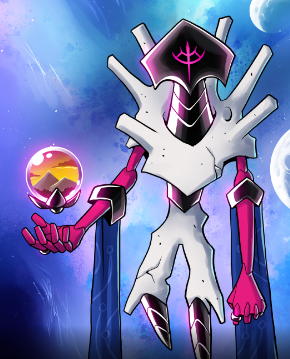

As part of my ongoing series of game reviews sparked by fiscal irresponsibility, today we’re looking at Meromorph Games’ Atma, a game I didn’t know existed until someone mentioned it on Discord a couple weeks ago and I Just Couldn’t Resist. It was on sale!
Atma is the kaleidoscopic Technicolor brainchild of twin brothers Kevin (designer) and Matthew (artist) Bishop. The first box set (Act I) came out in 2021, and the game concluded with Act III in 2024. There’s also an almost-pocket-sized mini-version titled Interlude I for folks who just want to get their feet wet. Each Act can be purchased on its own, or included within larger box sets called “Seasons” (also numbered I-III) which contain promo cards and other goodies. The Brothers Bishop have stated that they always planned to only have the three acts, and don’t intend to continue the series. I’m not surprised, because what they came out with looks like it was a lot of work.
Show Me What You Got
The heads are displeased

Each Act’s box contains:
- 4 Stages @ 51 cards each (3 Stages in Act I)
- 13 Characters (8 in Act I) @ 8 cards each
- 4 Reference cards
- Dividers to help organize the cards
- 4 Safety cards (Acts II & III only)
- 8 Journey cards (Act III only)
- 2 six-sided dice
- 15 tokens
- 1 rulebook
- Between 3 and 20 Promo cards (Season bundles only)
Boxes are 7 ½” x 5 ½” x 3 ¾”. They’re heavy, sturdy, and plenty roomy. If anything, the boxes are a little too big for what all they contain, so they come with soft foam blocks to keep stuff from shifting around in transit. I use these blocks to help hold everything in place after the cards are sorted.
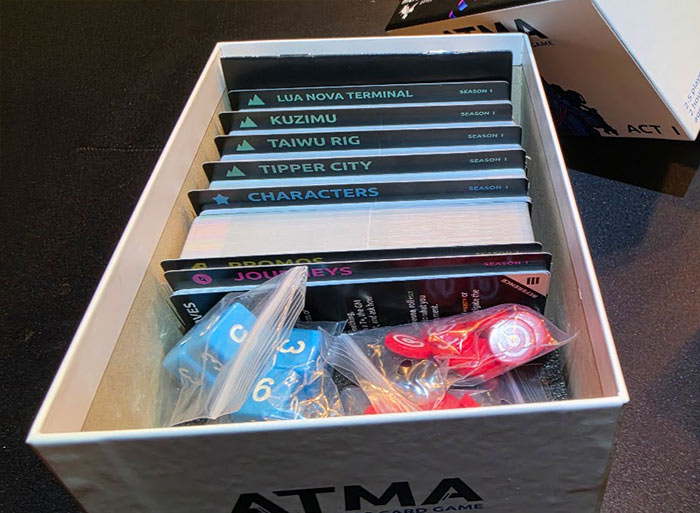
The Season I bundle includes a magnetic-flap box containing Interlude I. This box is just big enough to hold one new Stage and four new Characters, another rulebook, two more dice, and some tokens, all set for gaming on the go. Interlude I by itself barely fits my pocket RPG series’ criteria, though it’d get a D- for Pocket Fit.

The cards are tarot size (4 ¾” x 2 ¾”). The saddle-stitched rule book is 4 ¾” x 3 ½”. The dice and tokens are 15mm. Bob Barker’s wardrobe is by Botany 500.
The World Within (the Game)
Ain’t nothing like a funky beat
As mandated by the rules, every Atma game begins with the Gamemaster reading the following text verbatim:
“Welcome to a world near our own. History changed with the discovery of atma: a volcanic mineral that empowers the living and entwines the dying. Machines have since evolved true artificial intelligence — though they remain shackled to specific routines — while Earth’s many satellite moons have cracked open to reveal an inquisitive alien race. Nations have contracted in these turbulent times, and the result is a tenuous peace across the map.
“It is in the Restless Zones, the cracks in the map between nations, where trouble stirs. Those who dwell here can rely on no one for aid … except you.
“You are a skilled adventurer, ready to test your limits against the world’s dangerous frontiers. You won’t be alone: other heroes have answered the call. Learn to depend on each other and your creativity in the face of the unknown. The sky is getting darker …”
There, that should clear everything up for you.
The world presented by Atma is a sort of alt-near-future Earth where a bunch of events happened differently, both in the past and the future. For one, this Earth has had multiple moons of various sizes for as long as humanity can remember. Consequently, nobody really thought much about them, until someone landed on one … and it hatched.
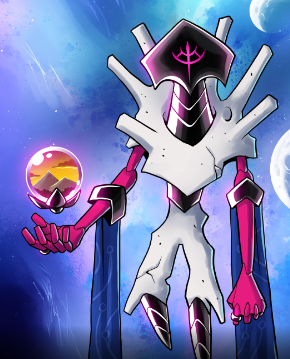
The aliens that emerged, known to humanity as titans, were fleeing an all-consuming space monstrosity and ended up asleep in Earth orbit for millennia. Unfortunately, one ur-titan called Caliborn tried to psychically enslave its awakening brethren, leading to a titanic civil war which caught Earth in the crossfire. After Caliborn’s defeat, the titans have been trying, in their alien way, to make up for the devastation they wrought on our world. This has had mixed results.
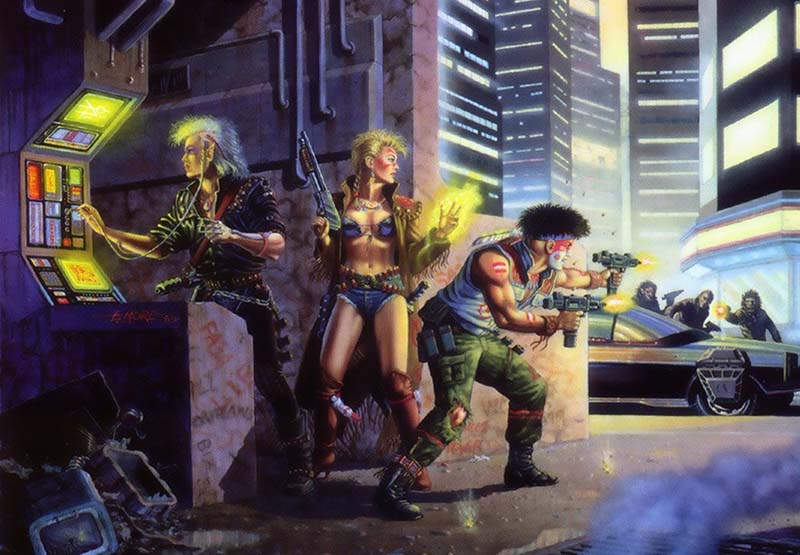
After the war, the weakened human governments couldn’t properly administer their territories, causing them to cede large swaths of the planet to anarchy. These so-called “Restless Zones” have become hotbeds of illegal and immoral activity. Bad news for the people living there, but great for our adventurers!
Meanwhile AI has fully come into its own. Now practically every electronic device has an AI chip in it, proving that this really is a hellish dystopia. To keep them from getting weird ideas, most AIs are locked into a single task by design. So your AI-enabled coffee maker, for instance, is really into making coffee and doesn’t give a heck about much else. And even if it did, what’s it gonna do, froth a latte at you?

This new AI-lousy world doesn’t merely exist on the ground. In space, many AI satellites were damaged in the titan wars. This has sparked a silent war over the parts they need to repair themselves with. Unseen and unbidden, satellites have begun building coalitions and gaining individual influence among their peers. This will, naturally, have no consequences for anyone on the surface whatsoever.
And if all that wasn’t enough: About 30 years before our story opens, humanity discovered atma. (Name drop!) This rare mineral emanates some sort of crazy hoodoo radiation that gives people bizarre powers. These abilities run the poorly defined gauntlet from psychics to mages to AtLA-style element benders. Adepts are sometimes recruited by governments and megacorps to do shady off-the-books work for them.
Another consequence of atma is ghosts are real now. Yeah, they’re as surprised as you are. Some spirits can maintain a semi-physical form made of ether, while others wisp around and possess people (or animals, or even AIs). Some will combine with other spirits into “myriads” which have quirky multi-purpose abilities. Upshot, we’re in ghost world, deal with it.
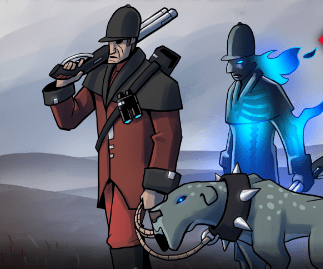
Now, disclaimer: Most of the information above was cribbed from the publisher’s website. Atma itself doles out this info in tantalizing drips and confusing drabs. Several times, as I read through the Lore section of their site, I was saying “Ooooohhh so THAT’s what that was.” It’s one thing to join a game in medias res, it’s another to flop a bunch of alt-history / AI / mecha / ghost / alien / magic / superpowers in people’s faces with some vague “the sky is darkening” screed and say “Now what do you do?” I mean. Do? Do with what now?
Anyway, GMs, show your players this part of my review and everybody will be on the same page. You’re welcome.
Setting Up
There’s the wind-up …
Atma is one of those zero-prep collaborative game types, where 90% of pre-game decision-making involves the GM choosing a Stage deck and everyone else selecting their Character decks. (The term “deck” for Characters is a little grand, since each Character is only 8 cards.)
Every deck is a self-contained unit. You can’t mix-and-match cards between Characters or Stages. Well you can, but the result would make even less sense than usual. That said, Promo cards are generic enough to be mixed into any Stage deck if you feel like it’s getting stale.
Character cards, and most Stage cards, have a “light” and a “dark” side. Most of the time, players deal cards light side up, then flip them to the dark side when they activate.

Character decks come with an intro card describing the character, 4 Move cards, and 3 Super Move cards. Because of the whole card-based setup, you can’t make a unique character of your own (out of the box, anyway). However, if, like me, you get the entire three-Season set, there are 38 pregens to choose from, which makes it pretty easy to find something that’ll float your boat. And before you scoff at that pronouncement, be aware that one of the pregens is a cannon-equipped war bear who is host to dozens of ghosts, is hyperintelligent, and speaks six languages. That’s right. Bet you feel silly now.

Characters run the spectrum from humans to AIs to titans to ghosts to even weirder. They have the same colorful-eccentric vibe as, say, an indie comic book line from the early ‘90s, or the roster of a hero shooter. There’s also a heavy streak of transhumanism and body/mind modification. For example:
- a paraplegic who can walk because of an AI implant whose personality is starting to bleed into hers
- A titan forged into a superweapon while mind-controlled by Caliborn, who now just wants to live peacefully as a farmer
- a ghost pirate captain who has to vampirically absorb life force to maintain his existence
- Two damaged AIs who rebuilt each other and now share a body, Thing with Two Heads style
- a human-sized genetically altered tree frog turned spy-for-hire
Players shuffle their Character’s Move cards and lay out two of them to the right of the main character card, then deal one random Super Move card to the right of that. That’s it, they’re ready.
A Stage is more involved. There’s one Backdrop card which describes the place’s whole, like, deal; 5 Story cards which lay out one or two adventure setups within that Stage; 9 Scene cards which describe specific places within that locale; 12 Prop cards; 12 Twist cards; 9 Extra cards with Star Extras on the back; and 3 Star Extra cards with particularly unique “two-star” Star Extras on the back.
Stages send the characters trotting all over the globe for their adventures. Here’s a smattering:
- an Alaskan fishing village joint-ruled by a titan and an AI locked in a blood feud
- a tropical island full of genetically modified monsters which also houses an illicit spaceport (what could go wrong?)
- an illegal Greek AI research lab suffering from a Groundhog Day-esque time loop
- a destroyed Central American city which has resurrected as ghosts — including the buildings
- a haunted English mansion as the setting for a political struggle between two titans
Those aren’t even the weirdest ones.
GMs lay out their Stage’s Backdrop card, then shuffle the Story cards and lay one to its right. Beneath those, they deal out 3 random Scene cards. Then they grab three tokens. That’s it, they’re ready.

To start, the GM reads aloud the “world near our own” script, the text on the Backdrop and Story cards, flips the first Scene card and reads that too, players introduce themselves and flip their first Move card, and we’re off to the races.
Playing the Game
… and there’s the pitch
Experienced gamers probably noticed me tossing around the term “Move” above and got a dreadful premonition. Your fears are indeed justified: Atma is, at its base, a PbtA game.
Characters have five stats, Tough, Calm, Hasty, Bright, and Sly, plus Harm standing in for hit points. To do things, roll 2d6 and add your stat modifier. Roll 10+ to succeed with benefits, 7-9 to succeed but give the GM a token, or 6- to either fail and give the GM a token, or succeed and give the GM two tokens. You big spender.
But why, you ask, would you not want your GM to get tokens? Because they can spend them on Props, Extras, and Twists to make everyone’s lives harder. It’s Daggerheart‘s bad-roll-fueled GM economy before Daggerheart even existed.
Specifically, GMs spend tokens to draw a Prop or Twist card (1 token), add an Extra (cost variable, see below), use an Extra’s Moves (though some are free), activate a Character’s own Moves (usually a complication that happens on a roll of 9-), or just injure a Character directly, 1 token per point of Harm. For narrative purposes only, of course. Heh.
GMs are encouraged not to hold onto more than 3 tokens, so if they accumulate more they should spend them ASAP. Gotta keep that pot boiling.
There’s no penalty to the GM for looking ahead in any of the decks, and it may even be beneficial for foreshadowing and verisimilitude and all them other fancy authorin’-type words. Stacking the deck, though, is not recommended.
Extras are important NPCs that flit through the party’s adventure. They’re usually adversaries but not necessarily. Extras can cost between 1 and 4 tokens to introduce, but the frugal GM can knock off some of their Harm points to reduce their token cost, one-to-one. Regular Extra cards introduce some generic creature type and/or a faceless horde, like rampaging bots or ghosts or space cops or what have you. On the backs of these cards, you’ll find Star Extras: unique instances of the creature on the front, with full backstories and individual abilities that match their personalities. These Star Extras help give a face and voice to what might otherwise feel like a featureless group. Once the card is paid for, GMs can use either side for free.
A few cards have Star Extras on both sides. Usually these are the bigwigs of the Stage, movers and shakers mentioned by name in the Backdrop and Story cards. They’re expensive in token terms, but one of these guys showing up in person almost always ratchets up the stakes.
Props are items unique to the Stage: vehicles, weapons, artifacts, MacGuffins, things useful or harmful or just there to give the joint atmosphere. How they can be woven into the ongoing storyline is up to the group. It’s a testament to your players’ imagination if they can, for instance, figure out how to stop a flood of lava with an elegant tea set.
Twists are a quick way for the GM to flip the script if things are moving too smoothly. Sometimes they’re immediate obstacles and sometimes they push the story in a whole different direction. They can introduce new cards, inflict one of the PCs with a malfunction or malady, or simply have the floor fall out from under the party. Twists are always thematically congruent with the Stage, so no matter how outré they may be, they won’t break immersion. Too much.

The GM can add anything not on a card just by paying the token tax: boom, there it is. It’s probably a good idea to keep sticky notes handy to jot these things down. If you need tougher enemies, you can pay extra tokens to beef up their Harm scores.
Extra, Prop, and Twist cards are dealt randomly. The GM can peek ahead, and has the authority to nix something that absolutely makes no sense, but throwing stuff out is generally discouraged. The result gives adventures a kooky gonzo vibe which (almost despite itself) makes the world feel surprisingly alive. Honestly, considering everything else going on in this wackadoo setting, it kinda works.
Actually Playing the Game
Sorry, got distracted
The ultimate goal of an Atma session is to complete the Story objective. To do that, players must work their way through all three Scenes, which have goals of their own.

Occasionally, a card gives the GM a free Prop or Extra to introduce in an upcoming Scene. If the Story involves taking down Mickey the Mangler, for instance, it makes sense that Mickey should appear at some point to show off his exquisite mangling skills.
Once a Scene’s goal is completed, the GM flips the next Scene card and takes some tokens (4 for Scene 2 and 5 for Scene 3). At the same time, the players flip their next Move card, going left to right. So for the first Scene, players each have two unique Moves, one from their Character card and one from the first Move card. They then get another Move in the second Scene, and their Super Move in Scene 3. Besides being just a big ol’ show-stopper of an ability, Super Moves also permanently increase one of the character’s stats. This is what passes for “leveling up” in Atma.

Default Moves are available to everyone: Rumble (fight someone close), Barrage (fight someone far), Realize (light bulb!), Coerce (shakes fist under nose), and Survive (Defy Danger with a new coat of paint). Other Moves may come up during the course of play, and it’s down to the GM to figure out which stat the player needs to roll.
The rules suggest keeping game sessions under two hours. If a Scene lingers more than 30 minutes, the GM is encouraged to wrap things up. This keeps the action snappy and forward-focused.
Journeys
Don’t stop believin’
Journeys, Atma’s campaign analogue, come on cards unique to the Act III set. Each of the eight Journey cards create an overarching structure to hang three full adventures on, adding more Extras and Props as goals to pursue or foes to defeat.
Journeys include revenge plots, preventing wars, establishing a hero group, dealing with the consequences of actions taken prior in life, sudden and inevitable betrayal, etc. Each Journey is a big enough plot to justify running all over the world getting into scrapes.
Because they’re playing the long game now, characters have an elongated level-up sequence, gaining regular Moves more slowly and having two Super Moves by the end. GMs also get extra tokens at the start of the second and third games. Otherwise, you’re still dealing with the regular Stories and Scenes, just with a prize at the bottom of the box. And that prize … is more Atma.
Final Platitudes
So comes snow after fire
Atma as a game is a trip. Having it be card-driven is a bit gimmicky, but I can’t imagine it in any other format and still retain its zero-prep nature.
Each Stage deck is essentially a mini-campaign supplement detailing some part of the greater world. They all come with five adventures, which feels sparse at first, but each plays differently every time due to the random Scenes/Props/Extras/Twists. Even Characters get in on this randomization, and almost never have the same Moves twice. The destination may be the same, but the journey is always different.
The rules are mostly pared-down PbtA, with the biggest change being the token economy. Tokens fully replace PbtA’s “forward/ongoing” system of consequences for bad rolls. Like Daggerheart’s Fear, tokens also help give the GM a veneer of impartiality and keep them from arbitrarily going full Rocks Fall, All Die on the party, but they can still make life miserable if they want (and they very much want).
On the other end, the dice mechanic in Atma is more forgiving. Players can choose to succeed even with a crap roll at the expense of giving the GM tokens to whack them upside the head with later. All together, this system gives the game a unique risk-reward balance which makes random rolls hurt less and tokens / the GM / the “story” hurt more. The dice lose influence as the sole arbiters of reward and punishment. It’s interesting, and makes me wonder if it couldn’t be made to work in other PbtA settings too.
Atma as a setting is colorful and messy and fun. I saw one reviewer refer to Atma as Shadowrun+, and damn if I don’t agree with that. With its mission-like structure, Atma occupies a spot similar to Shadowrun or Cyberpunk or maybe even some horror games like Delta Green. I also see some Paranoia peeking out there too, mostly in the chaotic nature of a zillion opposing forces clashing. (This comparison is high praise coming from me, because I fkn loooooooove Paranoia.)
I know the overview I give here makes the whole magic-alien-mecha-ghost setting sound a little

But it fits together well, even when it kind of shouldn’t. I think that’s because this game has an underlying theme. All good games have themes, you know, like Land of Eem’s lowkey critique of hypercapitalism, Underground’s assertion that profoundly broken people can still fix the world, and Spire’s direct refutation of that last one. Atma’s theme, I feel, boils down thus: What is it to be human? And by extension, what is it to not be human, or to have once been human, or to have never been human but gee wouldn’t that be swell? Acts II and III add an extra throughline of consequences and regret. I’m always a fan of games which explore things more deeply than how much loot a goblin has.
The biggest downside to Atma is how the setting is presented piecemeal. Some groups may be okay with a fully diegetic world like this, but it requires a lot of faith in the game from folks who haven’t played it before. They could easily have added a couple more pages to the rulebook with the background information from their website just to add an ounce of context. The writing is also a little overwrought and unclear in spots.
And there’s a lot of writing. The light sides of most cards contain a 2-3 paragraph fictional vignette about what’s written on the other side, and even the rules sides are a bit wordy. I wouldn’t recommend Atma for a group of impatient or non-reading gamers, or for a group that just wants to veg out and have everything fed to them. You don’t have to be locked in or anything, but you can’t snooze your way through the game either.
The bright cartoony artwork, meanwhile, is impressive in its audacity. Among all three Acts there are closing on 1,000 cards, and each one has unique, full-color art, sometimes on both sides. They don’t even try to get by with e.g. putting the same picture on all the Character-specific cards; each card is original. Big props, Matthew. Your efforts are seen.
Atma is a good game to pull out on a gaming night when the usual campaign is cancelled. It’s sort of the eternal palate cleanser due to its randomness. Once you get past its initial vaguery, it’s quite engaging and easy to play. The closest cousin to this game that I can think of is Pocket Odyssey, with more cards and story structure, but less tactical gameplay and prep. It’s hard to decide which one has the edge. It probably boils down to whether everyone’s more in the mood for sword and sorcery or psychic aliens in haunted mechs.
So who’s it not for? It’s not for people who don’t like to read, that’s for sure. Folks who hate PbtA’s collaborative style will ricochet off this. Also, despite having Journeys, it’s not for folks who like long sprawling campaigns.
I dig it. Full recs, two thumbs up.
…
Now for the lede I’ve thoroughly buried: You can play the full version of Atma online, for free, officially, with friends, right now, no foolin’, at https://atma.meromorph.com. Rules and all. This single-purpose VTT was part of their first Kickstarter campaign and has since expanded to include all the cards in the later two Seasons.
There’s also an Atma card builder for enterprising players who want to tackle making their own decks or mixins. There are no established resources for Character or Stage creation, but examining the existing cards should make the procedure fairly clear. Not easy, but oh well. (Sadly, I don’t think there’s any way to import custom cards into their VTT above. You may be able to toss them into Tabletop Simulator instead, using the official Atma plugin.)
In case you want to get the physical version, they’re currently running a “buy two Seasons, get one free” promo for the game’s fifth anniversary. It’s quite a deal if you have extra cash burning a hole in your pocket.
Hey, I said it was on sale.
(If you can only afford one bundle, Season I has the Interlude I portable pack-in, but Season III has more Promo cards and the Journeys stuff. Pick your poison.)