
For Part One, clicketh yon linketh.
The Gamemaster
(2020, Documentary)
We get two long skinny pages about how to be a GM. It’s almost exactly like every other “how to GM” section in the universe. The only unusual tool introduced here is the Countdown Roll. If something big is going on in the background (NPCs are rebuilding a fort, exploring a large area, gathering information, etc.), the GM rolls a d20 at the end of the game session. If it’s 3 or less, the task will be complete by the beginning of the next session. Otherwise, the GM reduces the die by one step (d20 -> d12 -> d10 -> d8 -> d6 etc.) and rolls again at the end of the next session. If the Champions actively help, the GM can reduce the die size multiple steps. Smaller tasks can start with a lower die if the GM thinks it prudent.
Hope and Despair
Off on the road to Morocco
I’m jumping ahead a couple chapters in the main rulebook to discuss this concept, since it’s the underpinning of several new systems. The arrival of the Scourge has plunged Radia into Despair, an overwhelming ennui which empowers monsters and disrupts the lives of the people. The deeds of the Champions help to return Hope to these lands and restore Radia to its former glory.
Mechanically, Champions gain between 1-3 points of Hope for completing a Quest. Every four points of Hope triggers an advancement to their Way, as mentioned previously. Players can also cash in 1d4 points of their character’s personal store of Hope to immediately gain and use a Boon. (Dropping Hope past the leveling threshold doesn’t take away their last advancement, and raising it above that level again doesn’t give them a new one.)
As Hope rises, things start to turn the Champions’ way. Maybe the king summons the Champions to give them a special item. A temple opens that was previously locked away, allowing the group to complete a Quest. A road is cleared so they can travel to a new region. We’ve all played these games. You know how it works.
Meanwhile, every Scourge-infested region in Radia has a Despair score between 3 and 5. Regions with higher Despair are dark and dangerous and full of timorous beasties. Completing a Quest in the region reduces this number by 1.
Reducing Despair to 3 or below also triggers some sort of event. A dark tower erupts from the earth, creating a new Landmark (see below). Monsters suddenly become more active. A hidden truth is revealed. The main Scourge villain starts moving. The closer it gets to zero, the more desperate the Scourge becomes. The final Quest will almost certainly involve a big boss battle, after which the region returns to normal and the people throw the Champions a huge party.
Despair is mostly a campaign thing. If you’re only playing random one-shots, you can ignore it.
Quests
No good deed goes unpunished
Quests are the bread-and-butter of Twilight Sword. During a Quest, Champions are expected to perform Deeds of derring-do, like help someone, explore a Landmark, or defeat a boss. At the end of a Quest, the heroes gain 1 Hope for each Deed they deedily-do. Completing a Quest also reduces the local Despair by a point.

Champions get one extra point of Hope at the end of their first-ever Quest, to mark the momentous occasion of becoming newly minted Champions. This will probably push them over the leveling threshold even if they blow a Deed.
Landmarks
:dramatic pointing: What’s that over there?
Landmarks are scattered all over: crumbling temples, dark dungeons, pastoral towns, brooding castles, whatever. Wherever a Champion stands in Radia, they should see a place or two on the horizon that entices them off the beaten track.
The rules provide several random tables to help generate a Landmark, from its appearance and inhabitants to local rumors and secrets. It only took me six d12 rolls to generate a burned ruin of a tower, once a prison for rebellious nobles, now haunted by a powerful cursed spirit desperate to break free and wreak havoc on the land. I could very easily put together an interesting Quest just from that seed.
And what better thing to find at the bottom of a Landmark than a Treasure Chest? Chests in Twilight Sword come in three varieties, Bronze, Silver, and Gold, each with their own random tables with increasing tiers of goodies to find within. Bronze Chests give mundane armor, a handful of Zin, some health potions, etc. Gold Chests overflow with hundreds of Zin, a magic weapon or armor, a useful Accessory, and other pearls of great price.
Kokkoros
Ow!
These tiny masked forest sprites wander aimlessly around the land, hide under random rocks, and otherwise hang around being dumb and cute. While they’re pretty useless on their own, they often have problems that only Champions can solve.

Kokkoros, small and silly as they are, may know the secret entrance to a Landmark or have information vital to a Quest. All you need to do is help them get home, or find their friend, or bring them a rare flower from the nearby mountaintop, or stop that weird-looking guy over there (who’s more than likely a Black Bogoblin) from beating them up. You do want Hope points, right?
Hitting the bricks
You got to move it move it
For every day of travel, Champions make two travel rolls to determine random events that may pop up. This travel table lists several possible complications, from blocked roads to sudden storms to monsters suddenly jumping out at them. Or they may discover an opportunity to get a valuable item, run into an old friend, or even just have some uneventful travel time.
Champions only need to roll once per day on the travel table if they have a reliable guide. As the level of Despair decreases, so too does the die used to roll on the table, which makes travel simultaneously safer yet more intense (1 and 2 are the best outcomes, but 3 and 4 are the worst). GMs can skip travel rolls entirely for return trips after major Quests.
Champions in the great outdoors naturally have to deal with the weather. Storms come in four levels. Level 1 is mostly just heavy rain which puts out fires and makes it hard to climb or swim. Levels 2-4 require the GM to start making thunder rolls: roll 1d20, and on a 1, a random Champion in medium or heavy armor is struck by lightning. Level 2 storms take one thunder roll per turn, level 3 is two rolls, and level 4, three rolls per turn. If the GM doesn’t roll a 1, they reduce the die size (d12 -> d10 -> etc.) and try again next turn.
Hot and cold weather have their own levels and dangers. Hot 1 weather makes it impossible for Champions to use 🔷; Hot 2 also inflicts the Burn condition (take 1♥️ damage per turn). Cold 1 inflicts the Freeze condition (can’t take Reactions, and moving costs an Action), while Cold 2 also takes away 1♥️ per turn and makes it impossible to recover health until they warm up. Pengus have a natural resistance to Cold 1, and Tolunas to Hot 1. Carrying an elemental sword of the opposite type also provides the same level of protection.

Champions can make Camp to Rest in the middle of a journey. If they have safety, shelter, and food, making camp counts as a regular Rest. If they only have two out of those three, camping counts as a second Short Rest instead.
And the rest
The Gamemaster chapter also contains a rather mundane list of typical NPCs (guards, bandits, etc.) The pictures are nice but otherwise it’s nothing special.

Campaigns
In for the long haul
There’s an interesting line at the opening of the Campaigns section: “Before starting a campaign, you have to create your own land or choose one of the many that already exist.” I mean, we already knew that, but it’s kind of cool of 2LM to admit that their version of Radia (or even Radia as a setting itself) isn’t the only way to play the game.
Radia is at least worth a look, though. The map of the world looks … I mean, it’s off-brand Hyrule, man. I can’t sugarcoat it.

The map is divided into cards so it can be revealed to the players as they travel about. Each square is about three days’ travel from edge to edge.
The GM is given a few things to think about if they’re going to raw-dog their campaign world: what’s the weather like in each region, what Landmarks are about, how bad is the Despair, that kind of thing. Whether you’re making your own map or building a campaign with the provided one, consider how big the game needs to be. You’re not beholden to using the full 25-card experience, but it should still have enough areas to explore to be interesting.
Sometimes not even a regular campaign will suffice. If the players want to defeat the Scourge once and for all, there are rules for a mega-campaign called a Legend. (What an interesting term, I wonder where they got it from.) The Scourge in a Legend has a world-wide Despair counter, from 10 for a Legend that takes maybe 15-20 sessions to finish, to 50 for something that everyone really has to commit to. This counter ticks down whenever the players reduce Despair in a region. At 0, the Final Battle begins.
At the end of a campaign or Legend, there should always be Scourge to defeat, be it one Big Bad Guy, a final push by a horde, a MacGuffin to destroy, a mystery to solve, a rogue moon to deflect, or however you like. The game provides a variety of boss-level monsters and there are tips to make your own.
If the Champions seem to struggle regularly to complete Quests, the GM can introduce a Patron. This mysterious GMC is slightly more powerful than the PCs and drops by to help when they’re in a jam. They only show up irregularly (requiring a countdown roll to appear) and may have unclear loyalties. Normally I’d be negative to this idea, but it does match the fiction, and might be helpful to keep groups of inexperienced players above water.
Radia (short version)
All we hear is Radia ga ga, Radia goo goo
The core rulebook skims lightly over the main campaign world of Radia. The real detail resides in the Lands of Radia book, which we’ll touch on later.
Radia was once ruled by the Good King Wenceslaus Myro, who kept Radia safe and prosperous through the power of the sacred Twilight Sword hidden underneath Castle Radiosa. But then the mysterious demon knight Vardas sneaked in, took up the Twilight Sword, and slew the Good King. Earthquakes reshaped the land and Vardas began amassing an army of Scourge monsters. Radiosa Castle transformed into the lava-moated Fortress of Evil. Now the good people of Radia tremble in fear of the day when Vardas unleashes the full force of his minions and takes over the world completely.
Yeah. It won’t win any Pulitzers, but that’s not what we’re here for.
Radia is divided into eight regions, from a cozy valley barely touched by the Scourge (tutorial region anyone?), to a tropical coast full of hunky tolunas, to a blazing desert mostly populated by cat people for some reason.

Each region listed in the core book has a very brief description of the overall atmosphere, its default Despair, and three permanent Landmarks, which still gives the GM plenty of room to make the region their own.
Monsters (reprise)
Scary monsters and super creeps
The rulebook presents us with a list of 16 common monsters, which (if you’re very generous) expands to 48 if you use Variants. There are also four boss-class monsters which are so large and have so many abilities that they need multiple cards. The monsters section also contains rules about balancing encounters, looting monsters posthumously, and the gruesome task of gathering monster parts for potion-making.

The Lands of Radia expansion adds another 14 regulars and 8 bosses, including some real campaign-enders like Vardas himself and the “True Scourge.”
Lands of Radia
Secrets in the dark
Folks who backed the pre-release campaign (like me) also received a copy of the campaign book, Lands of Radia. As you might expect, it goes into much more detail about all the various regions, including lots of adventure hooks of greater or lesser fleshed-out-ness.
As you might not expect, the supplement also includes three new Kin and two new Ways.
Aura: Tall, willowy, lavender-skinned, white-haired folk who originally founded Radia and were thought extinct ever since Vardas took over. They can learn one arcane spell and one blessing no matter what their Way is. Only one Champion can choose this Kin in a campaign, that’s how rare they are.

Dero: Raymond Palmer, rise from your grave. Small, grey-skinned underground miners with huge hands and feet. They have nightvision and can turn into indestructible stone at will once per day. While in statue form, they can perceive the world but can’t move.
Groda: To the max. Small frog people with a warrior culture which mimics feudal Japan. They have nightvision, can breathe underwater, and have Advantage on Agility rolls to swim and jump.
Way of the Hammer: Megaton strike! Hammer-Wayers know how to break and build. They prefer huge blunt weapons. Their Feats include Heavy Lifting (+4 inventory slots and heavy weapons only occupy one slot instead of two), Whack (+1d4 damage if you don’t move in the previous turn), and Blacksmith (Advantage on KNO rolls to repair things, can forge low-grade weapons, fix regular ones, and sharpen non-magical ones, giving +1 damage for a day). They start with an old weapon and shield, padded armor, and 3d6 Zin.
Way of the Shield: I say thee nay. Shield-Wayers are the iron-clad defenders of a party. They start with all the same stuff as the Hammer-Wayers. Feats include Unbreakable (permanently gain +3♥️, and falling to 0♥️ doesn’t incur a Wound), Bodyguard (spend 1🔷 to make yourself the target if one of your nearby allies is attacked this turn), and Withstand (if you miss a Parry roll, spend 1🔷 to avoid all damage anyway).
This new stuff is nice, but I wouldn’t buy the book just for that. If you intend to play in Radia as presented, though, absolutely get this book, and enjoy the rest as a bonus. The extra world-building really opens everything up, and it has plenty of Quest and Legend fodder to keep things going for a good long time.
Folks who pre-pledged (like me) also got a super special double-secret bonus Kin, the Mallard. This small-sized duck-person has Advantage on swim rolls and can lose their temper once a day to either gain Advantage on an ability roll or reroll a damage roll, after which they suffer the Confusion status effect. Waaak wak wak wak wak!
That’s a Wrap
Inna final analysis
Twilight Sword is trying really, really hard to be the Legend of Zelda TTRPG, to the point that I think they’re deliberately pushing Nintendo’s lawyers’ boundaries.
Besides the room-occupying elephant, 2LM also cites Final Fantasy as an influence, which I can sort of see in the team synergy and the fact that Kokkoros are sort of a mix of Koroks and Moogles. They go on to cite Ni No Kuni, which I haven’t played. (It looks fun, though, so maybe I should.) But I have played some of the Tales games, and I see that DNA in here too.
Despite the weird sizing, the book is gorgeous, lavishly illustrated, and well laid out. It might have benefited from a slight chapter rearrangement to make concepts flow better. I also found a fair number of typos. I know 2LM is an Italian company but they’re usually better about that.
As for the game itself … that’s complicated. The rules are solid. Everything flows reasonably well and nothing seems out of place or missing. It’s a fun concept. They know their genre and do a good job imitating it.
But, and I say this through gritted teeth: it’s very ordinary. The entire movement/action/free action economy might as well have come straight out of Design RPGs the D&D Way. It’s not particularly streamlined, either. Some players may dislike the “roll to hit, also roll to dodge” thing, but I see it as a necessity because GMs are rolling for their monsters’ actions, targets, and damage, every monster action, every turn. That’s a lot of busywork behind the screen already.
I wouldn’t recommend this game for the lazy GM, or for those who let their players roam free and wild. The cards make it seem like you should be able to deal out encounters quickly, but the rules themselves caution that the GM should be as prepared as possible, to the point of having monsters and maps ready to go for common scenarios that may never happen. I guess when I see random tables, I expect to be able to roll up encounters on the fly. They seem to view them more as a pre-game setup thing.
The world is great, but sometimes I’m not sure if I like it for itself or because I want to play Tears of the Kingdom again. There are enough monsters, but I wouldn’t call it a great selection, even including the additional ones from the expansion. But good lord the artwork is so on point. Not a bad-looking beast in the bunch.
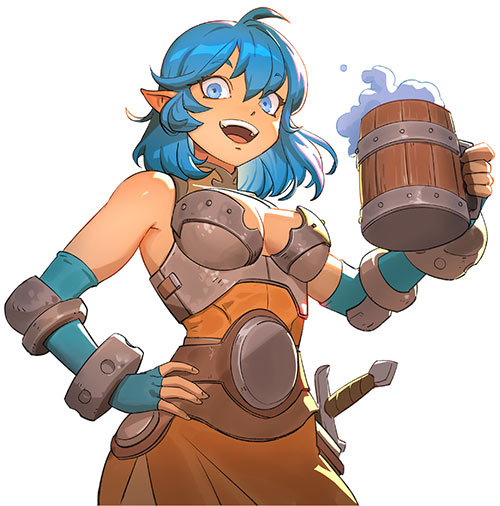
(Artwork note: Every single female humanoid character presented in the material is both traditionally attractive and wearing skimpy and/or form-fitting clothing. I’m not complaining, but be prepared.)

Twilight Sword is such a great concept, and it does a lot of things right. There’s no better Zelda-clone TTRPG on the market. But maybe because I just reviewed a game that really knocked my socks off, it feels stodgy, like the buttons are sticky. The things it gets wrong aren’t even wrong! They’re just … okay. It walks where it should fly.
I like it fine, but I really wish I loved it.
One point two thumbs up.