Month: June 2026

  • Nimble TTRPG: An Overview, Part Four

    Nimble TTRPG: An Overview, Part Four

    Nimble Logo

    If this is where you’re starting, check out Part One here instead. See you back here soon!

    Heroes, Part Three: Magic & Mayhem, Part Two: Jedi Academy

    Songweaver

    I believe you can get me through the night

    Songweavers have been gifted with the ineffable power of music by a muse or a god or something. They’re … they’re bards. They’re pretty much bards. They begin with 13 HP and a d8 Hit Die, proficiency in cloth and leather armor and DEX weapons, have WIL and INT as their Key Stats, advantage on WIL saves and disadvantage on STR saves.

    But who cares about that. Let’s sing! At level 1, Songweavers learn cantrips from the Wind school and one other school of their choice. Wind cantrips are Razor Wind (1d4 slashing damage, on a crit rolls two dice instead of one) and Breath of Life (restore 1 HP to a dying creature). They also get the unique fan-favorite cantrip Vicious Mockery, which does 1d4+INT psychic damage, ignores armor, and taunts the target for a turn.

    A beginning Songweaver gains Songweaver’s Inspiration, which gives them the ability to allow their allies to reroll a single die for an attack or save, up to [2 x WIL] times per Safe Rest.

    At level 2, they get a mana pool of INT x 3 + level to go with the Tier 1 spells of their schools. They can also play a Song of Rest which adds their WIL to their allies’ healing during a Field Rest, and Jack of All Trades allows them to move one skill point around every Safe Rest.

    Level 3 garners them one Utility Spell from each class they know, plus a subclass: either Herald of Snark or Herald of Courage. Goons Snarkers get upgrades to Vicious Mockery, like double damage if an enemy missed an attack, or causing a target to be taunted by someone else (“Let’s you and him fight”). Courage … ians get upgrades to Songweaver’s Inspiration instead, like temp HP to all allies or granting an extra action to a target.

    Songweavers have two lists of extra abilities. They start picking up Lyrical Weaponry at level 4, like Inspiring Anthem (granting all Dying allies within earshot 1 HP, which makes them not Dying anymore) or Not My Beautiful Faaace! (when Defending, force the attacker to choose a different target on a failed WIL save). They max out at four Lyrical Weaponry abilities by level 17.

    At level 5, they gain the one-time boon A “People” Person. Choose two friends out of a list of four and summon each of them once per Safe Rest with a song. The guest list consists of Stompy the Hill Giant, Mal the Malevolent Imp, Gran Gran, and Linos the Everfriendly, each with their own monkey’s-paw abilities (except for Gran Gran, who’s a lovely person and definitely not a hag).

    To rearrange their abilities, a Songweaver just needs to Perform! somewhere during a Safe Rest.


    Stormshifter

    Narrow doorways! My one weakness!

    Stormshifters are sorta-druids, but almost more in a Daggerheart way than a standard D&D way (though not as overpowered). They get several front-loaded shapeshifting abilities but their spellcasting takes a while to mature. They start with 13 HP, d8 Hit Dice, proficiency with cloth or leather armor and staves and wands, WIL and DEX as Key Stats, and advantage on WIL saves and disadvantage on STR saves.

    Out of the gate they gain Beastshift. This lets them transform into a harmless animal like a pigeon or a mouse [DEX] times until their next Safe Rest. Their new form continues until they drop to 0 HP, cast a spell, or will it to end for free. This ability rapidly evolves into Direbeast Form (a large beast with Gore and Fearsome abilities) at level 2, Beast of the Pack (a fast-running medium beast with an electrical Thunderfang attack) at level 3, and Beast of Nightmares (a tiny beast with an acid sting and inability to be targeted unless they attack) at level 5. What they transform into doesn’t change stats-wise, but they can choose whatever form suits their fancy.

    Meanwhile they can cast Wind and Lightning cantrips at level 1, and tiered spells starting at level 2 with their new mana pool of WIL x 3 + level. This builds to Tier 9 spells by level 18. Compared to other classes, the spell progression is pretty vanilla. They gain Lightning resistance at level 8 and can max out Wind damage by spending a Beastshift charge at level 13, but that’s about it.

    At level 3 they get their requisite subclass. Circle of Sky & Storm adds either the Ice or Radiant school of spells, allows spellcasting while shifted, can cast a free cantrip when they crit with a tiered spell, can use their master of the Wind to fly, etc. Circle of Fang & Claw lets them Beastshift for free at initiative and change Direbeast forms at will, makes it so beasts won’t attack them first, shapeshift into a beast and then teleport in a Ride the Lightning kind of way, hypnotize people while in their Beast of Nightmares form, etc.

    Starting at level 6 they gain Chimeric Boons. These add animacular powers to their various beast forms, like walking on walls or having a prehensile tail or breathing underwater. Normally the Stormshifter can only use one Boon per transformation, but the Fang & Claw subclass allows up to three active at once.

    To change their abilities around, the Stormshifter can Be Wild, spending a day with wild animals during a Safe Rest.


    Zephyr

    We trained him wrong, as a joke

    That’s enough magic, let’s kick something. Zephyrs deliver unarmed punchy-kicky action that builds strong bodies twelve ways. Starting HP is 13, Hit Die is d8, proficiency with melee weapons but no armor, Key Stats of DEX and STR, advantage on DEX saves and disadvantage on INT saves.

    Being unarmored is no big deal for a Zephyr, since they bring it with them. Their Iron Defense starting ability gives them STR+DEX armor while they’re unarmored. Swift Fists, meanwhile, means their unarmed strikes never have disadvantage for multiple strikes in one turn. Punch all you want, they’ll make more.

    At level 2, they gain Swift Feet (+2 movement speed and +level initiative while unarmored) and Burst of Speed. This latter ability gives them [DEX] Bursts of Speed when they roll initiative, which can be spent on one of four abilities: Slipstream (one enemy auto-misses when the Zephyr Defends), Whirling Defense (apply armor to every attack this turn when they Defend), Swiftstrike (ignore disadvantage for a second attack of any kind, not just unarmed), or Windstep (ignore difficult terrain for a turn).

    Level 3 gets them Ethereal Projection. Once per day, meditating for 10 minutes allows them to send a translucent projection of themselves up to 30 feet. They can see through the projection’s eyes but can’t interact with the environment. This power never gets an upgrade, so it seems pretty limited unless you really need to see what’s on the other side of a door.

    Of course they also get a subclass, so it’s not a wash. They choose between the Way of Pain and the Way of Flame. (Fountains of Wayne will be in a future supplement.) With the Pain Way they Bring the Pain, turning any melee attacks against them into a crit, but only taking half damage while sending the other half back to the attacker sans armor. They can also Swiftstrike-attack multiple creatures at once, and gain advantage on their first attack and all saves when they’re at half HP. The Flame Way gives them Exploding Soul, letting them take a self-inflicted Wound to deal STR+Wounds damage and inflict Smoldering on a nearby enemy. They can also pass through enemies to inflict STR+DEX fire damage on them, do the Exploding Soul thing for free on a crit, and ultimately double all fire damage they deal.

    Starting at level 4 they begin to accumulate Martial Arts. These include Bodily Discipline (take an action to end any condition on themselves), Quickstrike (when they Interpose, punch the attacker for free), and I Jump On His Back! (jump on a creature’s back to gain advantage on attacks against it, and any damage avoided or Defended goes to the carrying creature instead). Ultimately the Zephyr will have eight Martial Arts abilities by level 18.

    To choose new abilities, they can Focus in a secluded, wind-swept place during a Safe Rest.


    Story-Based Subclasses

    So I told him, “Have a heart!” Get it? Get it??

    Sometimes, while the game is underway, the story your character lives takes them down a weird tangent. The Oathsworn breaks their oath. The Commander abandons martial might and takes up magic as a shortcut to power. The Shadowmancer’s patron betrays them. A monster adopts the Hunter and refuses to leave. In these cases, the book presents four alternate classes: Oathbreaker, Spellblade, Reaver, and Beastmaster. 

    These classes are funhouse reflections of the main class, replacing their powers with new conceits. For instance, the Shadowmancer-turned-Reaver loses their Shadow Blast power, but gains a stolen summonable weapon called a Bonescythe which does 2d12+DEX necrotic damage instead. The Hunter-turned-Beastmaster loses their first two Thrill of the Hunt abilities, but gains an animal companion which they can order to attack enemies or defend allies once per encounter. They all trade off one or two things like this.

    These aren’t really classes you can play from level 1. They’re more appropriately grandfathered in during mid-levels, usually with great fanfare. Ideally the player would work with the GM so the circumstances can be arranged to make the change happen diegetically.


    Analysis and Synthesis

    Thoughtfulness? In Trump’s America?

    The way classes level up in Nimble reminds me very strongly of D&D 4e’s paradigm of giving everyone something new and/or strong and/or interesting at every level, yet without that D&D feeling that you have twelve gazillion things to keep track of. Part of that is due to Nimble’s terseness. That neat new ability doesn’t take up half a page to explain. You get maybe two sentences, easy to digest and easy to retain.

    Martial classes tend to get a bad rap in D&D-adjacent properties, since mages often ramp way up in power at high levels while martial classes (Fighters etc.) scale more linearly. It’s true that magic types in Nimble have some specific advantages. There’s nothing that e.g. a Commander could ever do that would inflict d88 damage on four foes at once like a Mage’s Seething Storm spell can. Meanwhile, the Commander can tank a hit that would reduce that Mage to gumbo. Magical defense is highly effective but costs mana and only lasts a turn, while armor and shields can block one attack per turn forever.

    The main factor that levels the playing field between martials and mages, though, is Wounds. Hit Points exist in Nimble almost exclusively to prevent the loss of Wounds. Most everyone only has six, and healing them is a big deal. HP? Pssh, 80% of classes have ways to replenish those. Heck, sit quietly in a corner for 10 minutes and you can get some back without trying. But healing a Wound takes special time and effort. Even healing HP to max won’t make you any less nervous about an approaching enemy when you’re sitting at five Wounds.

    Martials get a lot of HP, and consequently don’t have to worry about taking Wounds nearly as much as magic types. Martials also tend to get abilities that temporarily prevent dropping to 0 HP, heal Wounds one or twice during combat, or increase Wounds permanently. This gives them amazing survivability. Magic types are very squishy in comparison.

    What I’m getting at is that power in Nimble is well scaled. Played competently, every class is equally viable through their entire 20-level breadth.

    Now I will take back one kadam, to honor the Hebrew God whose Ark this is, by saying that you mostly have to play a class straight to maintain that competency, especially early on. I highly recommend being boring with your stat choices, putting all your high numbers in your class’s Key Stats and increasing them with a strict eye to the future and an agenda to min-max. Failure to do so will hamstring your character for many levels down the road. A sub-par build could even make it so you can’t use important abilities. That might be fun if everybody does it, but you have to have a real tolerance for that.
    Next time: Behind the GM’s screen, for real, really honest

  • Nimble TTRPG: An Overview, Part Three

    Nimble TTRPG: An Overview, Part Three

    Nimble Logo

    Are you starting here? You shouldn’t. Check out Part One instead.

    Heroes, Part Two: Magic & Mayhem

    Mage

    Geez the static electricity is just insane today

    Masters of the elephants elements, Mages are all about those spells. Gimme them spells. Spells! So many spells! Aahahahaha! They start with 10 HP and a d6 Hit Die. They’re proficient with cloth armor and blades, staves, and wands, not that they’ll use them much as weapons. Mages have INT and WIL as their Key Stats, gaining advantage on INT saves and disadvantage on STR saves. Poindexters.

    But of course that’s all secondary to magic. Mages start out with Elemental Spellcasting, which gives them knowledge of all the cantrips from the Fire, Lightning, and Ice spell lists. (I say “all,” but there are only two cantrips on each spell list.)

    Cantrips are about where you’d expect, power-wise. Fire cantrips are Flame Dart (1d10 damage at 8 range, inflicts the Smoldering condition on crit) and Heart’s Fire (give one nearby ally an extra Action). Ice cantrips are Ice Lance (1d6 damage at 12 range, gives the Slowed condition on hit) and Snowblind (1d6 damage within reach, inflicts the Blinded condition on hit). Lightning cantrips are Zap (2d8 damage at 12 range, hits the caster instead on a miss) and Overload (2d8 damage to everyone within 2 squares, but the caster must have the Charged condition first, which they get if they’ve received Lightning damage within the past 10 turns).

    Notice that you don’t add any of the caster’s stats to a cantrip’s damage output. You get what you get. Cantrips slowly grow as the caster levels up (Flame Dart gains +5 damage every 5 levels, for instance), but that barely keeps up with the foes they’ll face.

    At level 2, Mages unlock all Tier 1 spells and awaken to their mana pool. This is equal to their INT x 3 + level. Spells usually cost their tier level in mana to cast, and can be Upcast for more mana when the Mage achieves higher tiers. Upcasting usually gives greater range or increased damage. Mana is fully restored on a Safe Rest.

    Right away, we see there are no spell slots and no spell memorization. Hooray, I say. In return, each magic type only has one spell per Tier. Also, each spell type may skip tiers. They all have spells up to Tier 5, but Ice spells (for instance) don’t add any new spells until Tier 8. Fire spells go from 5-7-9. Lightning jumps from 6 to 9. So you always get something for reaching a new Tier, but you don’t always get everything. The Stones wrote a song about this.

    While there aren’t a lot of spells, there are too many for me to list without boring you to tears (more than usual). So here’s a sampler:

    Ignite (Fire Tier 1): One nearby target with the Smoldering condition bursts into flame, taking 4d10 damage.

    Cryosleep (Ice Tier 3): Creatures in a 2×2 area nearby are dazed and must make a STR save. If they miss, they fall asleep for two turns.

    Ride the Lightning (Lightning Tier 6): Teleport up to 12 squares, potentially swapping places with a willing creature. Anyone adjacent to their landing place takes d88 damage. If they survive, they must make a STR save or be thrown back 3 spaces, land on their butt, and be deafened for a day.

    Each spell list also has three Utility Spells. At levels 3, 6, and 14, Mages learn all three of these cantrips from one chosen list. Examples include Ice Disk (Tenser’s Floating Disk with the serial scratched off), Kindle (either ignite a small unheld item nearby or buy an e-book create a small visual illusion), and Spark Buddy (conjure a tiny electrical helper entity for an hour which can fetch small items, open unlocked doors, illuminate small areas, etc.).

    Deep cut

    At level 3, Mages get their subclass. An Invoker of Control can Demand Control and choose from a short list of effects: I Insist (cast a cantrip for free), Elemental Affliction (impose Charged, Smoldering, or Slowed on a nearby foe), No (one creature of the player’s choosing cannot harm another creature of their choosing during its next turn), or Lose Control (do all three, but the GM chooses the targets). The Mage can only do each option once per combat or until they’ve exhausted all the other options. At higher levels, this subclass can learn one spell and cantrip from the Necrotic school, automatically succeed at a failed save once per Safe Rest, and ultimately do each Demand Control option twice per combat.

    Alternatively, they can be an Invoker of Chaos. This garners them Force of Chaos, which lets them cast spells for 1 less mana at will, with the caveat that if it crits, the GM gets to roll on the Chaos Table. Players ostensibly aren’t supposed to see the Chaos Table, but that’s kind of a gentlemen’s agreement. Suffice to say it runs the gamut from very bad (you turn into a squirrel and your main priority is nuts) to really great (your skin turns to diamond and you can Defend for free). At higher levels, the Chaos Mage can learn a spell and cantrip from the Wind school, Invoke Chaos twice and choose which one to keep once per Safe Rest, and other interesting weird stuff.

    Every few levels, Mages get Spellshaper abilities. These allow them to spend extra mana to customize their spellcasting with effects like Echo Casting (cast a spell on two targets for 2x mana cost), Precise Casting (ignore one target in an area effect spell per 1 extra mana spent), and Elemental Transmutation (change the damage type of a spell to another type).

    If they don’t like where they’re at, they can Study! During a Safe Rest, study arcane books or get tutored by a high-level Mage to rearrange their options for free.


    Oathsworn

    On my honor I will do my best to do my duty

    Astride the border between being holier-than-thou and shoving a sword through monsters’ guts stands the Oathsworn. Starting with 17 HP and a d10 Hit Die, they have proficiency with all armor types and STR-type weapons (hammers, swords, glaives, etc.). Key Stats are STR and WIL, with advantage on STR saves and disadvantage on DEX saves.

    These guys are Lancelot from the get-go. At level 1 they gain the abilities Radiant Judgment (roll 2d6 Judgment Dice when attacked, deal that amount as radiant damage on their next attack if they hit) and Lay on Hands (gain a pool of HP healing equal to five times their level; as an action, transfer any amount of that via touch to another target). Judgment Dice, by the way, slowly increase over time to 3d20 by level 14.

    At level 2 they pick up the cantrips and Tier 1 spells of the Radiant school and gain a smallish mana pool equal to their WIL + level. The Radiant spells they start with are Rebuke (1d6 damage to a nearby foe, ignoring armor, x2 if it’s undead), True Strike (give someone advantage on their next attack), and Heal (heal someone by 1d6 + STR or WIL, whichever’s higher, at the cost of one action and 1 mana). Oathsworn get the Zealot ability at this time, with which they can spend mana on a regular weapon attack and either deal +5 radiant damage or decrease the enemy’s armor by a step (we’ll talk about enemy armor when we get to the GM’s Guide). They also get advantage on Influence checks when they’re telling the truth, and disadvantage when they lie.

    At level 3, Oathsworn choose a subclass between Oath of Vengeance and Oath of Refuge. Both oaths give them an aura which extends up to 4 spaces away from them. Vengeance types call this their Aura of Zeal; if an enemy is attacked inside it, it triggers their Radiant Judgment if it hasn’t been set off already. Refuge Oathsworn have an Aura of Refuge, and can perform an Interpose Reaction for any ally who is attacked inside their aura. Normally a character can only Interpose within two squares, so this is a bit of an upgrade.

    The Oath of Vengeance also gives abilities that increase or max out Judgment Dice. The Oath of Refuge increases the blocking power of shields by the Oathsworn’s WIL score, and at higher levels will prevent anyone within their aura from dropping below 1 HP, instead marking off a Wound directly. Characters still croak at 6 Wounds, of course, so they need to stay wary.

    Also at level 3, Oathsworn start gaining Sacred Decrees. These include abilities like Blinding Aura (once per encounter, blind all enemies within their aura. Makes sense), Reliable Justice (roll Judgment Dice with advantage), and Stand Fast, Friends! (all allies gain the Oathsworn’s STR+WIL as temporary HP at the start of combat).

    To swap out abilities, they must Serve Selflessly during a Safe Rest. It’s pretty much what it sounds like.


    Shadowmancer

    Me and my shadow(s)

    Shadowmancers are the mall goths of the fantasy adventure world, all dying their hair black and wearing eyeliner and using phrases like “I’ll put some dirt in your eye” and “Dig on this.” They’ve made an unholy pact with Something Man Was Not Supposed to Know and use that eldrich power to fart around with shadow monsters.

    They start with 13 HP and a d8 Hit Die, just like Hunters, with INT and DEX as their Key Stats. They get proficiency with cloth armor and blades and wands, with advantage on INT saves and disadvantage on WIL.

    These folks get a couple of unique Necrotic cantrips at level 1, Shadow Blast (1d12 + higher of INT and DEX) and Summon Shadows. Notice the emerging theme. The latter spell summons one Shadow Minion per action spent and/or lets them command all their summoned minions to move and attack for 1d12 damage. These minions use the same rules as monster minions: 1 HP, can’t crit, and multiples attacking the same target are treated as a single [group]d12 attack. They can’t act unless the ‘Mancer spends an action, and vanish instantly after combat ends.

    At level 2, the ‘Mancer’s infernal master grants them knowledge of Necrotic cantrips and Tier 1 spells. However, Shadowmancers don’t have mana pools, instead stealing power from their patron. The patron will put up with this DEX times per Safe Rest. After that, they’ll knock off half the Shadowmancer’s max HP as payment. Tough but … unfair.

    As they level up, they gain higher tier spells as you’d expect. However, they can only cast spells at their highest unlocked tier. For instance, a ‘Mancer who unlocks Tier 3 spells will always involuntarily Upcast Tier 1 and 2 spells to this level. This isn’t always a bad thing, since they don’t have to worry about mana, but there’s no downshifting or “just knocking off one die of damage as a warning” or whatever. All gas, no brakes, that’s the Shadowmancer way.

    At level 3, THE PACT IS SEALED. This nets them a subclass and a Lesser Invocation. The subclasses are Pact of the Red Dragon (access to Fire spells at the same tier as Necrotic, shadow minions become flaming wyrmlings which can inflict Smoldering, cast a couple of Fire spells without their patron’s ire, etc.) and Pact of the Abyssal Depths (access to Ice spells, minions become nightfrost beings who give the ‘Mancer temp HP when they would crit, regular attacks inflict Slowed and/or generate generous amounts of temp HP, etc.).

    That Lesser Invocation I mentioned comes from a list of Invocations split into Lesser and Greater. By level 18, they’ll have three Lesser and five Greater Invocations under their belt. The Lesser ones include Abhorrent Speech (communicate with aberrations and undead), Gaze of Two Minds (touch a creature and experience through its senses while concentrating), and My Favored Pet (one shadow minion can tolerate the ‘Mancer’s existence outside of combat and hangs around like a creepy sidekick). Greater Invocations are powers like Hungering Shadows (if a minion would crit on an attack, instead the Shadowmancer can cast one tiered spell for free), Shadow Rush (instead of rolling a minion’s attack, they just do max damage and die), and Vengeful Blast (when a minion dies, immediately cast Shadow Blast as a reaction).

    To switch powers mid-game, the Shadowmancer must Supplicate to their patron during a Safe Rest. A little groveling never hurt anybody. The patron may ask for something in return depending on their mood.


    Shepherd

    Bosh’tet

    The temptation is to just write Shepherds off as clerics, and they do fill a similar role, but they’re a little more nuanced than that. They get 17 HP and a d10 Hit Die, pulling up even to Oathsworn and Commanders. They get proficiency with mail armor and shields, STR-type weapons, and wands. Their Key Stats are WIL and STR, and they get advantage on WIL saves and disadvantage on DEX.

    At level 1, Shepherds hop on both the Radiant and Necrotic spell tracks by gaining all their cantrips, plus a unique cantrip called Searing Light. This beam either heals [WIL]d8 HP to a Dying creature nearby or inflicts [WIL]d8 damage to undead or any enemy with half hit points or lower. 

    I haven’t talked much about Radiant or Necrotic spells. Radiant spells have names like Condemn (Tier 4, damage 30 against an enemy that crit the character or any allies last turn, next attack against that enemy has advantage) and Vengeance (Tier 5, 1d100 damage to a creature that attacked a Dying ally last turn). You know, real Wrath of God type stuff. Necrotic all come at you with Ye Lyvelyest Awfulleness, doing things like Withering Touch (cantrip, 1d12 damage and target is considered undead for one round, making them extra vulnerable to several Radiant spells) or Gangrenous Burst (Tier 5, 3d20 damage to all damaged creatures nearby, half on STR save). The conceit for Shepherds is that they will defend their friends by any means necessary. Even really gross means.

    Level 2 Shepherds unlock Tier 1 spells and the mana to cast them, in the amount of WIL x 3 + level. They also get a unique Tier 1 spell, Lifebinding Spirit. A small-to-tiny intangible spirit companion springs into existence and follows the Shepherd around. What this looks like is up to the Shepherd; it could be a dog, rabbit, winged fairy, Mr. ZIP, whatever.

    I HAVE BEEN SUMMONED

    This spirit can heal friends or attack enemies nearby for 1d6+WIL healing/damage, respectively. Once it heals as many times as the mana spent to summon it, it vanishes.

    They get a subclass at level 3, deciding between Luminary of Mercy, upgrading most healing spells, or Luminary of Malice, upgrading most harmful spells. At level 5 they get their first Sacred Grace ability, which includes Assist Me, My Friend! (add the Lifebinding Spirit’s damage to their first melee attack each round), Illuminate Soul (one creature selected by the Shepherd starts to glow, and all attacks against it have either advantage or disadvantage, Shepherd’s choice), and Vengeful Spirit (their spirit turns into a raging vortex which damages all enemies nearby, lasting for as long as it had healing charges left, then vanishes). A Shepherd maxes out at four Sacred Graces by level 14.

    To switch out options, a Shepherd may Serve for a day during a Safe Rest. This is somehow different from the Oathsworn’s Serve Selflessly. Or maybe not. I dunno.


    Next time: Three and out

  • Nimble TTRPG: An Overview, Part Two

    Nimble TTRPG: An Overview, Part Two

    Nimble Logo

    If Google decided this was where you should start, it’s wrong. Check out Part One here.

    Heroes

    Dibs on Masi Oka … okay, fine, I’ll be Greg Grunberg again

    Okay, I lied. I was going to move on to the GM’s Guide, but controversy erupted after my review of the Core Rules. So let’s start in on the Heroes (classes) book instead, after which my agenda for this switch will become clear.


    Berserker

    Would you like some making DEATH

    These guys are just pure DPS. Their whole schtick is killing bad guys before they have a chance to kill them, or raise their weapons, or blink. They get the highest starting HP (20) and Hit Dice (d12) in the game, which is good, since they have no armor proficiency. Berserkers’ Key Stats are STR and DEX, and they get advantage on STR saves and disadvantage on INT saves.

    At the cost of one action per turn, they can Rage: roll 1d4 (the “Fury Die”) and add that as a damage bonus to every STR-based attack. They can have as many Fury Dice active as the higher of their STR and DEX, and lose them all if they don’t attack in a turn or drop to 0 HP. They can also expend an active Fury Die to reduce an incoming attack by STR + DEX. At level 2, they roll a Fury Die for free each turn if they’re already Raging. At level 5, they roll two dice at the start of their Rage. Fury Dice slowly increase in size as they gain levels, up to d12s at level 17.

    At level 3, a Berserker can choose a subclass. The basic rules list two subclasses for each class, which each add new abilities at levels 3, 7, 11, and 15. The Berserker’s are Path of the Mountainheart, which increases their Fury/Rage Dice defense by the amount on the sacrificed die, among other resilience features; and Path of the Red Mist, which maxes out their Fury Dice when they crit or kill something, allows them to do opportunity attack Reactions the moment an enemy enters their range coming or going, and just makes them better at all that kill maim murder business.

    Every two levels from 4 through 16, Berserkers get to pick one ability from their Savage Arsenal. This list of special moves include Mighty Endurance, which increases Wounds to 10 (!); Whirlwind, which lets them attack every enemy within the reach of their weapon at once; or Rampage, which allows them to apply the same damage from one attack to a second target without Disadvantage for the cost of one action. There are 12 Savage Arsenal abilities, but a character will only have seven slots by the end.

    If they find that their current setup isn’t quite working for them, they can invoke Wrath & Ruin. Perform a notable act of destruction or epic feat of strength during a Safe Rest and they can change their Savage Arsenal choices for free. Most classes have this option with a different name and trigger condition.


    The Cheat

    Meh!

    Wait, I mean

    Meh!

    These are the rogues, the thieves, the lonesome liars, the midnight riders, the ramblers, the gamblers, the backbiters. Cheats start with 10 HP and d6 Hit Dice, with proficiency with leather armor and DEX weapons. They have advantage on DEX saves and disadvantage on WIL. Key Stats are DEX and INT.

    A large percentage of The Cheat’s abilities involve structured cheating. Like, meta-game, dice-related cheating. One of the level 1 abilities they gain is Vicious Opportunist, which lets them change the Primary Die while attacking a distracted opponent to whatever they want, once per turn. If they change it to the max, it even crits. (So why wouldn’t you?) Pair The Cheat with someone good at taunting and watch those enemies melt away.

    If they pick the standard loadout, The Cheat begins the game with two daggers (1d4+DEX and throwable). This gives them advantage on one attack per turn. It doesn’t have to be the first attack either, so they could attack twice and use this advantage to cancel the disadvantage of their second attack.

    One of the interesting things about d4 weapons is how they have the highest probability to both fail AND crit. Now they do have to crit several times to reach the damage potential of something like a Greataxe, but there are abilities, particularly spells, that confer special effects on a crit. So who would a hypothetical Mage rather cast that spell on, the 10%-critting Berserker, or the 25%-critting Cheat? On the other hand, could they possibly be wasting their mana on the 75%-hitting Cheat versus the 90%-hitting Berserker? Decisions, decisions.

    On top of all that, any time The Cheat crits, they add 1d6 to the attack’s damage in Nimble’s version of Sneak Attack. Sneak Attack damage increases every few levels, up to +3d20 sneak damage at level 17.

    At level 2, The Cheat really comes into their own. Once per round, they can either Move once or Hide for free; rolling less than 10 on Initiative becomes a 10; they can change one skill check, of any type, to 10+INT once per day; and they have advantage on checks involving betting or games of chance. Just don’t get caught.

    The Cheat selects their subclass at level 3. One choice is Tools of the Silent Blade, with abilities like turning effectively invisible when an enemy dies from a Sneak Attack, gaining advantage on all Sneak Attacks when at full health, and (at level 15) straight killing anything that has fewer max HP than them on a crit. The other choice is Tools of the Scoundrel, which has Pocket Sand. There are more abilities, sure, but … Pocket Sand.

    It’s a Gribble of an ability

    Scoundrels get other stuff too, I guess. Low Blow has them spend two extra actions to incapacitate an enemy for a turn, and taunt them to boot. Sweet Talk gives advantage on all rolls to influence NPCs until they meet them a second time, at which point they have disadvantage on all influence rolls.

    The Cheat’s special moves, which they get every even level from 4 to 18, are called Underhanded Abilities. “Creative” Accounting lets them steal up to INT actions from their next turn, every other turn. How’d YOU Get Here?! lets them “teleport” up to four spaces to a spot adjacent to a Distracted enemy and hit ‘em. If they crit, they can “teleport” another four spaces in any direction. Trickshot makes thrown weapons return to their hand at the end of the turn; on a hit, it will travel up to two more squares to strike a second enemy for half damage.

    During a Safe Rest, they can Talk Shop, spending a night swapping stories with other thugs, thieves, and rogues, and switch in different Underhanded Abilities for free.


    Commander

    Why didn’t anyone tell me I had spinach in my teeth?

    Commanders bonk people on the head while inspiring other people to also bonk people on the head. They have d10 Hit Dice and start with 17 HP, tying with Oathsworn for second place. Commanders gain proficiency with all martial weapon types and mail armors, advantage on STR checks and disadvantage on DEX, and STR and WIL as their Key Stats.

    These guys have one big list of Combat Abilities divided into two medium-sized lists, Commander’s Orders and Combat Tactics. The main difference is that Combat Tactics take advantage of Combat Dice, a Rage-like ability Commanders start receiving every even level from level 4 to 14. They begin each combat with [STR] number of these dice and expend them to perform Tactics. Many Combat Tactics add extra damage to maneuvers equal to what they roll on a Combat Die, but some just require them to give a die up to trigger the action.

    The first Order they receive is Coordinated Strike! at level 1. This gives them and one nearby ally a free attack, up to [INT] times per Safe Rest. As they level, they’ll continue to accumulate Combat Abilities, including things like I Can Do This All Day! (once per encounter, if they drop to 0 HP, expend one Hit Die immediately and regain that many HP), Commanding Presence (spend a Combat Die to shout a one- or two-word command at a monster, who will [if they understand it and fail a WIL save] obey it until the end of their next turn), and Move It! Move It! (give themselves and one ally advantage on the Initiative roll and +3 movement for the first round).

    Every few levels, Commanders gain Weapon Mastery for one type of weapon, like slashing or bludgeoning. This usually involves reducing or eliminating the effectiveness of enemy armor while using that type of weapon.

    They choose their subclass at level 3, either Champion of the Bulwark or Champion of the Vanguard. Bulwarks get proficiency with plate armor, can Defend twice with a shield, do extra damage equal to their armor score when they do a Coordinated Strike!, and tank the hell out of everything. Vanguards get unique upgrades to Coordinated Strike!, like extra participants, extra movement, more uses per Safe Rest, and permanent advantage on their strikes.

    A Commander can engage in Rigorous Training with other soldier-types during a Safe Rest to rearrange their abilities, like the other classes.


    Hunter

    I thought this was washable paint

    Red in tooth and claw (and short sword and arrow), Hunters are the ultimate nature boys. Maybe even more so than Stormshifters, who at least get magic powers for all their rolling around in the mud. Hunters start with 13 HP, which feels slightly low, and d8 Hit Dice. They have proficiency with leather armor and DEX-based weapons. Key Stats are DEX and WIL, with advantage on DEX saves and disadvantage on INT.

    Right off the bat at level 1, a Hunter gains Hunter’s Mark, which marks someone as their quarry for up to a day or until they mark someone else. Attacking their quarry gains either advantage or +their level in damage.

    Next level, they pick up two Thrill of the Hunt abilities. Now having a quarry becomes more interesting, since attacking them in melee, critting them at range, or having them die gains charges which can be spent to activate these abilities. They include Addling Arrow (attack a target at range; its next attack must be against the closest creature, chosen at random); Hail of Arrows (two actions to shoot all creatures in a 3×3 area, also halving their movement for a turn); and Pinning Shot (spend three actions shooting their quarry, restraining them until they can save to escape). Best of all, Thrill of the Hunt abilities never miss. Just spend a charge and make it happen.

    If they don’t care for their current setup, they can Remember the Wild during a Safe Rest. Spend a day alone in the wilderness and come back with all new skills.

    A Hunter’s choices for subclass are Keeper of the Shadowpath and Keeper of the Wild Heart. Shadowpathers can use Hunter’s Mark without spending an action at the beginning of a fight, have advantage on tracking, never get lost, and at higher levels can mark two creatures at once. Wild Hearters get +5 HP and d10 Hit Dice (that’s more like it, I say), are better herbalists and healers, and gain the ability Ha! I’m Over Here! which, if they would drop to 0 HP, instead lets them move away for free and take no damage, once per Safe Rest.


    Next time: No! No martials! Only magic!

  • Nimble TTRPG: An Overview, Part One

    Nimble TTRPG: An Overview, Part One

    Do I look like a cat to you, boy?

    Nimble is a D&D-5e-alike-but-not-really-but-sorta-but-nah-unless? developed by Evan Diaz and the creatively named Nimble Co. Nimble started out in 2023 as a D&D 5e hack (now known as “Nimble 5e”), but came into its own as a full-fledged system in 2025 (sometimes referred to as “Nimble 2,” though that’s not what they call it themselves). The latter is what we’re looking at today. Advertised with the tagline “Slay TTRPG Slog,” Nimble has been much touted lately as a minimalist, quick-playing, rules-tight, semi-drop-in replacement for 5e.

    The base game comes at you three books deep: Core Rules, Game Master’s Guide, and Heroes, a.k.a. the classes book. The books are between 52 (Core) and 115 (GMG) pages long, with generous spacing and lots of illustrations. Nimble or not, it’s certainly light on its feet. I don’t own the print version because I’m not made of money, but pics make the books look almost comically thin.

    Aww lookit the little guy with its tongue hanging out. Bleh!

    Meanwhile, the digital version gives you a big honkin’ heap of files, including the above books (page and spread versions), the 5-panel GM screen, the Quickstart, and action cards, spell cards, item cards, and monster cards, both in color and printer friendly B&W versions. It also comes with a directory full of Markdown files ready to open in Obsidian, which is a real above-and-beyond gesture. You can supplement all this with a free ZIP file of VTT-ready maps for all of the adventures in the GM’s guide from their website. Their site also contains several video tutorials narrated by Evan himself.

    They really want people to play their game.

    Of course, all that is pretty worthless if the game itself isn’t any good. Let’s figure out if this actually has substance or if it’s just another heartbreaker.


    Cracking the Books

    I am speed

    The obvious starting book is the Core Rules, since it begins with a section literally named “Start Here.” This brief, mostly introductory text segues into a page titled “How to Be a Good Player.” Their advice boils down thus: act heroic, engage with the game, and don’t be a jerk. I mean, I’ve heard worse. There’s also a bit at the end about being nice to your struggling GM, who’s spent hours slaving over a hot table to lay out this nice game for you and yet you hardly show any appreciation. Would it kill you to say thank you every once in a while? You’re breaking your mother’s heart.

    Now we jump right into the meat of the matter. Every character in Nimble has four Stats: Strength (STR), Dexterity (DEX), Intelligence (INT), and Will (WIL). Each class designates two of these as their Key Stats. For some class-based calculations, the player can choose either Key Stat to roll with. Stats run from -1 to +5, sloughing off the old 3-18 system which has been increasingly vestigial for years.

    These stats provide the baseline scores for ten Skills: Arcana (INT), Examination (INT), Finesse (DEX), Influence (WIL), Insight (WIL), Might (STR), Lore (INT), Naturecraft (WIL), Perception (WIL), and Stealth (DEX). To make a skill check, the player rolls 1d20 and adds the relevant skill versus a Difficulty Challenge (DC) determined by the GM. Gee this sure feels familiar.

    Meanwhile, saves use a d20 roll plus the character’s base stat score. Each class has one advantaged save stat and one disadvantaged save stat, like for instance the Berserker’s STR+, INT-. When rolling saves, the player would roll the STR with Advantage, INT with Disadvantage, and saves from the other two like normal.

    While Nimble has fewer stats and skills than D&D, the way they work is still instantly familiar. Calculating DCs uses the exact same guidelines as D&D. If a published D&D adventure says doing a thing is a DC 12 check, you have nothing to convert. It may not always be the same skill, but it should be obvious which one fits.

    The first real quirk Nimble throws at us is how its versions of Advantage and Disadvantage work. Adv/Dis can be applied to any die roll, not just checks. So you could, for example, roll 3d6 with Advantage, which would involve rolling 4d6 and dropping the lowest. Adv/Dis can have multiple levels, too, so rolling 2d8 with Disadvantage 2 involves rolling 4d8 and dropping the two highest.

    And devil take the hindmost

    Hit Points work just like D&D … until you drop to 0. At that point, you take one Wound and gain the Dying condition. Wounds are serious injuries that take extra time and care to heal. A character can take six Wounds before they actually die die. While Dying, actions are limited, concentration is broken, attacking or casting a spell requires a STR check or you take another Wound, and you take more Wounds if you’re hit again. Healing HP is easy (and ends the Dying condition), but healing a Wound requires taking a Safe Rest away from danger for a while.

    The next two pages blast through the rules for Range & Speed, Concentration, Cover & Hiding, Grappling, and Conditions. There’s nothing really odd here for a 5e player, just pared down to their essence. F’rex, the Speed rules fix everyone’s movement to 6. Six what? Six spaces on the map. Are those meters or five-foot increments or what? Who cares, just go 6. Don’t have a grid? Measure from your thumb to pinky. That’s about six inches. Good enough.

    Shaka, brah

    Combat

    The bigger they are, the harder they hit

    I just want to break in here and mention that the rules started on page 5; we are now on page 13. Nimble doesn’t mess around.

    Tactical combat is where things really diverge from 5e. For one thing, characters get three Heroic Actions per round, Pathfinder-ishly. On their turn, they can spend these actions to Attack, Cast a Spell, Move, or Assess. (There are other situational actions too, which we’ll see later.)

    Here we learn the One Big Takeaway about Nimble: there are no to-hit rolls. When you Attack a foe within range, you roll damage dice and apply the total directly to their HP, unless you roll a 1, which is a miss, or the die’s maximum value, which is a Crit. If you’re rolling multiple dice, the die that lands to your furthest left is the Primary Die used to count these misses and crits. Crits explode as long as you keep rolling max values, and ignore monster armor too.

    Now this isn’t the first RPG to go to-hit-less; Sentinel Comics, Into the Odd, the various Bastionlands, even classic Tunnels & Trolls forgo hit rolls. This is the first D&D-alike I’ve seen that goes this route, though. I would even posit that it’s closer to D&D’s rationale that Hit Points are an abstraction of fatigue, little cuts that gradually bite deeper, etc. than D&D itself gets. HP here are essentially padding before you start taking Wounds and really get hurt.

    Characters can spend multiple actions to Attack more than once per turn, though each additional attack gains one level of Disadvantage. They can also Move repeatedly, so that 6-space move can become 12 or 18 if they need to book it. Spells have an action cost between 1 and 3, and may also cost Mana; we’ll get to that in a bit.

    The Assess action allows the player to make a DC 12 skill check to do one of three things: ask the GM a question about the current situation which they must answer honestly, create an opening against a foe to gain a bonus to attack them, or anticipate danger, which reduces all dice rolled against the character by 1 point until their next turn. The skill you use for the Assess check depends on what you want to do. Assessing whether there are hidden enemies nearby would be a Perception check, while a sneaky character who wants to anticipate danger might roll Stealth and use shadows to make themselves a poor target. This injects a little environmental forwardness into the game mechanics, which I think is neat.

    After a character’s turn ends, they immediately get all three of their actions back. This allows them to use them as Reactions when it’s not their turn. Basic reactions are Defend (reduce one incoming attack by your Armor score), Interpose (push someone in danger out of the way and take the hit for them), make an Opportunity Attack (attack with Disadvantage if a foe moves away), or Help (give an ally Advantage by taking some kind of action within the story). Unlike Actions, you can only perform each type of Reaction once per turn. So a character could both Interpose and Help in their off-turn, but they couldn’t Help twice. Also, each reaction costs one action, so e.g. someone who Defends will only have two actions left to use for their next turn.

    Here we find my first real beef with Nimble.

    The Defend reaction reduces incoming damage, as you’d expect. But! No matter what sort of armor you’re wearing, you can still only defend against one attack per turn. This is fine if you’re being attacked by a single ogre or something, but being surrounded by goblins would shred you up. Oh sure, a GM could describe how your attention is divided and all those little jerks are stabbing between the armored parts, but we won’t be fooled by that, will we, folks? Lord Murderdeath in his full dragonscale armor shouldn’t be so vulnerable to low-level mobs. I’d probably at least give a small passive armor bonus (like ¼) to characters in their big expensive armors, and leave Defend as is for that one big guy with the club.

    At the beginning of a fight, the GM asks players to roll Initiative. Everyone throws a d20 and adds their initiative bonus (usually DEX). If they roll a single digit number, they only get one action on their first turn. If they roll 10-19, they get two actions, and all three on a 20+. No matter how many actions they have to start with, they get all three back after their turn.

    There’s no dice-driven initiative order. The PCs almost always go first in a round, unless they’re caught completely flat-footed, and they (usually) all act before the monsters get their turn. The first player to act is the one who’s ready to go first, and then play continues clockwise.

    And that’s it for the basic combat rules. We’re now on page 16, taking a one-page diversion to discuss rest and healing. There are two types of rest, Field and Safe. A Field Rest can either be Catching Your Breath (take 10 minutes to regroup, rolling your Hit Dice to heal up a little) or Making Camp (similar deal, but takes eight hours and gives you the maximum value of your Hit Dice without rolling). A Safe Rest has you going to an inn or other safe haven for several days, restoring all your HP, mana, and Hit Dice and healing one Wound.

    Safe Rests can also involve downtime activities like shopping, working, mentoring, etc.


    Building Character(s)

    The measure of a man

    The character sheet is as compact as you’d expect. The normal version fills up only half a page, though there are other versions that take up a full page in either portrait or landscape orientation. You wastrel.

    Character creation is about as quick as everything else.

    1. Select your class, and take note of which stats are the Key Stats for that class. Classes are touched on very briefly here, but not fleshed out until the Heroes book. So equally briefly, here are your choices, along with which D&D class they’re wink-nodding:

      Berserker: Barbarian
      The Cheat: Rogue
      Commander: Warlord (welcome back, buddy)
      Hunter: Ranger
      Mage: Sorcerer
      Oathsworn: Paladin
      Shadowmancer: Warlock
      Shepherd: Cleric
      Songweaver: Bard
      Stormshifter: Druid
      Zephyr: Monk

      None of them are exact 1:1 comparisons but they all carry a heavy fog of familiarity.
    1. Choose an Ancestry and Background. That’s the subject of the next chapter, but all the classics are there, as well as some … interesting exotics. Your ancestry choice may alter some of your starting scores. Apply as directed.
    1. Use one of the following arrays to fill in your stats: Standard (+2, +2, +0, -1), Balanced (+2, +1, +1, 0), or Min-Max (+3, +1, -1, -1). Also find your class’ advantaged stat and mark a little arrow triangle printed at the top of the stat box as a reminder, then mark the bottom triangle for the disadvantaged stat.
    1. Fill in the skill boxes with the numbers from their respective stats, then add four extra points between them.
    1. Write in your Max HP and Hit Dice (provided by your class), number of Hit Dice (equal to your level), Initiative (default DEX), Speed (default 6), max Wounds (default 6), and inventory slots (10 + STR).
    1. Either equip up with the standard loadout given to you for your class and background, or take 50 gp and go shopping.

    Choose your languages, mark down any other weirdness that comes from your life choices, and you’re ready to roll.

    Leveling up involves rolling your Hit Die type with advantage for more HP, gaining another Hit Die for rests, adding one skill point, and picking up new class features. Every new level in a class gives you a new ability to play with. No leveling doldrums here.

    Spoiler from a future book: Leveling in Nimble is milestone only.


    Ancestries and Backgrounds

    Who is your daddy and what does he do

    The list of ancestries (a.k.a. races, heritage, folk, whatever term satiates the wolves baying at the door) reads like a hybrid of half a dozen other games’ race rosters smashed together. Let’s hit it.

    • Human – hey, it’s us! Gets +1 to all skills and initiative to make up for being boring.
    • Dwarf – gains 2 Hit Dice and 1 max Wound, but takes -1 Speed.
    • Elf – advantage on Initiative and +1 Speed.
    • Halfling – +1 to Stealth, and can choose to succeed a failed save once per Safe Rest.
    • Gnome – have the power of Optimism, allowing allies nearby to reroll one die. Tra la la.
    • Bunbun – okay, here we go with the odd ones. Little rabbit people. Once per encounter, can leap up to their Speed in any direction without expending an action.
    • Dragonborn – gains one point of armor and can inflict extra damage split among multiple targets, thus aping a breath weapon without summoning Hasbro’s legal team.
    • Fiendkin – wow I wonder what this ancestry is supposed to be reminiscent of. Change one neutral save to advantaged.
    • Goblin – skittery little fellow. Can move two spaces for free after being targeted by an attack or negative effect.
    • Kobold – Western lizard types, not Eastern dog types. Once per encounter, can force an enemy to reroll an attack. Also gets a bonus to Influence friendly characters, and gains advantage on any dragon-related check.
    • Orc – wait, I thought you were on their side. Once per Safe Rest, can reset any 0 HP result to their current level. Gets +1 to Might rolls.
    • Birdfolk – I really think we should wait for Jarnathan. Can fly, but crits against them have advantage and forced movement (pushing etc.) moves them twice as far.
    • Celestial – proof that angels can get bizzay. Their disadvantaged stat becomes neutral.
    • Changeling – a whole new you. Gets two shapeshifting “skill points” which they can add to any one skill each time they shift.
    • Crystalborn – rock rock on. Once per encounter, can deflect part of one attack back on their attacker.
    • Dryad/Shroomling – I can dig it, man. When hit, emit airborne spores which can daze opponents.
    • Half-Giant – bane of low ceilings. Can force an enemy to reroll one crit per encounter, and gains +2 Might.
    • Minotaur/Beastfolk – our friends against fascism. Can get a running start and knock people around the map.
    • Oozeling/Construct – I know what kind of man you are. Has a weird body that raises their Hit Dice by one step (d6 becomes d8, for instance) and always heals the maximum amount, except for magical healing which does the minimum.
    • Planarbeing – wasn’t even supposed to be here (in this dimension) today. When performing the Defend Reaction, they can mark off one Wound to phase out of existence and take no HP damage at all.
    • Ratfolk – well somebody likes little furry guys. Gain +2 armor if they moved in the last turn.
    • Stoatling – … but this is getting sad. Deals additional d6’s when attacking something larger than itself. Suffers the same from larger attacks.
    • Turtlefolk – on the half-shell. Get +4 armor and -2 Speed. Ayyyyup.
    • Wyrdling – odd folk full of raw magic power, causing surges around them. Nearby casters can roll on the Chaos Table for free once per encounter.

    Backgrounds answer the “where did you come from?” question, but also have a mechanical component. “Made a BAD Choice,” for instance, gives you an additional 1,000 gp or equivalent magic item at start, along with a powerful curse or an enemy who knows you have it and wants it back. “Back Out of Retirement” takes away one Wound permanently, but also lets you take a Wound at will to use an ability or spell at one level higher. “Bumblewise” requires you to have 0 or lower WIL, but any natural 1 on a WIL-based save or skill check counts as a natural 20 instead. Backgrounds all give with one hand and take with the other. It’s a cool idea, decently implemented.

    Optionally, a player can choose from a page of adventuring motivations. You’re trying to get home, you were betrayed by your bestie, your king sent you forth for some reason, you want to see what’s at the bottom of all these deep holes, whatever. These are mostly hooks for the GM to yank on at opportune times, but they can help with roleplaying too.

    “If [a player] asks, ‘What’s my motivation?’ I say, ‘Your [loot].’”

    Equipment

    I got a rock

    Equipment must be important in this game, since this chapter is eleven whole pages long. Woo.

    This section has your typical tables of monster mashers and glimmering gewgaws, interspersed with just enough equipment rules that you can’t really skip reading it. Here we find proficiency rules (proficiencies come with your class, unproficient weapons don’t crit, and defending with unproficient armor costs two actions), dual wielding (wielding two light weapons gains you one extra die on one of them), unarmed strikes, improvised weapons, etc.

    There are a couple pages of magic items here, including a Weapon of Many Hands which gives you two extra arms while you wield it, a Pocket Cauldron which can brew potions that let you see into the future or relive a past memory, and the ever-popular Ball of Spiders which generates a carpet of illusory bugs which skeeves monsters out. We also learn about scrolls and wands which allow even non-mages to cast spells (with a DC check, of course). There’s not a whole lot of stuff here, but it’s enough to get you started. If you want a huge list, you can convert them over from The Other Game.

    Ride the Snake

    Spells

    Bibbidy bobbity boo-wah

    There are six main schools of magic in basic Nimble: Fire, Ice, Lightning, Necrotic, Radiant, and Wind. Each school contains a couple cantrips, seven combat spells, and three utility spells. That’s it. That’s all you get. (Barring hidden spells … shh …)

    The various classes gain access to a limited selection of schools. Mage gets Fire, Ice, and Lightning; Oathsworn gets Radiant; Shadowmancer gets Necrotic; etc. Some of the schools get multiple dips, so for instance Shepherds also get both Radiant and Necrotic. This is mitigated by each class’ other features, so it’s not like Shepherds make Shadowmancers obsolete.

    Spells have Tiers, starting at Cantrip and rising through Tier 9. They also have an Action cost from 1 to 3, and many have a Mana cost as well. Generally, spellcasting classes start with all the Cantrips of their school and gain one Tier every two levels. Utility spells are chosen one at a time by the player as the character reaches certain levels.

    There are no spell slots. The main limit to casting is Mana, which is acquired differently for each class. This book doesn’t go into any detail and so neither will I (until we get to the Heroes book, anyway).

    Most spells, including Cantrips, can be Upcast once you reach a higher Tier. This costs extra Mana but gives each spell a unique powerup, like extra Reach or damage.

    So, about that relatively small number of spells. Players who enjoy picking from a huge list of funky spells may balk. Nimble, though, takes their spells and massages them into something unique with class features. You’ll … have to trust me on that for now. You’ll see what I mean when we get there. GMs might have to make the same case to skeptical players who’ve only read to this point.


    And the rest

    Altered states

    The last couple of sections discuss optional rules and edge cases, like multiclassing, knocking people off cliffs, playing dead, healing multiple Wounds during Safe Rests, customizing weapon dice, and such like. There’s a page with illustrations about how to measure areas of effect, cones, and lines on a grid, then a glossary, and then we’re out.


    Next time: The other side of the GM screen

  • Pocket TTRPG Roundup, Part Five (or maybe Eight)

    Pocket TTRPG Roundup, Part Five (or maybe Eight)

    HandiQuest

    Publisher: Lester Smith Games
    Year: 2022
    Dimensions: 2½” x 3½” x negligible thickness for the system alone, or ⅝” for everything you need to play
    Players: 1

    All right, all right, let’s get those giggles out now

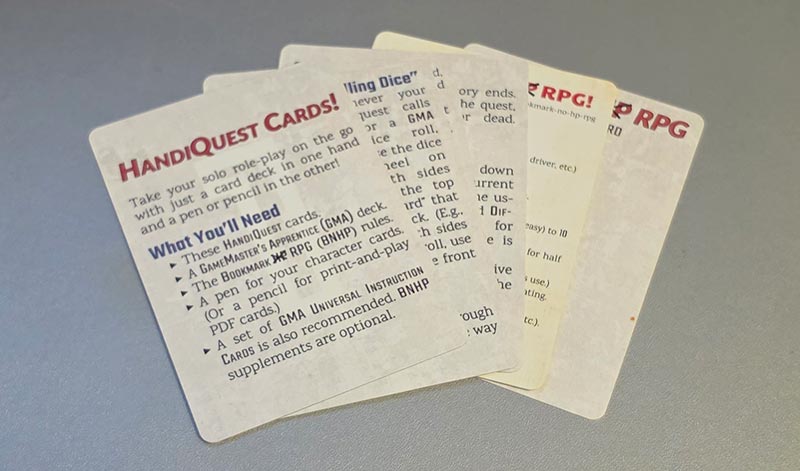
    This unfortunately-named solo ruleset comes with the Bookmark No-HP RPG Compleat Bundle on DTRPG, or can be purchased separately for a couple bucks. The system is printed on four double-sided poker cards, but you also need a copy of Bookmark No-HP RPG (BNHP) and some variety of the Gamemaster’s Apprentice Deck (GMA) to play. That makes this the Avengers of game reviews.

    Part of this complete breakfast

    HandiQuest (heh) attempts to marry the random prompts of GMA with the simple play of BNHP to create a solo RPG experience that you can literally play anywhere. The rules don’t mention it, but I’d assume that if you’re playing a genre game (fantasy, sci-fi, etc.) with the BNHP rules, you’re expected to be using the generic GMA deck or a matching themed deck. Though as I think of it, playing e.g. sci-fi with e.g. the Age of Sail deck would certainly give it a unique flavor. Y’know what, I withdraw my objection. Mix ‘em up.

    N.B.: The rules assume you’re using physical cards for all this. It can be played very easily with a virtual GMA deck (like you get with Bundle of Holding deals) if you use a card randomizer app or the deck system in your favorite VTT. I’ve been using a free Android app called Custom Image Dice, which works quite well. You just need to figure out your own system to hold and/or count cards.

    Gameplay: To start a game, make a BNHP character, then cut the GMA deck. The cut card shows your ultimate goal in its Location spot, and the difficulty getting there in the Difficulty Generator spot on the other side. Take this card, invert it, stick it somewhere in the back half of the deck, and reassemble everything. This gives you a largish but random number of card pulls for your adventure.

    From here, the game has a definite rhythm. Pull the top card, select a Location from either side, and take the Difficulty from the other. This is your next waypoint. Draw a second card and use the prompts there to make up what exactly the main obstacle will be on your way to the destination. Then run the encounter. When you would normally roll dice for BNHA, instead draw cards for the Dice Wheel.

    If you survive to reach your goal, draw another card and look at the Likely Odds section. If most of the prompts are “No,” it’s an encounter; if mostly “Yes,” it’s a battle. Once again use card prompts within the scene to describe what you’re dealing with. In a battle scene, continue using the cards to make up an opponent and fight them. Encounters are more for imagination and storytelling. You can also rest after an encounter unless any of the prompts on the card are “NO!”

    On to the next. When you reach the upside-down card, it’s automatically a battle, but otherwise run it like other locations. Win, lose, or draw, the game ends afterward.

    If you want to make it an epic quest, shuffle and run through twice, first to find a quest item which you then use as a Trait or Vocation for your second journey.

    Pocket fit: HandiQuest by itself weighs nothin’, but everything you need to play makes it hefty. The minimum set of HandiQuest + BNHP rules + one genre card + GMA is ~70 cards, and a slip case is practically required if you don’t want your deck to get all dog-eared. You’ll need a pencil to keep track of your character too. C-.

    Legibility: Quite nice. HandiQuest uses a slightly chonky 11-point-ish serif font with bold sans-serif headers. It’s readable even from arm’s length. A.

    Completeness: Hm. Well, literally by itself, this game is F-tier unplayable. With BNHP and a GMA deck, it’s about the same as BNHP itself, so I’ll crib from my previous review and give it a B-.

    Final thoughts: HandiQuest gives you the barest, barest minimum to play solo BNHP + GMA. Since it can only generate very standard “go here, do this, go there, do that” stories, it’s not the Ultimate Story Experience by any stretch. I dare say even a minimal story engine like Storytelling Mints has this beat on that front. It’s fine if you don’t mind galumphing around the countryside like a Dark Souls player for an hour or two, but it’s not really built for ultra-memorable, story-rich games.

    I appreciate it as a pack-in, but I wouldn’t recommend going out of your way to pick it up. One thumb passionlessly up.

  • RPG Review: ALONe Solo Game Engine

    RPG Review: ALONe Solo Game Engine

    I told you that story so I could tell you this one

    ALONe (an acronym for A Lonesome October Night … um … e) is a solo RPG engine built directly on top of the Gamemaster’s Apprentice Deck, both by Nathan Rockwood of Larcenous Designs. The original beta version of ALONe came out around the same time as the original GMA deck in 2015. Nathan finally decided to call ALONe “complete” in 2023, just in time for the second edition of GMA to come out and partially invalidate (or at least complicate) it.

    ALONe can either be played by itself or as a GM emulator mixin for another game system. When played by itself, all the themes, power levels, technology, magic, equipment, etc. come straight out of the player’s brain. Want to play a starving orphan child in steampunk Paris? Go for it. Want to be King Shit of the Universe, capable of destroying galaxies with your mighty butterfly kisses? Have fun, bud. The system expects you occasionally to be in some sort of peril, physical, emotional, or otherwise, to keep the story engaging. But hey, if you’re satisfied creating a narrative where you shout “And I win again!” a lot, nobody’s gonna yuck your yum.

    At last, a system that lets you play as the most dangerous and terrifying man in the world

    ALONe-on-its-own is designed for one player only. You could use it for GM-less group games, but the lack of power scaling can easily bite a group in the butt unless everyone thoroughly agrees what level they’re on. Using ALONe to run a separate system works somewhat more fairly since it engages that system’s checks and balances. There’s also no built-in system to ensure everybody gets their time in the sun, so you’d have to import a spotlight mechanic from elsewhere.

    Setting up

    Describe me like one of your French girls

    Preparing an ALONe campaign is a multi-stage process.

    1. Decide whether you want to do just ALONe, ALONe as a narrative engine combined with another system for its crunchy tactical morsels, or use another system for everything but the story. In the third case, the rules suggest skipping ALONe entirely and using one of the Gamemaster’s Apprentice Deck adventure guides instead.

      Using another game requires the player to do some lateral thinking. ALONe’s narrative engine relies heavily on Descriptors, like SPELLCASTING STUDENT, MASTER SWORDSMAN, DASHING ROGUE, etc. Using a different system requires the player to translate their character’s stats and abilities into these Descriptors so ALONe can play with them. The rules suggest things like translating a level 1 thief into ROGUE’S GUILD INITIATE and a high Stealth skill into BLENDS INTO SHADOWS. The player can also bring in character elements that the other system doesn’t cover, like BASTARD SON OF THE EVIL DUKE or MASTER OF THE KAZOO. It’s all the same to ALONe.

      If you’re not using another system, never mind. Move along to 2.
    2. Figure out your theme and your character. It’s all basic “Where am I? Who am I? Why am I here?” type stuff. This section includes a Mad Lib-like character motivation generator to get you started. If you can’t think of anything or don’t care so much, the back of the book has an appendix full of random character background/motivation tables.
    3. Gather your resources. This includes in-game resources like gold, weapons, and rations, and also Revision Points, which are ALONe’s meta-narrative currency. The player can spend Revision Points during setup to get more Descriptors, or use them in-game to re-draw a card, temporarily gain or edit a Descriptor, or trigger a story-altering Vignette, about which more later.
    4. Choose three initial Descriptors for your character. This might be disappointing for players who got all excited in phase 1 and came up with a dozen ways to describe their special unicorn OC. If three’s not enough, the player can buy extra Descriptors with Revision Points.

      There’s plenty of advice on creating Descriptors in this section. One thing that stood out to me was how they interact with the campaign’s concept. The example given is a vampire character in a campaign about hunting other vampires; in this case, “vampire” doesn’t really need to be a Descriptor, since that’s the campaign’s baseline. They still have the powers and everything, they just don’t stand out from the norm. If everyone they’re likely to meet is a normal human, however, VAMPIRE is definitely a valid Descriptor.

    Once the course is set and the main character is built, we can finally learn how to

    Play the Game

    Open up your mind and let me step inside

    Unlike those fools up Washington way, ALONe has some basic principles: ask leading questions for the cards to answer, seek inspiration from the cards rather than instruction, and don’t assume that what the cards tell you has the same ineffable weight as a GM. It’s a deck of prompts, not the Oracle at Delphi.

    Well now you tell me

    This bit, I think, is mostly here to help players who aren’t used to solo games get into a more active mindset. The cards may push your story like the wind, but it’s up to you to steer the ship. They report, you decide.

    The rules then describe a Stability/Tension system to help determine when random events occur. The player sets a Tension score from 1 to 10, with higher numbers indicating more hectic situations. Whenever they draw a GMA card for anything, they also look at the Difficulty Generator score on that card. If that number is equal to or less than the current Tension score, a random event occurs. Draw two or three cards and look at the Random Event Generator part to get a noun, a verb, and potentially an adjective. Then inject whatever you just drew into the story.

    That there and this here

    The Tension level can be set once for the whole game, decided per scene, or have a rising level that increases per draw until it triggers, then resets.

    The actual decision-making process is quite straightforward. Essentially, you couch what you want to know as a Yes/No question, decide your odds (bad, even, or good), draw a card for the answer, check the Tension level for a random event, and apply the results to the story. If you’ve ever used an oracle-based system before, this should be very familiar territory.

    Descriptors come into play when determining odds. Having a Descriptor which is advantageous to the current action (NIMBLE FINGERS while picking a lock, maybe) bumps the odds in your favor. A situationally negative Descriptor (HUGE DUMPY while squeezing through a small passage, perhaps) knocks them down. If various conflicting Descriptors apply, the player can either choose which one seems most important at the moment, or count up and down as they cancel each other out.

    A more complex point-based system exists for players that want more crunch, especially for mechanical questions like “did I hit the goblin” or, more importantly, “did the goblin hit me.” The player starts at zero, adds one point per each relevant positive Descriptor, subtracts one point per negative Descriptor, and adds or subtracts up to two points for situational bonuses/penalties. They then do that same calculation for their opponent. If both totals are equal or one point off, it’s Even Odds. Above that is Good Odds, and below that is Bad Odds. Flip the card and take your lumps.

    If this is the system you’re going with, the rules suggest adding a number to your Descriptors so you’re not, for example, trying to figure out how NOVICE SWORDSMAN, EXCELLENT SWORDSMAN, and LEGENDARY SWORDSMAN stack up against each other. Instead, just do SWORDSMAN (1), (2), or (3) and use that in your calculations.

    If you’re using a different system alongside ALONe, never mind all that mechanical stuff and use whatever they got.

    The Consequences of Your Actions

    Curse your sudden but inevitable betrayal

    While co-playing a different system, you most likely have HP/MP/Sanity/whatever to keep up with your current condition. By itself, ALONe doesn’t track any of that. Instead, failures impose either temporary conditions or negative Descriptors.

    On a failure, the player draws a card and looks at the Difficulty Generator. A low number indicates something brief and easily fixable, like dropping your weapon. A median number might impose a temporary Descriptor, like BLINDED BY VENOM, which requires special effort to mitigate during the scene but goes away once the combat is done. High numbers impose more grave, long-lasting Descriptors, like LOST A HAND or LEARNED DARTH VADER IS MY FATHER.

    Sometimes you may have trouble deciding what kind of consequence to take. There’s a handy random chart of effect types to help you figure that out, from confusion to incarceration to loss of motivation to good ol’ broken bones.

    Here we run into a minor snag: this random table, and many others later in the document, rely on the Tag Symbols from the GMA 1e decks. Thing is, GMA 2e does away with Tag Symbols in favor of a different random generator. Admittedly there are ten of these symbols and you could just use the d10 from the Dice Wheel for the same purpose, though not all tables have numerical indices. So you have to count rows. Like a commoner.

    Why I never

    An optional rule is the grandiosely named Doom of Damocles. This adds between three and five checkboxes to the adventure sheet. For every negative Descriptor the character acquires in-game, even a temporary one, check a box. If a Descriptor is cleared or mitigated, erase a box. When all the boxes are filled, your adventure reaches its bad end. Getting hit in the head with a sword is optional.

    The rules continue with tips on how to adjudicate combat, from brawls to mass battles, and a fairly long section on how to run social encounters without feeling schizophrenic by using random motivation tables for your NPCs. At times the social section gets a little overly specific, expecting the player to create unique reaction tables for particular genres or even for important NPCs. That all feels like work to me, frankly, but I know some of you sickos out there would get a kick out of it.

    Now that we’ve absorbed all that, here, on page 43, it’s time to discover

    How Everything Actually Works

    Our story is only just beginning

    So you thought reading all those rules meant you knew how to play? Ha! Think again! This section goes in-depth into concepts which so far we’ve only touched on: Revisions, Descriptors, Beats, Vignettes, and Downtime. Used together, these will hopefully help a player organize their random story into something coherent.

    We’ve already talked about Revisions and Descriptors. The rules go a little deeper here, like how to gain more Revision Points and add/change Descriptors as the story goes on, but nothing earth-shattering.

    Beats are units of story that start with a stake of some sort (e.g., you want or need something) and end when that stake is resolved (e.g., you get or permanently lose that something). There’s yet another random chart here to help spur the player’s imagination if it fails them. Beats are different from scenes, in that multiple scenes can occur within a Beat and/or a stake can be resolved in the middle of a scene and then either changed or doubled down on.

    Vignettes are chunks of narration that exist outside the rules and can change the story any way the player wants. This may sound enormously powerful, but that’s only because it is. If the player wants to take a simple snail herder and make her the God of Hamburgers, a Vignette can do it in a snap. Vignettes also cover flashbacks that explain how that latest setback was all Part of the Plan, which is why you happen to have the magic dingus that saves the day! What prevents Vignettes from turning the game into a Mary Sue fanfic is that they have a Revision Point cost, so you don’t have an unlimited number of them. If the Vignette would change the character’s Descriptors, you have to pay for those too.

    Downtime is where all the boring day-to-day stuff happens. If you want to quantify it, the player gets one Downtime Point and can buy up to two more with Revision Points. The more Downtime Points you spend, the more involved your off-hour actions become, from finding a safe place to hide (1 point) to founding a small-time crime cartel (3 points).

    On the Campaign Trail

    Vote early, vote often

    The concluding chapter goes into how to incite a campaign with random actions, plus how to generate your own random tables for your campaign. Bookkeeping gamers may enjoy this, but it’s not my bag. Building a table in the middle of running the game feels like filling out paperwork in the back of a speeding semi full of volatile Tripolodine.

    My patent papers are at a slight angle, Sam

    The rest of this chapter reiterates the Adventure Guide that comes with the GMA Deck nearly word-for-word. Select a Core, ask a Big Question, choose a Doom (not of Damocles), all that. I mean, it works, so there’s no reason to reinvent the wheel.

    The document ends with multiple appendices containing randomizers and examples of play. They’re fine.

    Final Thoughts

    Beyond the blue horizon

    I just wrote a lot. But that’s because ALONe is kind of a lot. The document is 84 pages long with the only picture being on its cover. As rules go, it’s a bit intimidating. It feels especially wordy when you compare it to the Gamemaster’s Apprentice Deck that fuels it.

    I’ll get my greatest complaint out of the way now: the document is poorly organized and badly edited. You must, must, read through the whole thing, cover to cover, to get the entire picture. Things are introduced without reference on page 11 that aren’t explained until page 46. There are several instances of “see page XX” instead of actual page numbers. The table of contents (and thank heaven we even have one) doesn’t show page numbers, only links. There are no PDF bookmarks. One form, apparently designed to be printed on one sheet, spills over to the top of the next page. For something eight years in the making, this is very … enthusiastically presented, one might say. Most of those problems could be fixed in an afternoon by a decent editor.

    That’s a shame, because what the document says isn’t so bad. Once you’ve put some brainpower and patience into untangling the rules, they fit together pretty well. The Tension system is essentially Mythic GME’s Chaos Factor without weirding up the odds. Personally, I also like how Vignettes let you course-correct the story (or fling it beyond Mars, if that’s your bent).

    Even there, though, it’s not all roses. ALONe wants you to engage with bespoke random tables a lot. But every time they tried to guide me to another table I kept glancing at the GMA deck, chock full of random prompts, just sitting idle. Use that, I thought. You made it too, Nathan. Have some confidence in your own brainchild.

    Anyway. ALONe has some good ideas poorly presented, a solid foundation that gets lost in its own weeds sometimes, and can be rewarding if you put in the effort to learn but requires more effort to learn than it should. Once you wrap your head around it, it’s a decent solo system.

    One and a half thumbs up for the system, but losing most of a thumb for the presentation.