Tag: Game review

  • RPG Review: This World Summons Too Many Heroes!!: Definitive Edition

    RPG Review: This World Summons Too Many Heroes!!: Definitive Edition

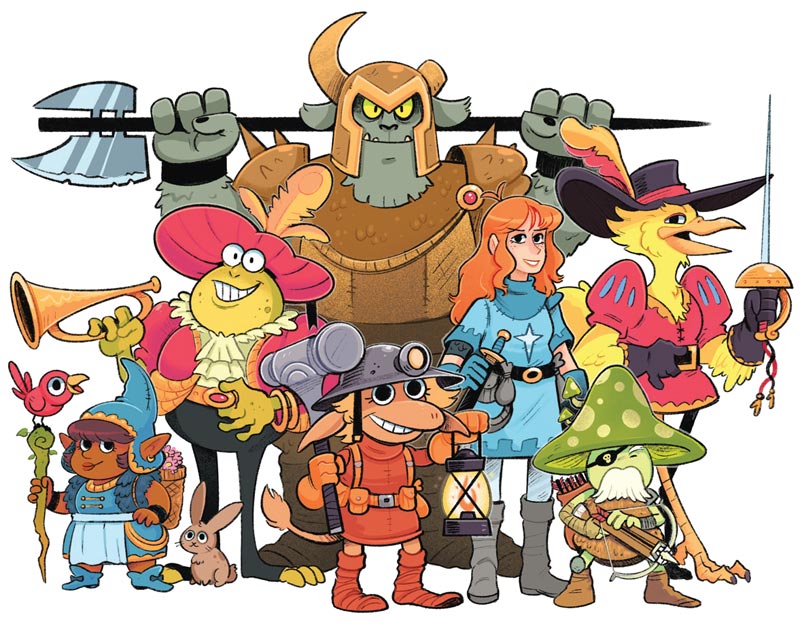
    Logo of the game "This World Summons Too Many Heroes!!"
    How many heroes is too many? … Ooh, yeah, less than that

    This World Summons Too Many Heroes!!: Definitive Edition (TWSTMH from now on, because I value my fingers) is a 2025 Kickstarter-funded compendium of the 2023 second edition of a 2021 RPG by Nick “Duffo” Duff. The Definitive Edition expands the original core rules and includes supplemental material written by Paul “Ettin” Matijevic, plus Tom Harrison and Joe Anderson from the Anime Sickos podcast.

    TWSTMH is an homage to/takes the piss out of otherworld isekai fiction like Konosuba, Re:Zero, Overlord, That Time I Got Reincarnated as a Slime, Uncle from Another World, Speedrunner Cannot Return from the Game World, So I’m a Spider, So What?, Reborn as a Vending Machine, I Now Wander the Dungeon, and a gazillion other light novels, manga, and anime that all have titles like that.

    If you have no interest in that stuff, this might not be the game for you. If, however, you’re amused by the concept of several hapless doofuses from 21st century Earth bumbling around in a medieval fantasy world with cheat powers, this might be the diversion you didn’t know you were looking for.

    Small note: Normally I like to break up reviews with masterfully captioned pictures from the game. I won’t be doing that (much) for this one, for reasons which will become clear.


    What a World, What a World

    A hero ain’t nothin’ but a sandwich

    A few years ago, the generic fantasy world of Ceria was having its shit pushed in by this generic fantasy villain fella called the Cryptlord. Powerless before the Cryptlord’s generic evil powers, the various generic fantasy kingdoms pooled their magical resources to create a powerful spell. Once cast, it would force Launrith, the Goddess of Resurrection, to pluck a person from another world, give him a super powerful magic Gift, and bring him here to fight their battles for them.

    Luckily, it worked out. Their reluctant hero, a man named Yuya Muto, had the Gift of creating spell scrolls out of thin air, which allowed him to become the greatest spellcaster and sage the world had ever seen. With this mighty power, he managed to depose the Cryptlord. Then he promptly retired rather than taking his revenge on the people who yanked him out of his world, which may be the least realistic thing about this whole story. Maybe he’d been something unpleasant in his previous life, like an advertising copywriter or IT professional.

    Before running off, Muto told the assembled kingdoms that he would leave them with the means to save themselves in case another generic overlord might appear. He used his Gift to create hundreds of scrolls containing the very spell which summoned him to this world, and left them in the care of his closely trusted mage friends with strict instructions to only use them if absolutely necessary.

    So of course almost the second Muto vanished, war broke out between the kingdoms to gain control of these scrolls. Soon whole caches of them had fallen into the hands of petty monarchs with scores to settle. Soon after that, the world became littered with summoned heroes who have been tricked, brainwashed, or threatened into fighting each other. The world now shudders before their mighty conflicts, yet Muto is nowhere to be found.

    The PCs, as you might have guessed, are recently summoned heroes as well, given the task to contain any unused scrolls, mitigate the damage done by their peers, find out what happened to Muto, and maybe (if they have time) see if there’s a way to get all these “heroes” back home and out of the natives’ hair.


    The Hero System

    Wait, not … that is … you know what I mean

    TWSTMH is based on the LUMEN rules system, or I suppose “Illuminated by LUMEN” because of marketing or something.

    Characters have three Attributes: Might, Mastery, and Mischief. Cute. Might is simple raw punch-’em-up strength. Mastery is the character’s “control of the situation,” which could be anything from aiming a weapon to making a plan. Mischief is stealth and trickery and making people believe your lies. All three overlap conceptually in weirdly fuzzy ways. GMs should be ready for arguments about which Attribute works in which situation.

    Players have 7 points to divide between these Attributes, which can be as low as 0 and as high as 7. This number determines how many d6 they roll when attempting a relevant feat. (They still roll one die even if the Attribute is 0.) The outcome of the roll is determined by the highest die rolled. If it’s 2 or less, they fail with a consequence. On a 3 or 4, they succeed with a complication. If the high die is 5+, they simply succeed.

    The probabilities of success with this dice system shoot up very quickly. By the time you’re rolling 4d6, the chance of a failure is less than 1% while a full success is over 80%, and it gets even more ridiculous from there. GMs may struggle to keep things challenging. Since the PCs are supposed to be superhuman, though, it tracks.

    Characters also start with 8 HP and 6 SP (“Special Points,” which activate their Gifts).


    It’s Heroing Time!

    And then he heroed all over those guys

    To build your very own isekai hero, start by choosing an Archetype.

    • The Bystander: Whoops! You weren’t even supposed to be here today, but you were standing too close to someone else being summoned or were hit by Truck-Kun and got sucked into another world by accident.
    • The Demon Lord: Evil cultists summoned you here to rule the world, but you didn’t care for their vibe and you look terrible in black leather, so you dipped.
    • The Hero: You were brought to Ceria to defeat an ancient evil. You blew through that quest easily, of course, so now you’re just looking for something interesting to occupy your time.
    • The Myth: You’re never alone; there’s the spirit of a great Cerian hero or magic beast in your body. Once per adventure you can flip them in so they can wipe up the bad guys for you.
    • The Noble: You occupy the body of a previously existing high mucky-muck, who by all accounts was kind of a snot. Now you have to navigate their life and maybe make things better for the people around you.
    • The Reader: Ceria was the subject of your favorite book or video game in your past life, and you know more about it than even the people who live here.
    • The Reincarnated: Only your spirit arrived, without a body. Unfortunately the summoning spell doesn’t do “making a human body” very well, and you now have the form of something completely different.
    • Tragedeigh The Tragedy: You were summoned by someone very bad, who used you for very bad purposes. You managed to escape but now you have terrible scars and trust issues.

    Each Archetype includes a choice between two special background-style benefits. For instance, the Noble can choose either Disowned Heir (get better starting equipment) or Villainess (any attempt to bully people always uses your best Attribute).

    People who know the genre will easily be able to recreate their favorite tropes here, except one: the person who changes the primitive world with their encyclopedic knowledge of some modern niche subject (16th century castles, miso making, book publishing, WWI artillery, eclipses and other natural phenomena, etc.). Sadly, out of the box, you can’t save the world with your mastery of actuarial tables. Guess it’s not that kind of story.

    With Archetype in hand, it’s time to choose a starting Class. There are 26 different classes, from the mundane (Blacksmith, Brawler, Mage, etc.) to the exotic (Beast, Living Weapon, Phantasm, Vampire, etc.). There are also four extra-powerful classes, Magus, Sage, Champion, and Servant, which can only be acquired during the campaign at great expense.

    Each class gives a character two basic Class Abilities, plus a unique third depending on their highest Attribute. For example, the Blacksmith Class gives anyone who takes it the Metalwork and Signature Weapons abilities, plus Full Potential (spend SP to power up your weapon) if Might is your highest Attribute, Mana Forging (able to create magic weapons) for Mastery, or Cursed Weapons (able to create and wield jinxed weapons) for Mischief. The player gets to choose if the character has two equally high Attributes.

    Leveling up either unlocks one of the other Class Abilities or increases the power of one you already have. For instance, the Blacksmith above could change their Full Potential ability to Full Potential+, either doubling its damage, halving its SP cost, or increasing its area of effect.

    Multi-classing is possible if the character buys a class treatise to learn a new class. Common class treatises can be found in any town, but the more rare and powerful classes may require some questing to find. No matter how many Classes they have, a character can only have three Class Abilities active at a time by default. Known abilities can be swapped around freely outside of battle.

    Happy birthday, it’s time to receive a Gift. The Gift a character receives depends on their highest Attribute, and the rules encourage rolling them randomly. Each character only gets one Gift and can never gain another.

    Gifts are, frankly, super powers. There are 36 enumerated Gifts, but GMs and players are encouraged to come up with others if they think of something interesting. Here’s a smattering of the examples given in the book:

    • Phantom World: Your starting weapon is also the key to a pocket universe where time passes quickly and you are immortal. In this pocket world is the spirit of a great hero who will train you and give you advice.
    • Mindfreak 100: Every time you do damage, tally your attack rolls. When your tally reaches 100, your next attack does +100 damage.
    • Invincibility Frames: Automatically avoid as many enemy attacks as the number of attacks you’ve made this turn.
    • Base: You have a house or other dwelling which you call home. You can fast-travel there and back without casting a spell.
    • Shopping Channel: Freeze time to enter an interdimensional supermarket where you can purchase anything you want.
    • Exposition Fairy: A tiny creature which only you and certain monsters can see will follow you around and tell you all kinds of hidden secrets about your opponents.

    People who regularly consume manga/manhua/anime/video games will quickly pick up what the game is putting down. Others would at least agree that these are some powers, all right.

    Lastly, a new character receives their Weapon(s), as determined by their Class choice. Weapons are semi-abstracted into the categories of Small Melee, Large Melee, Ranged, Tomes for spellcasters, Unarmed, and Shields. Weapons also have at least one Tag to customize them. Some Tags increase damage under certain circumstances, like a +1 when wielded by a Mischief hero, or have special effects, like paralyzing enemies anytime you roll doubles. Weapons can be enchanted with more Tags if you can find an enchanter and spend the required cost.

    Tomes are the basis of the game’s magic system. Each Tome contains one fairly simple spell, and anyone can use it. Certain Classes can also unlock Ritual Spellcasting versions of each Tome’s spell, which requires spending SP and making multiple Attribute checks. The Ritual versions are far more versatile and powerful, however, so it’s usually worth the effort.

    For instance, a Fire Tome can be used by anyone to poof out a small bolt of flame which does +1 damage. Yawn. With Ritualized Spellcasting, however, a caster could use the same Tome to create a wave of flame which sweeps over the entire battlefield, doing 2 damage per round to all enemies for 5 rounds. Decidedly not yawn.


    Fighty Bits

    Heroically punching helpless goblins in the throat

    Fighting evil in TWSTMH is your usual affair of going around the table, choosing a target or targets within reach, and attempting to thump them. Initiative order is up to the players.

    One interesting peccadillo is, if a PC rolls 4 or less on their action, one of the enemies takes an action immediately afterward, before the next player gets a turn. That doesn’t necessarily need to be the enemy that PC is fighting, either. After all the players finish, the GM gets three more actions for the enemies to take, rolls Drops (HP, SP, or Materia) for each enemy defeated that turn, makes any changes to the battle (introducing reinforcements, changing the terrain, etc.), and then the process loops until one side is out of the fight, one way or another.

    The GM-us interruptus nature of gaining an action on a player failure is an interesting mechanic in theory. However, it also incentivizes players to always use their strongest abilities, which could become dull or repetitive depending on the circumstances. The GM needs to stay on their toes and throw out varied challenges to keep things fresh.

    Battlefields are divided into three ranges, Close, Near, and Far. There’s no blocking movement, so characters can charge around freely. Positioning is general and theater-of-the-mind. It’s very very abstract. You just gotta vibe with it, man.

    Weapons and powers do set damage: all Small Melee weapons do 1 damage, Large Melee weapons do 3, etc. Armor is mostly not a thing, though Shields will always reduce damage by 1. Characters brought to 0 HP will fall unconscious and have their SP set to 0. Next turn, as long as any allies are still standing, they’ll reawaken with 1 HP.

    If all the PCs are knocked out in one turn, it’s a TPK. The characters reappear before the goddess Launrith and have to bargain for their lives. If and when they return, it’ll be without their weapons and possessions.


    Goddesses and Monsteresses

    Pantheism and You!

    The world of Ceria has several goddesses who oversee the world and their worshippers.

    Launrith, Goddess of Resurrection, for most of her existence, was a mysterious figure rarely thought of outside of births and funerals. After the hero-summoning scrolls put her front and center, her popularity exploded. Launrith discovered along the way that she loves the attention. Her personality has become bright, informal, and cheerful, almost like an entertainment idol, which scandalizes some of her older priests who preferred her all distant and spooky.

    Henritte, Goddess of Law, has directly placed the crowns on the heads of state for time immemorial. She also polices said kings to ensure they follow the laws of their respective lands. This doesn’t prevent the monarchs from being objectively awful, but as long as the laws allow their awfulness to flourish, she’s cool with it. Henritte holds regular god-meetings so they can all discuss the best way to administer their power. Her sisters rarely attend.

    Mellennia, Goddess of Drink and Festivities, has another title: Mother of Monsters. Mellennia has a dozen children with a variety of powerful beasts, like dragons, giants, elementals, and worse and weirder still. The Cryptlord was (secretly) one of these, in fact. In her mind, Mellennia’s demigod spawn were supposed to be the true rulers of this world, and she’s not happy that plain little Launrith’s heroes are stealing her thunder.

    Cloe, Goddess of Secrets, is a recent addition to the upper god pantheon after Muto banished their previous fourth member, Death, back to the underworld. Cloe is obsessed with hiding objects of power all over the world, and is the source for a lot of the treasure chests and magic items heroes might find in otherwise empty 10’x10’ dungeon rooms. She particularly enjoys hiding hero-summoning scrolls where the weirdest people might find them.

    There are several other minor gods and goddesses about, but Raphaelle, Goddess of War and Chaos, is a real up-and-comer. Henritte’s younger sister, Raphaelle likes to disguise herself as a human and sow discord wherever she goes. She dreams of a day when every kingdom uses their remaining summoning scrolls all at once, bringing a great war which will transform the world.


    People, Places, and Things

    That which is seen

    The book goes on to describe a number of realms around Ceria. Some of the more interesting ones are:

    Checkout: Deep in the frozen north, there lies an enormous, twisting, non-Euclidian supermarket. Many believe it was the Gift of a summoned hero. Now that hero is gone, but the supermarket remains, and has become home to multiple communities of raiders, scavengers, and cultists who sentence shoplifters to gladiatorial combat at their brutal Food Court.

    Prosperity: A summoned hero had the Gift of 10% Commission, which he used to become quite wealthy. Merchants and kings begged him to use his Gift to their benefit, and everyone became stinking rich as a result. Unfortunately he was tricked by the goddess Raphaelle into being unable to use his Gift, and now the only thing that keeps all his deals afloat is mounting loan debt. The hero will beg the PCs to help him find the stolen object which will restore his Gift. If they can’t, the entire kingdom will fall to financial ruin.

    Volkovia: A bustling factory town full of skeletons and zombies, all working under the Gift of a summoned necromancer Demon Lord-turned-hero. The living people here relax and enjoy the fruits of undead labor. Other necromancers think the summoned hero has made necromancy boring, and skulk about painting graffiti on the walls like gangs of pouting mall Goths. Despite the peoples’ distrust of the undead after that whole Cryptlord business, the ease of life has won most of them over. This area is surprisingly peaceful. Smells a bit though.

    Each realm has its own set of NPCs and monster mobs. The following chapter gives thorough descriptions of the more important NPCs, including (for the first time, here on page 70 of 122) illustrations. I hadn’t realized how much I missed having incidental pictures until we got a few. I mean I wasn’t bored per se, but it just kinda startled me that it was even a possibility. And while I’m usually the first one to poo-poo extravagant page-wasting art, there’s a difference between big multi-page spreads and occasional line art to break things up.

    Sadly, the pictures abruptly stop after page 77, and there are only three more pictures in the whole rest of the book. Ah. What might have been.

    A kind of spiky fangly dude with a spear
    FOUND ONE

    (Addendum: After some research, I learned the lack of imagery is due to the Kickstarter not reaching its stretch goal for full internal illustrations. I’m totally sympathetic on that front. It’s still kind of a shame. Even a little more would have gone a long way.)

    The book continues with over 40 mob, monster, and minor NPC listings. These run the gamut from your typical wolves and skeletons to feral catgirls and giant enemy crabs. Some mobs are gathered into groups which the GM can drop in to give the PCs some instant rivals to vie against. My favorite is the Egg Boy Gang, a group of bandits led by a juvenile dragon who has yet to break entirely out of its shell, so it’s just an egg with two feet sticking out.

    Stat sheet for Egot, the Dragon Egg that Walks Like a Man
    “Breathe fire out the leg holes” is my new favorite power

    NPCs and monsters can also gain Class Abilities at the GM’s whim, either to fill them out or shake them up. There’s not a lot of guidance in this, so it’s possible to inadvertently make something overpowered for an encounter. The flexibility is appreciated, however.


    The Frame of the Campaign

    Falls mainly on the plain

    The book wraps up with two mega-adventures that could well be campaign outlines. These were previously published as additional supplements which Nick (do you mind if I call you Nick?) has kindly bundled in with the Definitive Edition.

    .Dungeon//Tower, by the Anime Sickos guys, outlines a 99-story dungeon tower which was the Cryptlord’s base of operations before he himself became … non-operational (pinky to corner of mouth, wry smile). Once the major threat was past, the tower became a popular location for newbie adventurers to grind its infinite monster spawners for XP.

    Everything was hunky-dory until a group of heroes made it to the top floor and slew the main boss. This caused a cascade of magic energy to flow through the entire tower. All the monsters suddenly powered up, trapping dozens of lowbies in a dungeon way above their level. This became known as the “New Game+ Incident.”

    This supplement suggests skipping past a lot of the boring dungeon exploration and getting straight to the boss fights, which include such iconic villains as The Bird Which Is Too Big, the Glitched Protagonist, and Slingo da Blue Mage. Then there’s Mr. Gun. The kobold who found a gun. And will shoot you. With his gun.

    Season of the Sage is more of a traditional adventure. The PCs are hired to find a lost caravan which was carrying a summoning scroll, along the way discovering a grand conspiracy which involves goddesses, the lost Sage Muto, idol concerts, chaos demons, ninja, and even more silly things.

    Both of these supplements are fun in different ways, and show off how a TWSTMH campaign can unfold in this weird-ass world. .Dungeon//Tower is by far the goofier of the two, and also the least focused. The Dungeon Tower is more a setting than a storyline. It’s mostly up to the GM to find a reason for the players to enter this cursed place. On the other hand, Season of the Sage has, like, a plot, and is set up like a proper intro adventure with motivations and everything.


    Thoughts and Prayers

    My Goddess Can’t Be This Cute?!

    And that’s it.

    Presentation-wise, the game is workmanlike. Previous editions are somewhat infamous for their questionable design and Comic-Sans-like font choices, but the Definitive Edition is quite legible, even approaching the level of attractive, thanks to a bang-up layout job by Ettin. Too bad about the art situation. Darn capitalism.

    Content-wise, there’s quite a bit here, a lot more than you’d expect from a high-concept comedy RPG in fact. Locations and NPCs, from goddesses all the way down to a kobold with a gun (who will shoot you, with his gun), all come with a passel of motivations and story hooks. Of all the parts of this game, I think the world as presented is surprisingly my favorite bit. It’s not always consistent, but it’s consistently entertaining. What more could you ask for really.

    Rules-wise, it’s LUMEN with some extra stuff bolted on. It can be a little clunky but it mostly works. I guess that’s better than some games. It helps that most isekai fiction has a very video-game-y veneer to it already, so a simple mechanistic ruleset works in its favor.

    Gameplay-wise … that’s the deal, isn’t it. The player experience will depend heavily on their understanding of the underlying trope and/or their willingness to go along with the gag. In practice, I can see the base game feeling something like Drawn Together, where you put several similar but disparate character types in a pressure cooker and see what happens. If you’ve ever wondered how the Shield Hero might interact with Bakarina, then (thrusting hands palms-up toward you) there ya go.

    The humor of the setting mostly lands. .Dungeon//Tower really pulls out the stops on the wackiness. Everything else is vaguely more grounded (as much as a game like this can be anyway). Despite a few slight nods to dark anime tropes, the game remains positive and aboveboard, and very much discourages anything really awful like slavery and incest and the other stuff that gives some stories in this genre a bad name.

    As a celebration of isekai craziness, this game works. As an actual game, it’s fine. To really have fun, you have to want what it offers. If you’re into that, I can totally recommend it.

    One-and-three-eighths thumbs up.

  • RPG Review: Land of Eem

    RPG Review: Land of Eem

    Twelve thousand rhyming puns incoming

    Land of Eem is a 2023 TTRPG from Ben Costa and James Parks, who also authored the Rickety Stitch and the Gelatinous Goo graphic novels and Dungeoneer Adventures YA books which the game is based upon (neither of which I’ve read, so I’m coming into this totally blind). The game is published by Exalted Funeral.

    I’ll be up front about this, since you may have read other reviews (and how dare you): most everybody, including the developers, refers to LoE as Muppets meets Lord of the Rings. And while that’s fairly apt, I think it’s closer, tone-wise, to say it’s as if the Fraggle Rock cast were let loose in the world of The Dark Crystal. Either way, this has Jim Henson’s stink all over it.


    What is Eem?

    Full Eem ahead

    One must remain civilized even in such uncivil times

    In broad strokes, the multi-cultural land of Eem was once bright and amazing and full of magic. Then came the Gloom King, whose undead armies toppled the bastions of civilization and ground the world under its heel. Finally an alliance of heroes and wizards rose up and destroyed the Gloom King. Over the next several hundred years, Eem began to heal.

    That healing lasted exactly as long as it took for capitalism to appear. A Goblin king ascended from his underground domain in pursuit of a simple yet compelling idea: If we rip everything of value out of the land, we can make a butt-ton of money. This king employed thousands of the native folk from the southern Eem province of Bogswain to dig and chop and raze and generally despoil everything they could. However, the Goblin king didn’t have a firm grasp on his hirelings. Soon several tycoons rose up among the locals and snatched back the reins of power.

    Still, there was money to be made. The tycoons built huge Corporations which raped the land with never-before-seen efficiency. In so doing, they began to dig up artifacts from the previous shining eras of Eem history. This led to what is now termed the “Dungeon Era” and the rise of the dungeoneers. Some of these adventurous souls want to keep the artifacts safe as treasures of a bygone era. Most, though, just want to sell them and become filthy rich. (Emphasis on filthy.)

    Today, Bogswain is more commonly known as the Mucklands, a ravaged area largely stripped of anything beautiful. In all quarters, ramshackle mining machines using sputtertech and sparkwork chug and grind and smoke and squeal. Many of the native folk are slaves to corporations in all but name. Worse than all that, rumors have begun to surface that the Gloom King has returned.

    It is a time of despair and decay and impending doom. Who, the people cry, will save them? Who could be brash and bold and, frankly, dumb enough to become the heroes the world needs?

    :: looks directly at the PCs ::

    Who?


    Rolling the Dice

    Eeming the Cube

    LoE uses a simple d12 dice mechanic, because, as the developers said at the time, there aren’t enough games centered around d12s. This was before Daggerheart came along and made them all anyone could talk about.

    When a player wants to do something, the GM can call for a Check. This is just a 1d12 roll plus a skill + circumstances modifier limited to between -3 and +3. The result of the roll is a complete failure for 2-, fail with a plus on 3-5, success with a twist on 6-8, regular success on 9-11, and complete success on 12+. The GM is the ultimate arbiter of what each result means, but player input is encouraged. The game stresses that you should only roll a Check if the action is consequential and advances the story.

    If a player wants to do something really out there, like a common Boggart trying to rip a full-grown tree out of the ground with their bare hands, the GM can tell them before they roll that that action will have a limited outcome. That way, even if they do succeed on their roll, the GM can say they just managed to rip off some bark or a branch or something.

    This is also yet another game that yoinks Advantage and Disadvantage (roll twice etc.) directly from 5e. It spices things up a bit with Proficiencies and Deficiencies, which are permanent Adv/Dis a character may have on certain actions. For instance, the frog-like Bogrils may have Proficiency in Leaping Over Chasms, a circumstantial use of the more generic Nimbleness skill.

    Since rolling 1d12 gives a flat distribution, the midrange “Success with a Twist” result will always have a 25% probability of showing up no matter how good or bad you are. When you get up toward the +3/-3 area you’ll start clipping the higher and lower ends, and along the way you’d be eliminating either the “Complete Failure” or “Complete Success” possibilities entirely. Since the game is story-forward by nature, and there’s no possibility of “welp, you failed, just sit on your butt until next turn,” this isn’t particularly bothersome. But it’s worth keeping in mind.


    Building Characters

    There is no “I” in Eem

    First, consider the kind of character you want to build, then select a Class. There are six (though in most cases, realistically just five) Classes:

    • Bard – Charisma personified, party face, buff generator
    • Dungeoneer – Treasure hunter, minion master, Temu Indiana Jones
    • Knight-Errant – Gallant swordsperson, cavalryman, party tank
    • Loyal Chum – Samwise Gamgee. Pretty much it right there.
    • Rascal – Skulker in the dark, disguise maven, confidence trickster
    • Gnome – Party mage. This Class can only be taken by Gnomes.

    Your Class sets your base Courage Stat (see below) and your Dread Die (see further below).

    When you select a Class, you have a couple of choices to make regarding what kind of character you want to be. For instance, the Loyal Chum selects another party member to be their Best Chum, and has to decide whether they’re a Share the Load type, Lighten the Mood type, or Take the Hit type, each choice giving their own special bonuses for their Best Chum only. They must also choose a Handicraft from Cooking, Building, or Alchemy, which allows them to create unique boosts for the whole party.

    Class selection includes two Abilities (essentially unique character powers) at level 1. For instance, the Knight-Errant gains Wayfarer (invent details about the surroundings) and Inspiring Orders (which boosts party rolls or healing).

    The more interesting thing about Classes is how they level up. When you spend the XP to go up a level, you gain two new Abilities but you have to drop one Ability from the previous level. So your Knight-Errant at level 2 gains Tactical Combat and Feat of Strength, but has to drop either Wayfarer or Inspiring Orders. At level 3, they gain both Discerning Eye and Sworn Protector but have to drop one of the level 2 ones. And so on.

    It’s a bit weird conceptually, but I can see that they’re trying to give plenty of options while not loading characters up with Abilities to the point of becoming insanely powerful. While it may be occasionally disappointing, especially if the previous level had two Abilities that seemed equally good, you do still get two new toys to play with. And when it’s time to level up again, usually you’ll already know which one you like better.

    Next we determine our four Attributes:

    • Vim – Charisma, intuition, spirit
    • Vigor – Strength, fortitude, fitness
    • Knack – Agility, dexterity, stealth
    • Knowhow – Intelligence, wisdom, knowledge

    Now, these are some cute names. They’re easy to remember and just whimsical as all get-out. But the English major in me feels like he must stand up and loudly declaim that that’s not what “vim” means. “Vim” is a synonym for “vigor.” It’s nowhere near what you’re using the word for here, designers. Even if you squint! Words MEAN things!

    Okay, I’m done.

    … Playing fast-and-loose with “knack” there, too, duders.

    Okay, I’m really done.

    So anyway, you take these Attributes and distribute an array of +2, +1, 0, -1 among them.

    Your four Attributes are used to help calculate your five Stats:

    • Courage – Used to resist Dread. Determined by your class and modified by Vim.
    • Attack – Used to bonk things. Equals your Vigor.
    • Defense – Used to resist being bonked. Equals the inverse of your Knack (e.g. +1 Knack equals -1 Defense).
    • Quest Points – Spent to activate your special Abilities, or give a +1 bonus to Checks post-roll. Equals 3 + your Knowhow.
    • Inventory Slots – How much equipment you can carry. Equals 20 + your Might and Vitality Skills (see below).

    Each Attribute is the basis of four Skills each. Vigor, for instance, is the underpinning for the Athletics, Might, Intimidate, and Vitality Skills, which all equal the base Attribute to start. As the player receives XP, they can add points to each individual Skill, to a maximum of +3. The player then takes one point each from one +2 and +1 Skill, and adds them to one +0 and -1 Skill.

    Now we select a Folk (a.k.a. race / species / heritage / other non-offensive term). Here’s where Land of Eem’s rubber really hits the road. People disappointed by the paucity of Classes will have their brains expanded by the list of sixteen different Folk types. So let’s get to it. Deep breaths. Here we go.

    Group shot!

    Boggarts: The most populous Folk in the Mucklands, and the area’s original inhabitants. Technically related to Goblins, but less generally pointy. Boggarts come in many sizes, shapes and colors, averaging around Human sized.

    Boggles: Little guys with pointy noses and ears; like Goblins, but smaller and more mischievous. Tend not to be very brave, but are really good at running and hiding.

    Bogrils: Chubby, skinny-limbed frog people with clammy skin. Like to wander and are good at swimming and jumping. Tend about the same size or larger than Humans.

    Bugbears: Lotta similar sounding “B” Folk, aren’t there. These are big ol’ shaggy guys with a vaguely bear-like demeanor. Not super pensive. Enjoy the simple life of farmin’, drankin’, and rasslin’.

    Gelatinous Goos: Become the slime you were meant to be. These are blobby translucent jelly-like fellows with no features, often bluish in color. Despite their lack of sensory organs, they can perceive the world just fine. They understand Folk Tongue but can’t speak it, instead having their own language, Gelatinous Gooese.

    Gnomes: Short magic beardy people, protecting what little of the natural world remains in corporate America Mucklands. Endearingly (and sometimes annoyingly) upbeat and honest. Often accompanied by an animal companion, like a squirrel or something. Can only take the Gnome Class.

    Goblins: Cousins of the Boggarts, with green skin and highly pointed ears and noses. Generally industrious and hard-working, almost to a fault, as you’d expect from the architects of the Dungeon Era. Just kinda regular folks otherwise.

    Humans: Surprisingly not the default Folk this time. They’re not common in the Mucklands, and the ones that hang around tend to live quiet lives. However, stories abound that Humans were once among the greatest heroes of yore, and some of them think they might be again …

    Imps: Little red winged dudes spontaneously generated by magic. Often conjured to be minions for evil wizards, but escaped Imps are neither particularly good or evil on their own, just clever and, well, impish. All Imps can at least hover with their wings, and some can actually fly.

    Mushrums: Small-to-medium ambulatory mushrooms. Being fungus-based, they can have some weird abilities, including telepathy with other fungi and the ability to spawn into two identical copies of themselves when they die. Not much of a sense of humor, though.

    Quortles: We’ve already had frog people, so why not turtles? Slow paced but well armored, they love living in lush green wetlands, and their closeness to the land makes them excellent alchemists and herbalists.

    Shryms: Furry, shrew-like Folk from a distant desert land, Shryms are born engineers and gadgeteers. They’re the ones responsible for all the sputtertech machines tearing up the joint, and are constantly tinkering with them.

    Skeletons: Extremely rare in the Mucklands, sometimes these former minions of evil necromancers will break free, regain some of their basic humanity, and become ordinary, skinless, gutless, regular Joes. Sadly, making friends remains a constant uphill battle.

    Welkins: Bird Folk. Come in a myriad of shapes and colors. All Welkins can fly if they’re not holding something in their hands/wings, though some are proficient in grasping things with their feet.

    Whalens: Humanoid whale Folk. Their thick blubbery skin gives them good durability, and their singing voices are very soothing. They do need to keep their skin hydrated, though, so many of them work as sailors or dockworkers.

    Wugs: Bigger beefier Boggarts. Indispensable anywhere that needs heavy lifting. They mostly choose to keep their ears open and their mouths shut, which some people think indicates simpleness, but they’re often sharper than you think.

    Each Folk has a list of Perks, which are usually Proficiencies, and Quirks, which are either Deficiencies, Skill minuses, or inconvenient role-playing bits. The players can choose one Perk, or take two Perks and one Quirk.

    Chosen your Folk? Good! Now select a Homeland. The Mucklands is (are?) divided up into various smaller regions, each with a list of local Proficiencies to pick two of, plus a unique set of starting Equipment. These Homelands include a magic forest, a vast swamp, a large urban area, a grassy wilderness, an area of lakes and rivers, a pirate-infested seacoast, the desolate wasteland known as the Used T’Be Forest, and subterranea.

    Finally it’s time for a session zero, where the players and GM will flesh out each character’s Backstories, Ideals, Flaws, and Personal Quests. By the end of this phase, the players will have created NPC Allies and Rivals for their characters, role-playing prompts which net their characters extra XP if they engage with them during a session, and some juicy character arcs which the GM can mine to their heart’s delight.

    The players then take a little extra time to establish Relationships with each other, and at last we can get to the adventuring!

    … Just as soon as we look at


    Equipment

    Eem of the crop

    More stuff! More! More!

    Your character has a number of Inventory Slots, usually somewhere in the low 20’s, determined during character creation. Now it’s time for them to earn their keep. Carryable items have an Item Slot value between 0 and 3 which indicates how bulky they are. Subtract those values to see how you fare. If you run out of Inventory Slots, you become Overburdened, suffering a penalty to Defense and a Disadvantage on Movement Checks. Some very large items have the Bulky tag and can’t be carried by one person.

    This slot system seems like an attempt to bridge the gap between sweating over every ounce you carry, and just hauling all your stuff around in Hammerspace. I’m not sure it’s entirely successful, because it still kinda feels like OD&D pound-tallying with extra steps. In practice, though, it’s rarely consequential after the adventure begins, and it does keep characters from carrying everything that’s not nailed down.

    Consumables (rations, coins, ammo, etc.) aren’t tracked individually. Instead, every time you use a significant amount, roll the item’s Usage Die, which is anything from 1d6 to 1d20. If you roll 2 or less, you use it up completely. Rolling higher than 2 instead reduces your die for the next roll, progressing from 1d20 -> 1d12 -> 1d10 -> 1d8 -> the minimum of 1d6. As long as you keep rolling above 2, you won’t run out. But 2 or less on any of these rolls puts you out of stock. (Ammo, luckily, is only rolled at the end of a battle rather than for every shot.)

    Personally I’m not a huge fan of this, even if it is tee-hee whimsical. Rather than keeping track of your item tally, you’re keeping track of your die level. And there’s always the disappointment of having 1d20 worth of arrows and blowing your load on the first engagement. Um. I mean. That’s never happened to me, of course, but can you imagine?

    Weapons inflict Dread on the enemy. The size of your Dread Die depends on your Class, not the weapon. For instance, a Bard’s Dread Die is d4 and a Dungeoneer’s is d8, so the Dungeoneer is simply more dangerous with any and all weapons than the Bard is. This also means that every weapon wielded by a character is equally deadly. This can be modified for things like two-handed weapons (+1 Dread), improvised weapons (Disadvantage on the Dread roll), Ranged weapons (Disadvantage to hit at close range), etc.

    Armor and shields, meanwhile, can reduce Dread taken, as well as other effects like Advantage on Resist Wounds and Defy Death Checks (about which, see the combat section). Heavier armors also confer Disadvantage on Movement Checks.

    Occasionally you’ll run across a Magnificent item. This is an item with a particular Trait, like [trusty] (can’t be fumbled or dropped), [precious] (sells for extra money), [mastercrafted] (Advantage on the relevant Check when using this item), etc. You can even find Magnificent containers, which increase your Inventory Slots.

    There are several random tables for Treasure Hoards, ranging from Loot Piles which contain some copper coins and a few other mundane bits and bobs, to Mythic Hoards overflowing with Magnificent magic items. GMs are encouraged to drop at least one Treasure Hoard in every dungeon and/or after a significant fight against a particularly deadly foe.

    Finally in this chapter, we find Crafting rules. Crafters must have/rent/buy the proper tools, including a forge for metal items, an alchemy set for potions, or cookware for food. Large or expensive items may also require the help of a hired crafting crew. The characters must gather sufficient inorganic Materials or organic Components to craft with, then spend the time to assemble their target item. At the end of the process, they make a Tinker Check on a variety of tables depending on the item they’re crafting. These result in anything from complete failure to accidentally crafting something Magnificent.

    The core book has over 20 pages crammed with tables and lists of Materials and Components, where in the Mucklands they can be found, and recipes for the items to make from them. These are not small pages with a lot of white space, either. It’s very, very impressive and very, very daunting to look through.


    Living the Adventure

    Eem me up

    Halfway through the core rulebook, we’ve finally reached the Adventuring chapter. Huzzah.

    We musta taken a wrong toin at Fleabag County

    Traveling in Land of Eem is a textbook sandbox hex crawl, with a big lovely map of the Mucklands for your players to mess around in. Each 24-hour period is divided into four turns, and the party can travel 1-2 six-mile-wide hexes per turn during the day or one hex per turn at night. Every turn spent traveling merits a Travel Check, with consequences including perilous encounters, bumps in the road (losing something, bad weather, etc.), uneventful travel, or discovering something new. If the players want, they can spend a turn exploring a hex rather than traveling, either to find something they need or just to increase their chances of a discovery.

    During the two night turns, players on the road are encouraged to make camp and rest. Each turn they can talk (increasing their mutual bonds), forage, keep watch, or just sleep. If they have the Tired condition, the only cure for that is a Long Sleep, taking up two consecutive turns. This is also their opportunity to heal, which requires both food and rest. The GM rolls for wandering monster encounters during this time as well.

    So you can already see there’s a lot of randomness here. Many choices include rolling on a table, which sometimes requires a roll on a second table for specifics. Get used to this pattern, we’ll see a lot of it going forward.

    The next section is Conflict. Conflict is not just Combat, which has its own section, but also everything leading up to the actual fighting. Despite its apocalyptic setting, Eem is silly and quaint, and often fighting can be avoided by talking.

    The first phase of Conflict is Parley. Anyone who wants to charm or trick their opponents can roll here. Adversaries have a Parley Rating between 0 and 2, which is the number of times they’ll listen to your pitch. If that doesn’t work, next is the Improvise phase, in which the players can take any action short of running away to deescalate the situation. If that doesn’t work, it’s time for phase three: Run. Whenever the group wants to scarper, the party member with the lowest Nimbleness Skill rolls to get away. If that fails, you’re in the soup.

    The better part of valor

    Combat itself is an extension of the rules we’ve seen so far. It takes place theater-of-the-mind style, using range bands to separate combatants. One quirk is changing the 1d12 success chart for melee combat to “critical miss – miss with a plus – hit with a counterattack – hit – critical hit.” That counterattack makes Eem combat particularly dangerous. Characters don’t have the wherewithal to really stand toe-to-toe with an adversary for long anyway, so giving them an opportunity to hit you in the middle of your own attack just makes it worse.

    Note that a counterattack also requires the adversary to roll on the same chart. This sets up the potential for a series of trading counters, almost like a duel, that at the end has both participants greatly depleted.

    Damage, as mentioned before, comes in the form of Dread. Dread can be inflicted in a variety of ways, not just combat, though only Dread received in combat can be reduced by armor and shields. Dread reduces your Courage Stat, which works much like HP. When Courage reaches 0, the character falls unconscious for 1d4 rounds and must make a Resist Wounds Check; on a failure they gain the Wounded condition, which inflicts -1 to all rolls until they receive medical attention or magical healing. Waking up, either at the end of the allotted time or by being awoken by another PC, heals their Courage by 1d6 + their level.

    If a character falls unconscious twice or more in the same session, they have to make a Defy Death Check, with consequences running the gamut from “take a heroic last action before dying” to surviving with a lasting injury.

    The book continues with a list of Conditions. Besides the ones we’ve seen like Tired, Overburdened, and Unconscious, there are many others with set game effects like Frightened, Poisoned, Burning, Prone, Engulfed, Entangled, and other fun things to do on a Saturday night.

    Last in this section, the book discusses Downtime. Between adventures, characters can indulge in crafting, gambling, infiltration, information gathering, merrymaking, performance, recuperation, research, training, or work, with a handy chart for each.


    Being Adversarial

    Eeming into the void

    The Adversaries chapter outlines them wot want ta bash ya. Adversaries come in three broad categories: Creatures (sapient beings), Critters (animals and beasts, which can still be vaguely sapient and may even speak in broken sentences, but can’t be reasoned with in the usual sense), and Creepers (unintelligent pests that are more like environmental hazards than monsters). Those devs sure do like using cutesy terms which don’t really fit, don’t they. Grr.

    Aaaanyway. Adversaries also come in three general classes: Goons, Bruisers, and Champions. Goons are the dumb weak minions, Champions are big boss types, and Bruisers live somewhere in between.

    What’s amazing is the amount of information provided for each Adversary, with not just stats and descriptions but full-color illos, social patterns, how they normally fight, and how they act in victory or defeat.

    This is one entire page

    Because of the enormous amount of space devoted to each monster, the core book only outlines 26 different Adversaries (though if you include classes there are more like 50). The separate Bestiary (Vol 1), which came with the Kickstarter, adds something like 200 more, all with the same amount of detail. Just nutso.


    Mastering Gamery

    We are the music makers, and we are the dreamers of Eem

    The Gamemaster chapter is probably the most normal part of the book, even though the first tip on the first page is “Make the Land of Eem feel alive and real and weird.” But the advice they give to do all that is solid, if unremarkable. All the greatest hits are here, like “be fans of your players but don’t be afraid to challenge them” and “offer the PCs difficult but interesting choices.” You know, the usual.

    There are sections singling out how to run Conflicts and Combats in interesting ways, including tips on running mass combat and vehicle combat. There’s also a page about random dungeons with a few tables to roll on to get started.

    But brother, if it’s random tables you want, you ain’t seen nothin’ yet. The GM section is followed/supplemented by:

    Appendix A

    (receding echo)

    Okay, you wonder, why am I singling out an appendix in this review? Well, mostly because Appendix A is 57 pages of nothing but random tables.

    Wandering intruder tables. Encounter tables. Loot tables. Curse tables. Books. Spells. Relics. Dungeon traps. Location aspects. Boons. Discoveries. Puzzles. Riddles.

    And often not just one table for each subject! No, encounter tables have a different table for every area in the Mucklands. The Location Aspects tables are split by location type. Some tables are so full of stuff that they require you to roll 1d200 (using a d20 for the tens place).

    They’re all like this. They’re all like this

    Much like the Bestiary, being confronted by this wildly insane amount of effort takes you to a place where you can only intense-clap like Orson Welles. Appendix A is simply a tour de force. Bravo, Appendix A. Bravo.

    If you don’t want to give yourself carpal tunnel by rolling, most of these tables are on the Land of Eem website as one-click generators. Talk about value-added.


    Sample Adventure: Wally’s Waffles and Rats!

    Eem park

    The core book ends with a smallish adventure which leads the characters into the basement of the local waffle house to locate the owner’s property deed. There they discover that the rats in the basement ate magic cheese which gave them intelligence, grabbed the deed, and dug through the wall into a vast underground labyrinth. As you might expect, hijinks ensue.

    Short as it is, the adventure has a lot of opportunity for role-playing, especially in the opening scene when they’re chatting with the weirdos in the waffle house. It sets a good tone for what an Eem adventure should feel like. Giant talking rats and all.


    Conclusion

    (clears throat, leans in very close to the mic, slight squeal of feedback) … Eem

    Temba, at rest

    Whew. Well.

    Land of Eem is certainly unique. Despite the simplicity of its rules, I’d call it deceptively … not complex, really, but thick. Just oozing with character and detail and obvious love for this strange broken little universe the developers have created. This was so obviously written by writers. I mean, yeah, I know. But this was written by someone who’d written, like, books, about what the game is about, even. It’s chock full of the authors’ mental comfort that comes from really living in this world.

    I may not be making sense anymore. That’s what this game has done to me.

    It’s very silly, and very cute, but in that hard, semi-grotesque, down-to-earth way that only the prime-time-era Muppets have ever been able to pull off. The artwork only doubles down on that. It’s a game about the world essentially coming to an end and yet staying brave and cheerful through it all, not in that ironic Rick & Morty clenched-teeth way, but straightforward and genuine and natural, almost cozy.

    Now where have I heard that term before

    It’s also easy to play, unusual for a game that’s 258 pages of small text. There are a lot of people online who talk about playing this with their kids. I can super-dig that. The developers just completed a Kickstarter for an even simpler version aimed squarely at young people, as well as a supplement for an entire subterranean campaign. If either of them even vaguely match the quality of the main books, they’ll be more than worth the money.

    Land of Eem is weird and silly and good. There’s a free preview even. Give it a shot.

    Two-and-a-third thumbs up.


    Unused Puns Table (1d6)

    1. Coming apart at the Eems
    2. Nothing is as it Eems
    3. I Eem, you Eem, we all Eem for ice Eem
    4. Inappropriate and un-Eemly
    5. It belongs in a mus-Eem!
    6. Eem Rules Everything Around Me
  • RPG Review: Nobi Nobi

    RPG Review: Nobi Nobi

    Purple Monkey Dishwasher: The Game

    Hot on the heels of my last card-based TTRPG review, another one just crossed my doorstep. Nobi Nobi (sometimes written with “TRPG” on the end) is a 2017 Japanese card-based RPG for 3-5 players, which recently completed a successful Kickstarter for an English edition by the game’s French publishers. Don’t think too hard about it. Anyway, after some delays, the cards finally have made their way into backers’ hot little hands.

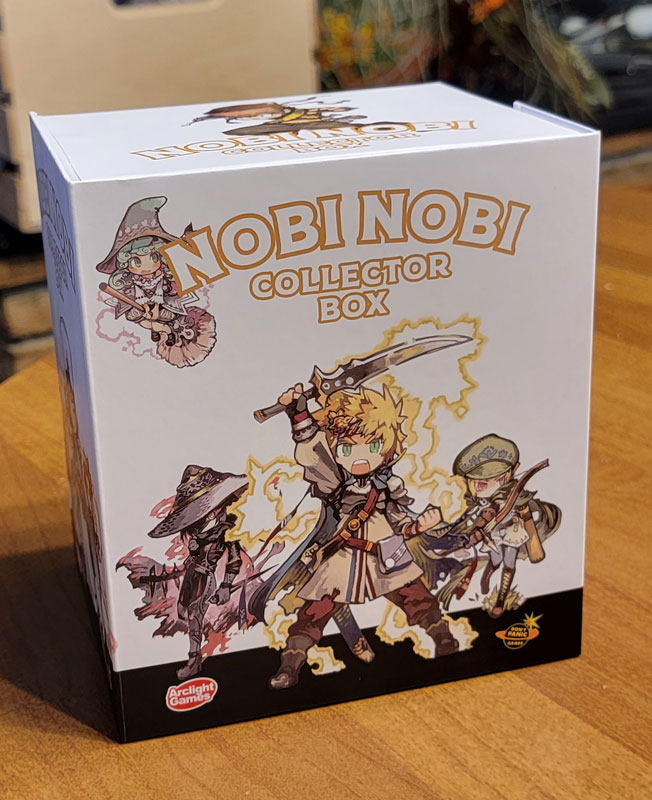
    Yep, that’s a box, all right

    “Nobi Nobi TRPG” is Japanese shorthand for “Novice Novice Tabletalk Role-Playing Game.” (“Tabletalk” is a Japanism for most role-playing-type games, since you talk at a table. Literal, ain’t it?) From the name alone, you can already see this won’t be Hero System levels of complexity.

    The Collector Box contains four standalone game sets, which they call “flavors:” Sword, Magic, Thriller, and Horror.

    Sword is your typical high fantasy pack, extremely medieval in tone. Fight dragons, get treasure.

    Magic slots right in next to Sword and has a penchant for wizards, magic schools, and evil necromancers in high towers.

    Thriller creates games somewhere between a gritty crime drama and the X-Files. The characters and prompts all have a modern-day flair, with Police Agents and Journalists and guns and computers and that kind of thing. One of the Introduction cards is Squid Game crossed with Saw. Very noir.

    Horror is also modern in tone and seems tilted toward creeping terror, encroaching madness, and weird dimensional shenanigans. Maybe a zombie invasion or two in there too. Not as many pumpkins and cackling witches as you’d expect, sadly.

    Boxception

    Each set contains:

    • A rules booklet
    • 8 character cards (6 for Horror and Thriller) with different characters printed on each side
    • One rules reference card (double-sided, but with the same rules printed on both sides for some reason)
    • One “GM” card
    • One “Main Character” card
    • One Opponents Table card, double-sided
    • One Objects Table card, double-sided
    • 8 Introduction cards (6 for Horror and Thriller)
    • 8 Epilogue cards
    • 40 Scene cards (32 for Horror and Thriller)
    • 20 Light cards (16 for Horror and Thriller)
    • 20 Darkness cards (16 for Horror and Thriller)
    • 6 six-sided dice (three light, three dark), colored with each box’s theme
    Pick a card, any card

    There aren’t any extra gewgaws in this game; no tokens or maps or meeples. You’re also not beholden to use just one genre per game. If you want to add magic to your sword game, for instance, just shuffle each set’s Light, Darkness, Introduction, Scene, and Epilogue decks together, let players choose from either box’s character cards, and then draw from the combined decks during the game. The downside is having to separate the decks out again afterward, which is really only a problem if you’re anal about keeping things organized (like me. eye twitch).

    Setup is as simple as “players pick a character card, shuffle all the decks, and put them in the middle of the table.” Bang zoom, we’re playing.

    Okay, But What Are We Playing?

    Frittered away by detail

    Here’s the entire game cycle of Nobi Nobi. Ready?

    1. Choose one player to be the first GM. Give them the “GM” card.
    2. The person to their left is the Main Character of this scene. Give them the “Main Character” card.
    3. The GM draws an Introduction card and reads it aloud. This sets up the whole general vibe of the adventure. Everyone lets that sink in for a second.
    4. The GM draws a Scene card and reads it aloud. It’s either a Skill Check card that can be resolved by a die roll, or a Role-play Challenge card that has to be talked out to the GM’s satisfaction.
    5. If the Main Character succeeds at either the roll or the role, they draw a Light card and add it to their hand. If they fail, they draw a Darkness card instead.
    6. The former Main Character becomes the GM and the player to their left becomes the Main Character.
    7. GOTO 4
    8. After three times around the table, the GM draws an Epilogue card and reads it aloud. The group combines their powers and accumulated cards and hopefully succeeds in the final challenge.
    9. The players all go home satisfied (?).

    It’s a slow game of Nobi Nobi that takes more than an hour from start to finish.

    While it’s simple enough even a caveman can play it, I’m ambivalent about the “GM/Main Character always passes to the left” rule. Some folks are just better than others at certain roles, and it would suck to have a dud counterpart through the whole game. Personally, I’d suggest that any group of 4 or more players should pass the Main Character card one extra chair down every time they complete a round, to ensure that everyone gets a unique pairing every turn.

    Nobi Nobi uses a simple 2d6 + Stat vs. Difficulty Number system to resolve Skill Checks. Different characters have special abilities which can alter this (see below).

    All the Cards

    Relax, guy, be vague

    Character cards are larger than the other cards, mostly to accommodate the cutely sketchy character art by game designer and “Love, Death & Robots” mangaka Takashi Konno. At least they have their priorities straight. Each character has two stats, Power and Technique. There’s no real balancing going on; some characters are obviously more powerful than others in raw stats.

    But they have a fantastic personality

    However, this imbalance is countered by each character’s Ability, a rule-changer that applies only to them. For instance, the Paladin gains +3 to any roll when facing an opponent in noble combat, while the Assassin automatically succeeds in any check, no matter how high, if they roll a 1 on either die. A few are goofy (but fun); the Samurai can drop five dice on their character card from a height of at least 10cm, and if any die comes to rest on the character portrait’s sword, they automatically succeed. Otherwise they fail.

    Ehh, I give myself a 60% chance

    According to the rulebook, Abilities are categorized as Solo, Assist, and Permanent. A Solo Ability can only be used while that character is the Main Character. Assist Abilities can be offered to the MC when it’s not your turn. Permanent Abilities are just blanket always-dos, like the Paladin’s +3 above.

    Note that I said “according to the rulebook.” The cards as printed also show two other Ability types, “Self” (which is obviously “Solo” and the proofreader goofed) and “All.” “All” is undefined in the Ability section, though elsewhere the rules state that only “Permanent” and “All” Abilities can be used during the Epilogue. So it’s a deliberate type.

    The most logical assumption is that “All” Abilities are switchable from “Solo” to “Assist” where applicable. But they really should have said something.

    Introduction cards are all broad-strokes adventure starters. The floor collapses beneath your feet, plunging the party into the deep dungeon. A mysterious benefactor approaches the party and offers great riches for a “simple” task. A terrible army appears on the horizon and only your group can stop it. You awaken in a twisty-turny set of passages, all alike. Everything else that happens in the game supposedly hangs from this skeleton.

    Test your might

    Introduction cards are open-ended enough that they funnel the game in a certain direction without saying “and this is exactly what’s going on.” This gives the GM an opportunity to fill in the details with …

    Scene cards are most of the meat of the game. Every time the GM mantle passes to a new player, they draw a Scene card, read it aloud, and try to work it into the story so far.

    Making an entertaining game session out of these cards super duper really depends on the players’ narrative chops. That’s true of any RPG, of course, but it’s especially true here. Scene cards run the gamut from “you have to stop the evil ritual” to “You are all in prison” to “you are now in a baking contest.” Often they’ll drop the group into a fracas in medias res. What bridges the ongoing story to this new predicament? The GM’s imagination and nothing else.

    Ow, my neck

    In a four-person, three-round game, players will deploy twelve random Scene cards. Coherence is almost always out the window before the end of round one as the game becomes an extended improv routine. If the players are good at that, and everyone’s dialed in, and the cards are kind to you, this has the potential — the potential, mind you — to be really wild or really funny or both. If not all the above is true, everyone will instead sit around sighing, “Okay what monkey cheese bullshit happens to us THIS time?”

    The rulebook has this to say about Scene cards:

    “Sometimes, the Scene card that has just been drawn will seem to have very little to do with the previous one. The GM’s task is to weave the scenes together into a story. It doesn’t matter if the connection seems far-fetched or forced; the most important is to make it creative. Don’t worry about the result; strange and unexpected connections sometimes make the most interesting stories!”

    In my Pocket Odyssey review, I was disappointed by how little guidance GMs got. So it’s pretty impressive to find a game that has even less. Bear in mind that everyone at the table becomes the GM, so everyone has the “honor” of wracking their brains trying to slap another hunk of random action onto the teetering plotline. This is neither a game for shy people nor story sticklers. Only the loosiest of goosies will prosper.

    Light and Darkness cards are what the Main Character draws at the end of their scene; Light if they succeed, Darkness if they fail. In a way, both types of card are level-ups, giving bonuses to stats (some quite hefty) or new Abilities.

    The main addition these cards bring are character beats. Light cards are full of bright positive things that the character either gains or reveals, like a vow of non-violence, a fancy new vehicle, or a famous family name that you must uphold. Darkness cards give your characters troubles like a gruesome reputation, awareness of a sinister plot (which may or may not be real), or a hopeless devotion to one of the other PCs. How these beats change your character are up to you and the GM du jour.

    What hurts you, blesses you

    Despite their names, both card types offer palpable mechanical improvements to a character, and never take anything away. “So what,” you may ask, “are the downsides to failing?” To which the answer is pretty much “Eff all.” I mean sure you’ll slowly reveal a dark past that makes you a grim antihero instead of a shining paragon, but that might be your kink. The game doesn’t judge.

    In truth, a couple of Abilities do synergize with these cards. The Necromancer from the Magic box gains power by having Darkness cards, for example. But the vast majority of the time it’s all just window dressing that the players and GMs have to make significant on their own.

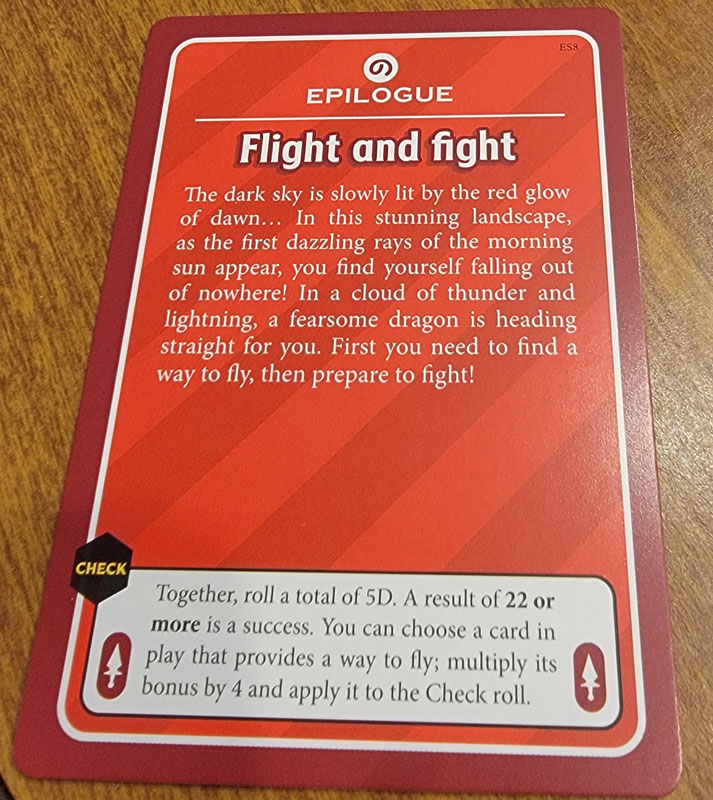
    Epilogue cards are drawn after the GM role has made three circuits of the table. They’re essentially Scene cards that involve the whole group. They nearly always drop the party into a huge predicament, and either everybody has to pass an individual check or the party has to somehow combine their powers to beat an enormously high check score.

    The chance that an Epilogue card in any way resolves the story of a typical Nobi Nobi game is so close to zero as to be negligible. There’s no thematic throughput from the Introduction to the Epilogue. It’s always just “Suddenly, CLIMAX!”

    We all go down together

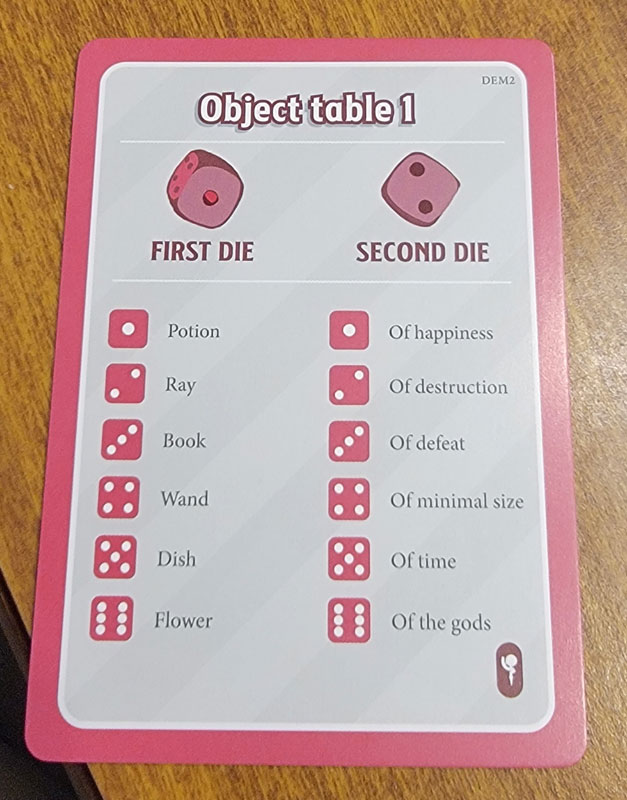
    Opponents Table and Objects Table cards are just there in case the GM needs to create a random NPC, monster, or MacGuffin and can’t think of anything off the top of their head. Roll 2d6 on a list and prepare to be inspired.

    “Wand of Minimal Size”? No need to get personal, sir

    Each box set has different cards, so if e.g. you need a potion, crack open the Magic box.

    GM and Main Character cards have “GM” and “Main Character” printed on them. Whee.

    Hello, My Name Is

    The Presentation

    Are you watching closely?

    The Collector Box slipcover is made of a laminated sturdy cardboard with a magnetic flap strong enough that it can be bounced around without worrying about it opening.

    Each individual game box’s quality is on the high end of standard. The thick laminated boxes are taller than the decks of cards they contain, but not quite tall enough to hold two full decks shuffled together. The boxes each have an off-center divider which holds half the cards snugly to one side, with enough room to hold the rest of the cards plus the dice on the other. That snugness makes it difficult to remove the cards without flipping the box over.

    The character cards are largish placards about 3 1/2” x 5”, while the playing cards are standard playing card size. Y’know, like you do. The finish is satin and adequately “grippy,” so the cards won’t slide around much.

    The rulebook is a full-color, 20-page, saddle-stitched pamphlet which just barely fits the box. Each set’s rulebook contains identical rules laid out identically, but the illustrations are all customized to fit the box’s theme, and they’re each printed in the color scheme of their box set. It’s nicely well-presented.

    There’s one unfortunate peccadillo. The font size on the cards and rulebooks is pretty small, and the text is sometimes printed over mid-range background colors in a way which is probably not ADA compliant. This makes the cards and rules hard to read sometimes, especially if the lighting isn’t perfect in your gaming area. People with visual impairments should be aware of this before picking it up.

    What is this, a card-based TRPG for ants?

    Conclusion

    The sooner we’re rid of it, the sooner to rest

    Nobi Nobi is a silly game. Full stop. It’s constantly at the mercy of the winds of chance. Good players can spin it into gold, but more mediocre players might butt their heads against its incessant randomness.

    Games have no danger. All characters are guaranteed to live through to the end. Someone who fails at everything will be able to stay even with (or even get ahead of) the guy who skates through every challenge. That would make this a good game to play with kids or novices (“nobi nobi,” to coin a phrase), but the kind of people who passionately argue for hours about “game balance” will pop a clog.

    I honestly don’t know whether I can blanket-recommend this game. It depends on who you play with and what everyone at the table is looking for. Personally I’ve had fun in the couple games I’ve played, but I’m a fundamentally silly person. I’ve also seen players report great frustration with it. That’s life, I guess.

    “It’s good for what it is, if that’s what you want” is the best I can do. One thumb, mostly up.

  • RPG Review: Pocket Odyssey (Collector’s Edition)

    RPG Review: Pocket Odyssey (Collector’s Edition)

    Give a cheer for all the broken

    Prologue: So. Know how you get weird Facebook ads sometimes? I kept seeing this one for a travel TTRPG product Kickstarter with drop-in maps and dry-erase tiles and magnetic map pieces and thought it looked sorta interesting until I learned it was $99 at the rock-bottom tier. But then someone in the comments said, “This is just an updated version of Pocket Odyssey” which sent me on a half-hour journey from Google, to rpg.net, to BoardGameGeek, to an ill-advised online impulse buy. So now I have this thing and I’m gonna review it. All aboard. Choo choo.

    Pocket Odyssey is a mostly-card, sometimes-dice, TTRPG-adjacent, 2-4 (2-6 for collector’s edition) player game by Anthony Sato, who as far as I can tell designed this game, another game called Dice Odyssey which never came out, and nothing since. Card artwork is by Xavier Saulter. The basic version was published in 2014 after a successful Kickstarter; the Collector’s Edition came out the next year. For a while this game was practically impossible to find except for people selling their used KS reward copies. Outland Entertainment picked this up for publishing in 2022; that’s where I got my copy, new in box. So it may no longer be the eBay rarity it once was.

    Let’s check out the game’s description on BGG: “Pocket Odyssey is a micro dungeon crawling game inspired by traditional table top RPG games. It takes place in the Dungeonfell, also known as the buried plane, with all but one player acting as a group of adventurers on a quest.”

    Not the most original setting, I guess, but still intriguing. What is this Dungeonfell? Why is it called the “buried plane”? Where are we? Why are we here?

    As it turns out, absolutely nothing about that exists in the game itself. No mention of dungeons, fells, or planes, buried or otherwise. All you get is cards, pieces, the basic rules, and a hearty “Figure it out yourself.”

    But I’m getting ahead of myself. Let’s take a look at:

    What’s in the Box

    Insert Se7en meme here

    The Collector’s Edition comes in a sturdy laminated cardboard “Box of Holding.”

    Full disclosure: I dusted the countertop just before this photo shoot. Good job, huh?

    Though the standard version comes in an actual pocket-sized 3” x 5” package, this box is around 5” x 10” and stands about an inch and a half tall. So right away the game’s name is wrong and the whole concept is ruined. Ruined!

    However, despite now having to wear cargo pants to maintain the theme, the bigger box is necessary to hold all the stuff you get.

    Let’s unpack all this

    Big thick cards (3 ½” x 5 ½”):

    • 28 map tiles (double sided)
    • 1 Rules Reference
    • 1 Name Card
    • 1 Newb Card

    Regular cards (about 3 ½” x 1 ½”):

    • 24 Background Cards
    • 10 Stat Cards
    • 39 Power Cards
    • 36 Baddy Cards (yes, the game calls enemies “baddies”)
    • 10 Flow of Battle Cards
    • 25 Hidden Power Cards
    • 18 Quest Cards

    Half-size cardlets (about 1” x 1 ½”):

    • 16 Personal Goal Cards
    • 20 Flaw Cards
    • 35 Loot Cards
    • 15 Marker Cards

    The cardboard tokens:

    • 40 Item Tokens
    • 80 Counters (printed “1” on one side and “2” on the other)
    • 20 Special Counters (exclamation point on one side and lightning bolt on the other)

    Everything else:

    • 1 six-sided die
    • 20 pawns (5 player meeples and 15 monster markers of various shapes and colors)

    Opening the box led to Game Niggle #1: When you first break into the shrink-wrapped card packs, you quickly discover that all the cards are shuffled together. Not even stacked by type but separable, but actively all mixed up. Note that while playing the game, you don’t mix the various card types. So prepare for a rousing 15-minute card sorting session before you even begin.

    While sorting, I quickly ran into Game Niggle #2: The cards are quite slick. The merest brush scattered my nice neat piles all over the place. The worst were the half-size cards, which aren’t heavy enough to hold themselves down to begin with. The game also doesn’t provide any way to keep the cards secure in the box, so a quick shake will undo all your hard work unless you hold each pile together with rubber bands or something.

    Because of the slippery cards, I definitely recommend playing on a surface other than a polished tabletop. A felt poker surface, place mats, even laying down a piece of cardboard, would make it much less likely to have your game suffer a sneeze disaster.

    So far, you’re probably saying to yourself, “Self,” you say, “this sounds more like the setup for a prestige card game. Chris must be hopped up on goofballs and posted this in the wrong section. Is this really a TTRPG?”

    First of all, right now I’m only high on Corn Nuts and Sprite Zero. And secondly, the answer is yes, this is 100% a TTRPG.

    … In a sense.

    Setup, Part One: The Storyteller

    There are a million random stories in the naked random city

    One player takes up the mantle of “the Storyteller.” This Storyteller deals themselves four random Quest Cards, chooses one to discard, and quickly gins up a three-act adventure outline using the remainder. This adventure doesn’t have to be particularly detailed, and the Storyteller is encouraged to worry more about setups than resolutions.

    Sure, I’ll get right on that, Chief

    Despite being what is essentially the cornerstone of the entire session, the rules for Storytelling make up two pages of the 32-page rulebook, one page of which is an example. The Storyteller is fully expected to vibe something together and then run with what the players do. It’s not quite zero prep but it’s a very close cousin.

    Pocket Odyssey came out four years after Apocalypse World. However, there’s not a lot of indication that Anthony was influenced by AW, or even much aware of zero-prep as a game style. I get the feeling that if he knew more about it, he would have couched his tips better for how to run a collaborative role-playing game session. As written, it’s more of a “toss you in the deep end” kind of thing. “Here’s some random prompts. Now make a story. Byeee!”

    Funnily enough, this lack of guidelines has little to do with the size of the rulebook. The full-color, 32-page saddle-stitched 4” x 8” pamphlet has a surprising amount of filler, including six pages of example gameplay, several half-page illustrations, a blank inside back cover, and a full-page ad for the designer-publisher’s website which has (according to archive.org) been dead since 2017. You’d think he coulda maybe thrown us an extra bone here.

    Of course, some GMs can run this sort of loosey-goosey game just fine. I dunno how easy it would be for a group of complete RPG naifs who found this weird card game and wanted to see what it’s about, though. As with most RPGs, it’s pretty clear the Storyteller has to have at least some experience and/or creative chops, or nobody will have much fun.

    Setup, Part Two: The Players

    Luck be a lady

    Player setup is more involved. First, each player is dealt two Background Cards and chooses one to keep. Background Cards have a generic title, like “Aelfen Blood” or “Charmer,” and a list of two to four special skills which that character can use at any time. For instance, the “Swindler King” card has “Burglary: You are a master thief picking both locks & pockets”, “Trick: Bending the truth for you is as easy as breathing air”, and “Street Smart: You grew up on the streets and know its ways.” Any time your character needs to perform an action, and as long as the player can make a case that the skill is applicable, their special skill makes things easier.

    Next, each player receives three Power Cards. Each card gives their character a one-time-use super ability, like Lightning Bolt or Entrapping Spores, which can change the tide of battle. The player can keep all three Power Cards and use each one once, or discard one or two of them to increase the number of times they can use one of the others. Power Card uses regenerate between acts.

    The players use chits to distribute three Stat Points between their three stats: Attack, Defense, and Special. Points in Attack are added to the player’s die rolls when attacking a monster. Defense increases the player’s Dodge Points, which we’ll explain in a bit. Special points increase the efficacy of Power Cards and other non-standard abilities. (If the powers on their cards don’t require a roll to activate, the player may not need to worry about their Special stat at all.)

    Players then draw one each of (deep breath) a Flaw Card, a Personal Goal Card, a Hidden Power Card, a Loot Card, and an item token. By the end, a typical player’s loadout will look something like this:

    Hey! It’s our old pal, Grim Freezy Mushroom Hypnotist Spellsword

    Flaws include things like Pyromaniac, Prankster, Overconfident, etc. The rules state that “this is how others would describe your character,” to give you an out in case you drew something you don’t want to play (and would rather spend the game going “I’m not narcoleptic, I don’t know where people get that idzzzzzzz”).

    Personal Goals and Hidden Powers stay hidden from the rest of the table until you triumphantly reveal them in the heat of the moment. A Personal Goal is a secret victory condition that every player is expected to achieve at some point during the game. These cards have a brief phrase like “Save a Life” or “Start a Fight.” The rules don’t mention what happens if a player doesn’t achieve their Personal Goal, other than this line: “In order to win the game, you must complete both the party quest AND Personal Goal Card.” So I guess if you don’t you just lose, like a losing loser who loses.

    Hidden Powers are a bit like regular Power Cards, but have a singularly OP effect that you can only bust out once per game. These are major things like “Life Pulse: You may revive a dead creature” or “Time Break: Freeze time for 3 rounds. You may act normally during this time. Frozen beings are invulnerable and you can only move items that aren’t being held.” How you can perform such miracles is up to you to explain. Or not.

    Loot Cards are, well, loot, like a Magic Wand or a Jump Potion. Some of them give extra abilities that you can use at any time, others are useful once per combat, and potions are always consumed upon use. Each player also has a 50% chance of drawing another Loot Card after each successful combat.

    Item tokens are cardboard chits with one-liners like “Bag of Keeping” or “Candle of 1000 Smells” on them. The player and the Storyteller discuss what exactly each item does and how often you can use them.

    Some item tokens are more esoteric than others

    Finally, players decide their characters’ melee and ranged weapons (which don’t have stats, so just choose whatever fits your concept) and pick a name. There’s even a handy Name Card which you can use to select something suitable, provided you have no imagination at all.

    What name means “uncreative dingus”?

    Sometimes you get a player who is either above drawing cards, only playing under protest, or is someone’s hyperactive little sister who will turn on the waterworks if they don’t get to play but would take longer to teach the game than everyone’s patience will allow. That player can take the Newb Card, which is a map-sized card with a selection of skills and powers already printed on it. Strictly speaking, the character printed on the Newb Card is overpowered, with 6 Dodge Points and a unique Luminary power which gives them Advantage on all die rolls. In practice, whoever gets this card is probably going to make a lot of bad decisions, so it all balances out.

    The first thing you may have noticed is that character generation is VERY random. Of its nine steps, only three involve meaningful player decisions. I found an old video review of Pocket Odyssey where the reviewer particularly hated the chargen, and suggested players should be able to go through the cards and choose whatever they liked the best.

    This is, of course, a terrible idea.

    Players play these characters for an hour and a half, tops, in what is essentially a pickup game. Minmaxing characters feels against the game’s spirit. Enjoy playing your Generic Merchant of Death, I’ll be over here having fun with my acrophobic half-elf with X-ray vision and the power to summon flaming monkeys.

    You thought I was joking

    Playing the Game: How to Do It

    Thanks, Jackie. That was great!

    Once you have all your cards and chits arrayed out in front of you, it’s time to play. Generally, the Storyteller will drop the party straight into the first act. The amount of exposition and background information is entirely up to the Storyteller, or they can rely on the players’ imaginations to fill that in for them. “The party wakes up in a prison cell. Considering your characters, how do you think you all got here?”

    As the players suggest actions, the Storyteller determines whether what they are trying to do is Normal, Hard, or Impossible. Normal actions, like climbing a ladder or opening an unlocked door, automatically succeed. Hard actions require a 1d6 roll and only succeed on a 4, 5, or 6, unless the character has a skill which covers the requested action, in which case they automatically succeed. Impossible actions automatically fail unless the character has a relevant skill, in which case they succeed on a 4-6 roll.

    This game also steals the concept of has Advantage and Disadvantage, which plays exactly like the D&D 5e mechanic: roll twice and take the high roll if the Storyteller says you have Advantage, or the low roll with Disadvantage. Usually a character will gain Dis/Adv based on narrative circumstances, like climbing a wall if you picked up a grappling hook in an earlier scene. Some special conditions can give a character blanket Dis/Adv, too, like being Blinded or Exhausted by items or monster powers.

    There’s no set turn order outside of combat. It’s all discussion, and it’s all up to the Storyteller to keep everyone engaged and prevent one person from monopolizing the narrative. You know the one. Why do we keep inviting that guy.

    Playing the Game: How to Do MURDERS

    Faster, pussycat

    Combat is slightly more formalized:

    The Storyteller chooses Map Cards and arranges them in the middle of the table. Most maps are meant to be set up in square groups of four cards, which creates a combat surface about 7” x 11”. The Storyteller also puts together a team of “Baddies.” Each Baddy has a level, and the Storyteller chooses (number of characters x 3) levels worth of opposition. That multiplier increases to 5 for the second fight and 7 for the climax. The collector’s edition has a healthy selection of 36 Baddy Cards. They’re mostly a generic mix of “we have D&D monsters at home.”

    Baddies prepare to do no-nos and owies to our heroes

    All the players roll a die, high roller going first, and play passes to the left. Each player also chooses a meeple color. The Storyteller divides the Baddies (ugh) into as many groups as there are players, and places markers on the map using the same colors as the players’ meeples.

    A wild geometric shape appears! Command?

    On their turn, players can make a short move and attack, a normal move and nothing else, prepare their ranged weapon to fire next turn, use a Power or Loot Card, Fortify (hunker down, gaining two temporary Dodge points until their next turn), or anything else that takes about 10 seconds.

    Movement is measured using the regular-sized cards. The short edge is a Short Move; the long edge is a Normal Move. Area effects are also measured using a card’s short edge from the epicenter. It’s a pretty clever piece of game design.

    You paid for the whole card, but you’ll only need the edge

    Attacking is a simple matter of rolling 1d6 and adding your Attack stat. Compare that number to the baddy’s Dodge + Buffer Health number. If you roll higher, the baddy is instantly slain. If you don’t, the baddy loses one point of Buffer Health. This combat attrition continues until the foe is defeated or they run out of Buffer Health, in which case they continue to use their base Dodge score until someone can roll high enough to put them out of their misery.

    After a player’s turn, the Storyteller attacks with all the Baddies that have the same color marker as that player’s meeple. Baddy combat flips the script, making the PCs roll 1d6 plus their current Dodge Points versus the Baddy’s Attack score. The PC’s Dodge Points go down one if the opponent misses, and they gain the Wounded condition if it hits. A Wounded PC can only act every other turn and will die if hit again. The Storyteller is encouraged to ignore Wounded players unless a Baddy is particularly cruel or the player does something to antagonize them. The Wounded state goes away at the end of combat.

    PCs can heal using items or skills, though this only restores Dodge Points.

    If anyone rolls a 6 in combat, the Storyteller flips over the top Flow of Combat card and applies its effect immediately. Some Flow cards are minor boosts to the PCs, while others benefit Baddies or could go either way. It’s a nice little way to keep fights from getting too predictable.

    GRRRARRGH

    Once combat ends, surviving PCs regain all their Dodge points and Power uses, roll a die to receive another Loot Card on a 4-6, and gain one more Stat point to use as they wish. Players also choose an MVP, who gets an extra Power use for the next fight.

    Dead PCs are out for good. The player deals another character and levels up to match the rest of the party.

    Conclusion

    What do you think, sirs?

    I started this review describing Pocket Odyssey as “RPG-adjacent.” And that’s pretty much what it is: the TTRPG Experience, the equivalent of a Vegas revue full of celebrity lookalikes. It’s sort of a lot of things: sort of a microgame, sort of a role-playing exercise, sort of a tactical combat system. And it’s a pen-and-paper-style TTRPG that uses neither pen nor paper. Talk amongst yourselves.

    Pocket Odyssey is also not a lot of things. You’d never ever attempt to run a serious game with this. It isn’t campaign-ready or even capable of such. The rules are barely a skeleton. It’s not as lo-fi as Lasers & Feelings but it occupies a similar space.

    It’s rather fiddly as well. There are lots of cards and pieces and tokens to keep track of. But all those bits exist to give options to the players and the Storyteller. They may not always be the options you want, but that’s life, hey? Each option serves to spur creativity, which is what roleplaying is ultimately all about.

    In essence, it’s a game to pull out when you have an hour to waste, use it to waste that time, then put it away, with little lasting consequence. In that sense, it’s more of a board game than anything. But while you’re playing, you’re telling a story and breathing life into characters and fighting Baddies and everything you do in a regular TTRPG. Just pared down to the bone.

    Anyway. Sketchy rules, bare-bones rulebook that isn’t very clear sometimes, neat ideas, fast play, nice (but slick) cards and components, bit of a “thrown to the wolves” feeling for Storytellers, requires everyone to be willing to improv a little.

    I like it, though more as a palate cleanser than a regular thing. Whether you’d like it depends on the kind of people you have on hand to play with.

    Two (provisional) thumbs up.

  • SW2.5 Supplement Review: Monochromatica

    SW2.5 Supplement Review: Monochromatica

    Welcome to Yandere World, enjoy your extremely creepy stay

    Time to dip back into Sword World 2.5, the popular Japanese answer to D&D, with the latest supplement/campaign world translated by the Sword World Translation Project: Monochromatica. But this time we’re not returning to the default world of Raxia. No, we’re headed way beyond, almost-but-not-quite outside the universe completely, to a whole new realm where color is power and the gods are nutbars.

    It’s gonna get weird.


    I: Where are we?

    They Bubbled and Bobbled the Fingal Dopple

    Many eons before the story opens, there was a war between the gods. (This is known Sword World lore, so don’t look so surprised.) On one side were the gods of the First Sword, who were dedicated to peace and harmony; on the other, gods of the Second Sword, desiring only power and anarchy. Clashes between these forces caused ripples in the structure of reality. Small pockets of space-time formed in the barrier which separates Raxia from other universes. These so-called Bubble Worlds are essentially bizarro mini-versions of Raxia, with their own local flora, fauna, laws of physics, and gods, who alter the structure of their pocket universes to their whims.

    When these bubbles formed, populations of Humanoids, Barbarous, and other creatures living in the Divine Civilization Era were sometimes trapped inside, and have since evolved their own little cultures in Galapagos-like isolation. But Bubble Worlds are not totally separate from the main reality. Creatures, items, and people from Raxia can sometimes fall into these alt-universes and spread their knowledge among the population. Therefore, many bubbles still have familiar features to Raxians, like the various branches of magic and Magitech and such, though with different proportions and levels of significance.

    For some bubbles, the membrane is so permeable that people from the prime reality are fairly common, and the population will be at most faintly curious about their isekai’d cousins. On the other hand, leaving a Bubble World is usually much harder. The few people who came back with stories of funky otherworlds were historically treated as kooks. Recently, with the rise of the Adventurer’s Guild and other means of organized information gathering, these stories are gaining more traction.


    II: Yes, but where are we?

    Fifty shades of gray

    In the Bubble World of Monochromatica, the people have given all the color in the world over to the gods. Maybe it was to curry their favor. Maybe it was to ensure their survival. Maybe they didn’t have a choice. However it happened, now everything’s in living black-and-white and the gods have enormous amounts of power.

    The concept of “color” isn’t entirely foreign, though; it’s mostly associated with the gods and god-adjacent concepts, including life and death. Upon death, most living beings will become vividly colorful for a brief time before their bodies fade back to the usual monochrome. Oftentimes the only time anyone gets to see someone’s real skin, eye, and hair color is the moment they die. Plus of course the gods themselves appear as in-color beings when they venture out in person.

    And they really are in person. In this setting, the local gods are not only previously living beings (as they all are in Sword World), but they still have physical bodies. When they say “church is god’s house” in Monochromatica, it’s not just a homily. There are numerous gods at all power levels, some with only a few followers (and consequently very little power) and others who are known and worshiped by all.

    The biggest homegrown gods are:

    Aznareps, the Root of Despair: 2 goth 4 u. Pretty much wants to destroy the world, or at least cause so much jealousy and despair that nobody wants to live there anymore. Always appears obscured in black flame. Ancient depictions reveal them to be a giant eight-winged serpent. Not really an improvement.

    Biblically accurate Aznareps

    Ethirael, the Sleeping Goddess: Goddess of the dreams of Monochromatica, be they snooze-type or aspiration-type. Appears as a woman with the head of a blue jellyfish, tentacles and all. A beautiful female face appears on the jellyfish head, with her eyes perpetually closed.

    Tirkat, Keeper of the Boundaries: Goddess of lines that should or should not be crossed, from national borders to “that’s your side of the car seat, this is mine.” Appears as a stunning woman from the waist up and a huge crimson spider from the waist down. Worshiped by explorers, inventors, researchers, and anyone looking to push the envelope.

    Neraingatos, Daughter of Time: According to legend, as long as she dances, time flows normally. When she stops, everything stops. Whether this is true or not, nobody (mortal) has ever seen her standing still. Appears as a slender woman with limbs that taper into needle-like points, surrounded by a golden glow.

    Formless Chaos Medoro: Y’AI’NG’NGAH YOG-SOTHOTH … ahem. Medoro is a playful trickster god who likes to wander around Monochromatica being cheeky and causing trouble. They appear in a different Humanoid guise every time they venture out. Nobody knows their true form. Just a silly guy, a funny li’l guy.

    Also, oddly, the ancient gods from Raxia (Lyphos, Tidan, Dalkhrem, all them) are worshiped here like anywhere else. Some of their churches are transplanted faiths from Raxians who fell into the Bubble World; others were already established gods when the bubble came into being. They grant spells to Priests like normal, even. These more traditional gods don’t make contracts with people like the locals do, though (see below).


    III: Return of the Mack

    The preferred term is “people of color,” DAD

    Besides colors and lack thereof, the other big concept in this Bubble World is “lingering attachment.” Any living being who dies with a strong longing or regret can attract the attention of the local gods. If their worldly attachments are strong enough, one of these divinities will offer them a contract; if they agree, they will be resurrected on the spot. These returned beings are called, with exceeding originality, “Returned from Death.”

    Note that I said “beings,” not ”people.” Pretty much any living thing can be Returned from Death, from plants to animals to mythical beasts. “Regret” is a broad term, apparently. The quickest way to identify a Returned from Death is to find some small hint of color on their person (eye color, maybe, or a lock of hair) which will grow and become more vivid as they deepen their contracts with the gods. Eventually they’ll become full-color people or critters walking around in this grayscale land.

    You’ve got red on you

    You may remember that people who are resurrected over and over in Raxia will accumulate soulscars and eventually become Undead. This isn’t the case in Monochromatica. Returned from Death (which I’ll just call “Returned” from now on) who die by normal means come back to life scot-free, without a spell even, due to their divine contracts. While this is a short-term boon, after a few decades the fun may fade. The only way to stop the endless cycle at this point is either to give up your regrets and move on, or be killed by another Returned.

    Becoming a Returned has other sweet bonuses. They’re the only ones in this world who can cast magic spells or use class abilities like Spellsongs or Evocations; they get interesting and useful superpowers called “Gifts;” and, if they gain enough power, they’ll eventually become rampaging monsters who mindlessly spread wild, corrupting coloration throughout the world until they can be destroyed.

    Um. Maybe not that last one.

    When a Returned … returns, they don’t remember which god they made a contract with. All they know is, they’re back, they have a cool Gift, and they can go follow their dreams. But the more they use their Returned abilities, the closer they get to their contracted divinity, until one day they have a breakthrough and their existence is completely aligned with their chosen god. Suddenly they become a divine conduit, and all that god-color-power flows into their soul “like a muddy stream,” as the book evocatively puts it. The person that was the Returned ceases to exist. There is now only a mindless avatar of power known as a Deformed.

    You can paint with all the colors of the wiiiiiiind

    Color Overflow, as it’s called, causes anything a Deformed touches to gain color. But it’s false color, random and bizarre. Yellow grass and red bushes under a canopy of blue and orange leaves. A purple brook teeming with day-glo fish. Marmalade trees, tangerine skies. Groovy. Any living thing that spends too much time in this Stained Land becomes likewise stained, dies, and resurrects as Deformed themselves. For people from Raxia, seeing Stained Land is strange and off-putting. To a Monochromatican who has spent their whole life in black-and-white, it’s terrifying.

    ‘Scuse me while I kiss the sky

    Luckily, Returned can kill Returned, which includes the Deformed. Returned hit squads called Hunters are often called out to destroy these dangers. If the Deformed dies, the Stained Land they create will very slowly (like, decades slowly) return to normal. Of course, Deformed can also permakill Returned, so it’s not a perfect solution. Worse, a Returned isn’t immune to the corruption of a Stained Land, and hanging around in one long enough will turn them into Deformed too.

    Currently, Monochromatica is divided by a large swath of Stained Land crawling with Deformed monsters. The locals have built a series of watchtowers along the border and will often call for the Hunters if monsters try to enter the black-and-white areas. Nobody really knows what’s on the far side of this corrupted land. The colors have even spread into the sea, where shipping is increasingly affected.

    Destroying a Deformed or Returned monster leaves behind a multicolored gemstone called a Colored Sphere. People can sell these Spheres to the Monochromatica version of the Adventurer’s Guild, the Red Blood Engine. Let’s all just take a moment to appreciate that name. Metal.

    The Red Blood Engine has the technology to extract the divine power from Colored Spheres and use them in proto-electromechanical devices called Red Blood Circuits. These Circuits are used to power large-scale civic projects like public lighting, smelting furnaces, and intercity rail. Everything powered by a Red Blood Circuit glows a creepy crimson color. The whole Red Blood technology is unique to Monochromatica; any devices somehow brought back to Raxia become inert.

    One must have a splash of color

    IV: Gifts and other . . . gifts

    Oh, you shouldn’t have

    The Returned gain access to funky, double-edged powers called Gifts which only work within Monochromatica. These are semi-divine spell-like abilities like mutual chains which increase the damage you do to a foe and the damage they do to you; summoned butterflies which cause anyone in the area to fail their Willpower rolls; magical traps which zap anyone who tries to move; pillars which rise from the ground, protecting everyone in a location but preventing them from making melee attacks; etc.

    Each Gift has a flowery description of its appearance, and most also have an overkill effect called a Spill which happens at least one out of six times. Spills will often take the Gift to unintended extremes. Sometimes this can be helpful. Probably not, though.

    And the Master of the Game spake, and said: Lo! Thou gainest +2 to thine actions for one round

    Gifts are connected to a new form of combat unique to this supplement called Grid Combat. This is essentially Sword World’s Simplified Combat, but on a grid. Makes sense. Positioning becomes important in Grid Combat, since Gifts have specific areas of effect. At the same time, there are still boundaries between the Rearguards and the Frontline, blocking rules are similar, and you can conduct a melee attack against anyone in the same area without having to be directly adjacent. It’s an interesting take on the sort of “everybody piles together in one big melee” combat that Sword World usually does, if a little odd conceptually. Without Gifts, though, this is just a more complicated version of Simplified Combat, probably not worth using for regular fights.

    As a Returned does things to pique the interest of the gods (finishes adventures, levels up, is resurrected or awakened from unconsciousness, causes a Spill, etc), they receive Contract Seals, which they can use to buy or improve Gifts. The number of seals they have in total is called their Contract Depth.

    Around Contract Depth 12, they can learn the name of their contracted god. This nets them a Blessing. Much like Gifts, Blessings are all kinda strange and edgy. Someone contracted to Aznareps can sever people they kill from their regrets, ensuring they can never come back as Returned. A person contracted to Medoro can change their appearance with time and concentration. Ethirael sends prophetic dreams. Neraingatos gives the ability to briefly stop time. And Tirkat allows people to leave Monochromatica and return to Raxia, though she reserves the right to yank them back anytime she needs them.

    The contract will continue to deepen until they reach Depth 31 and Color Overflow becomes increasingly inevitable, which for most characters will be around 9th level. The only reliable ways to prevent Color Overflow are to stop leveling up, or find a way out of Monochromatica for good.


    V: Playing in Monochromatica

    If you wanna be my baby, it don’t matter if you’re black-and-white

    As you’ve probably surmised by now, the PCs are all Returned from Death with lingering regrets about their former lives. The basic conceit is for the party to start new characters who died suddenly in Raxia or a Shallow Abyss and made a pact with a Monochromatica god for a second chance, or somehow got yanked into the Bubble World and attracted a god’s attention along the way.

    After making a regular character, players must also choose a personal regret or attachment, and gain a few Contract Seals to purchase some beginning Gifts. Every character must take one level of a Gift called “Clinging to Life,” which gives a small bonus to HP and all the powers of a Returned. Beyond that, it’s the player’s choice.

    The most obvious attachment for a Raxian is wanting to return to Raxia to see their family or feed their goldfish or something. If that doesn’t appeal and you can’t think of anything, there’s a handy chart of suggestions to roll on or choose from, from Revenge to Protection to Atonement.

    From there, the PCs enter Monochromatica. The rules suggest they quickly be met by a guide who helps explain the world and how things work. (The alternative, to let them flail around, may be funny but probably not good for player engagement.) Ideally this guide is a Returned Hunter from the Red Blood Engine. The PCs are then encouraged/somewhat railroaded into joining the Red Blood Engine to use their Returned powers for the good of all, and start their epic journey to find some way out of this creepshow.

    Welcome to the lower level of a Multi-Layered City! Enjoy your … er … Welcome!

    Most PC groups will become Hunters fighting monsters and Deformed who threaten the monochrome commoners. Pretty much any monster from Raxia can show up in this world in regular, Returned, or Deformed varieties. Consequently there aren’t a lot of unique monsters described in this book, but the ones that are are particularly powerful and bizarre. The Warped Berserker, for instance, is three or four Barbarous merged into a single Deformed body who can use Gifts and Divine Magic together. Hue Spirits are Deformed Fairies, with all the sinister mad capriciousness that entails. Strangest and most tragic are Innocents, Deformed children whose pure wishes and desires cause them to appear and act as normal Monochromaticans, naively spreading Stained Lands and slowly color-poisoning everything and everyone around them.

    No, she’s thrilled to be here, honest

    The book ends with three scenarios, each intended to take around 3 hours of play, which will carry characters from beginners to level 4-5. The first has the adventurers hijacked into Monochromatica, where they end up protecting a train from Deformed monsters. The second takes them to the Multi-Layered City of Le Veille where they have to break up the world-ending plans of the Cult of Aznareps. Finally, they venture into the Stained Lands to find a means to travel to Raxia, and possibly even come back again. You know, if they want to.


    VI: Thoughts

    Such as they are

    My first impression upon seeing this book was: Holy crap this is dense.

    My current impression, after reading it through and writing this review, is: Holy crap this is dense.

    I mean, the concept is fairly simple. Bubble Worlds, sure, we already had Shallow Abysses, it’s not that far removed. Gods being capricious greedy buttholes, yeah, been there. World without color? Okay, interesting, let’s see where this goes …

    But Monochromatica takes these ideas and runs alllll the way down the field with them. It takes Sword World as a whole, adds a huge scoop of bizarreness, and shakes it like a snow globe. What settles out is a whole new world with the regular bits and pieces assembled in new ways. It is funky and it is cool and it is ambitious and it is artistic and it is weird. It also opens up a multiverse of sorts, where GMs can remix the game however they like, dump the players in, then bounce somewhere else when they get tired of it. Though the easy D&D comparisons are to Planescape and Spelljammer, it actually reminds me more of Eberron or Dark Sun; not necessarily in theme, but in how it takes the all old familiar refrains and makes something different out of them.

    Monochromatica is not for first-time Sword World players. I can’t stress this enough. You have to know what Raxia is about before you experience how thoroughly this setting messes with it.

    But do I recommend it for experienced players? That depends on where your group is at. Raxia is a big playground all on its own, with labyrinths and magic trains and floating cities and portals to the netherworld and whatnot. If you’re lucky enough to have a group who plays Sword World regularly, and seems happy with it as is, there’s already plenty to keep them occupied without having to leave the world behind.

    Where this setting would shine most, I think, would be with older gamers. Monochromatica sometimes feels like a meditation on life and death, longing and regret. Players who’ve been around the fantasy RPG block, who’ve already slain more than their share of dragons, or who want a more layered experience in their games, would (I feel) really take to this setting. There’s still plenty of action and excitement and really wild things, but there’s this sort of underlying feeling that you’re not fighting evil. You’re fighting inevitability. The light is dying. Get to raging.

    As a greybeard grog who’s played more games than you’ve had hot dinners, I love the hell out of it.

    Monochromatica is an original. It’s certainly its own thing. It’s a game setting. It’s a magnum opus. It’s a philosophical treatise. It’s a dessert topping.

    It’s a lot. If you like your campaign to be a lot, you’ll love this.

  • Sword World 2.5: New Supplements

    Sword World 2.5: New Supplements

    Sword log: supplemental

    Since my original set of Sword World 2.5 reviews, several more books have been translated by the Sword World Translation Project. Collectively, these books help mitigate what I thought was the biggest problem in the original rulebooks: useful information split up among several rulebooks. Now, with these supplements, useful information is split up in a different way among several other rulebooks. That’s progress.

    Of course, these supplements do more than re-Balkanize the rules. They also offer more. More spells, more items, more monsters, more options, more feats, more classes, more races. More. More.

    This time I’ll be doing an orbital review of five of these supplements: Magus Arts (MA), Epic Treasury (ET), Monstrous Lore (ML), The Character Building Book (CBB), and the Outlaw Profile Book (OPB), plus how they synergize with the original rulebooks.

    The Compendia

    Ooh, five-dollar word

    MA, ET, and ML are primarily books of listings, which take up about 50% of each volume. MA, for instance, contains lists of every spell for every magical tradition that had been released at the time, including all the extra divine spells for all the gods of Raxia. That’s something like 480 spells in total! All unique! It’s enough to make you puke!

    MA also tries to mitigate a problem with the Artificer class. Y’see, Artificers are the only class that can fire guns, since bullets are Magitech items. However, guns are effectively useless without the Marksman minor class. So there was always an “Artificer tax” in that you also had to grab a few levels of Marksman or else ignore half your spells.

    In response, MA expands the Artificer spell list to give them extra utility without guns. The downside is that most of these new spells are a bit … lame. For instance, [Sound Bomb] lets you throw a ball of magic that makes one loud sound of the user’s choice. Oh joy, a less useful version of the Minor Illusion cantrip. I mean, it’s nice when you need it, but it’s not really a bread-and-butter spell, you know?

    Oh well. They tried, bless ‘em.

    In the same vein, ET contains every weapons table, plus a big ol’ encyclopedia of potions, accessories, and adventuring items, magic and otherwise. ML has nearly 400 distinct monster listings, many brand new to the system. And they’re all right there, in single volumes, top to bottom, without the original rulebooks’ level splitting. No more trying to remember which book Basilisks are in. It’s a completionist GM’s wet dream.

    Each book also contains a world-building chapter or two. Magus Arts has several pages of information about magic: where the different magical traditions came from, how the common people tend to feel about them, how the Barbarous monsters have integrated magic in their society, and so on. Epic Treasury discusses adventurers’ social status, what the Adventurer’s Guild does exactly, and deep dives into the origins of each character class and how they synergize with each other. Monstrous Lore examines the history of Humanoid/monster interactions and how non-human intelligences generally fit in the world.

    I’m a lorehound, so naturally I love these chapters. If you aren’t, they’re definitely skippable. The huge data chapters are the meat. This is the mustard.

    New Classes

    A new pleasure, a new pleasure

    ET and ML together introduce four new classes into Sword World.

    Tactician (Minor Class): Shout orders at people. Tacticians use Stratagems to provide minor bonuses to their own side or hindrances to their enemies. Each successful Stratagem builds up a resource called Edge, which you can then spend on Maneuvers which give the caster a bigger bonus on their own actions. This class synergizes very well with Bard, to the point of including Stratagems specifically intended to power up Bard Spellsongs.

    Druid (Major Class): Not quite what you’re thinking. Druids use Nature Magic to summon spirits of the wild to attack their enemies. The way it’s described, I get the mental image of the Druid calling up giant glowing 1980’s-style special effects versions of eagles and tigers and stuff. Druids can also create Symbols of Beneficence for other characters, which allow them to cast extremely powerful boosts or protective spells upon their friends.

    And I shall call him “Rearprojectiony”

    Warlocks (Major Class): Sword-World-brand Warlocks have made a contract with a mostly harmless Daemon called a “Gate Imp,” who can open a portal and summon bigger badder Daemons to fight for you. A Gate Imp will constantly look for ways to break or at least change their contract to their own benefit. Warlocks should also either have special sacrificial items ready to banish the Daemons they summon, or be prepared to fight them if their Banish check fails. It’s also possible (with several very bad rolls) to lose control of the summoning portal itself and unleash a new Shallow Abyss on the world.

    As mentioned in an earlier review, this class is extremely frowned upon in polite society. Probably not a great idea to go advertising. Summoned Daemons are very effective in a fight, though, so other adventurers are generally more tolerant of the class.

    Geomancer (Minor Class): All right, let’s get weird. Geomancers can deploy a magic item called a Geograph, which accumulates essential Qi from the surrounding area. They can then expend this energy to cast Aspects (essentially spells). Using a Geograph doesn’t require MP, can be used as a Minor Action, and can confer some fairly powerful buffs/debuffs …

    Randomly.

    Yes, nearly every Aspect affects one randomly chosen character within range, friend or foe. This makes the Geomancer’s exact position on the battlefield extremely important, and sometimes requires playing the odds. Thankfully Aspects can be canceled if needed, but the spent Qi is still lost, and the Geomancer can’t cast another Aspect that turn.

    Stand back, I don’t know how it works!

    The Geomancer class is good for gamblers and people who like serendipitous results. It doesn’t use up your own resources, which is a bonus. Since it only uses a Minor Action, it doesn’t really get in your way if you want to try something else.

    Yeah. Ehh. Not for me.

    New Races

    We don’t much cotton to your kind ‘round here

    The Outlaw Profile Book (OPB) adds a handful of new races to Raxia.

    Alv: Pale-skinned Goth Elf-types who must occasionally absorb a handful of MP from people around them or die. Possibly vampires reincarnated by the grace of the goddess Harula, the Guiding Star, for a second chance at a decent life. Rare enough that normies often confuse them with Nightmares or Undead. Abilities include Darkvison and Spirit Drain.

    Shadow: Tall Humanoids with gray skin and white or silver hair. Their defining feature is a small third eye in the center of their foreheads, and all three of their eyes glitter like a cat’s in the dark. Historically, Shadows were often used as assassins, and they still carry that reputation. Their language is so complex as to be nearly impossible for non-Shadows to learn, so they’re good couriers for secret information. Abilities include Darkvision and Moonlight’s Protection, giving them a permanent +4 bonus to Willpower.

    Soleil: My guys. My guys. Soleils are big bronzed muscular himbos (even the women). They hate to wear a lot of clothes and tattoo sun imagery all over their bodies. Their big ability is Radiant Physique, whereby they can make their bodies glow dazzlingly once per day to blind enemies. They can also recover HP by laying out in the sun for a few minutes, and gain a big bonus to Willpower and Fortitude checks during daylight hours. Unfortunately, they also receive a big penalty to those same checks at night. The Soleilian language is made up entirely of poses and gestures.

    Huh hah HYAH!

    Weaklings: You may recall that the Humanoid races of Raxia can literally get scars on their souls. Soulscarred beings will become slowly more twisted and monstrous until they hit 5 Soulscars and become Undead. The Nightmare race is born with one Soulscar, which makes them pale-skinned and horned.

    So since it’s possible to be born with more Soulscars than usual, what happens when the rare Barbarous is born with fewer Soulscars? Well, they become Weaklings.

    Hey hey, we’re the Weaklings! People say we Weakling around!

    Weaklings have a more Humanoid appearance than their parents. That doesn’t mean they look Humanoid; Garuda Weaklings have small wings, Tannoz Weaklings have a claw on one hand, Minotaur Weaklings have big ol’ horns, etc. But they’re not instantly recognizable as monsters and can disguise themselves with minimal effort. Weaklings know first-hand what it’s like to be really oppressed by society, and tend to be motivated to help Humanoids change things for the better. Or at least not let things get worse.

    Each variety of Weakling gets a healthy one-stat bonus and a weakness to an elemental type. They also get special powers depending on their species, like the Basilisk’s Poisonous Blood or the Minotaur’s Herculean Strength.

    New Ways to Make Friends

    And influence Tabbits

    The CBB and OPB add a table-based way to create characters in Sword World. All you have to do is choose a Course (Basic, Intermediate, or Advanced, each of which opens up more races and classes), then a race based on the Course you chose, then a character category (Warrior, Spy, Remote Support, or Magic Warrior). Then you just start rolling on tables.

    So. Many. Tables.

    I think the idea behind the CBB character generator is to provide role-playing prompts and give your character an actual background. Which is a fine idea. However, this method has so many tables that even the flowchart that describes the procedure is pretty intimidating.

    Ye gads

    Once you decide on your race and category, you’ll receive the character’s basic ability scores just like during regular character generation.

    Just for grins, I’ll create a Dwarf Warrior. Looking on the Warrior page, I see that nets this new character a Skill/Body/Mind of 4/11/5. I’ll add that to the character sheet.

    Then we get to rollin’. Many of the tables are d66, giving numbers from 11 to 66.

    The Environment table (of which there’s one per race) describes the circumstances of your birth/origin. I roll 34 on the Dwarf Environment table, netting me “Blacksmith’s Family (Weapons)”. The description is “You were born and raised in a family of armorers who make swords, axes, spears, hammers, and a variety of other weapons. You were raised in the blacksmithing environment. Whatever path you choose, you will know a certain amount about weapons.” All right! Role-playing hooks, gotta love them.

    Now for my Childhood Experience roll. I had to flip through the book to find the table for Dwarves, discovering that there are FOUR tables, one for each character category. The amount of data in this book is seriously impressive/daunting. Anyway, I rolled 31 on the Dwarven Warrior table: “An Eye for Value (Generic Search): As an artisan and armorer, it is important to have an eye for things. You have been trained or blessed with the opportunity to see the fine works and treasures of your ancestors and predecessors.” The roll also gives me my adjusted ability score values, which I shall duly enter.

    Looks like a fairly prosaic “Dwarf raised by weaponsmiths to take over the family business” background so far. Let’s see if we can interject some drama with the First Happening. This time I just roll 1d on a simple forking table: “1-2: roll on the Tragedy Table, 3-4: nothing, 5-6: roll on the Fortune Table.” Aaand of course I roll a 2. One quick roll on the Tragedy Table later, and

    Okay, but life goes on, right? Next we roll on the Juvenile Experiences Table. In this case there’s just one table for all Warriors, Spies, and Magic Warriors, which simplifies things. I rolled 15, which gives me “Learned the Adventurer’s Basics” and one level of Scout, costing 500 XP. “Hearing the sounds beyond the door, avoiding unexpected dangers, and finding what is hidden. These are true qualities of an adventurer.”

    Ehh, Scout’s a worthwhile class to have, I’ll take it. I still have 2,500 XP to spend, plenty to build whatever I want.

    Okay, Second Happening, and I roll … 1. Another Tragedy. Great. I roll 15: “Caught in a Disaster.” This kid’s life, I swear.

    For Adolescent Experiences, there are three tables to choose from, including one that mentions “Generic Search” from my Childhood Experiences, so I should use that. I roll “Conviction to Meet Expectations,” which gets me the [Power Strike] combat feat. This is an excellent first feat for a Warrior, so I’m good with it.

    Third Happening! What horrors await me now? Roll … another 1! Excellent! I am Wednesday’s child. So I roll 32: “Spent Time as a Slave.” Just a wonderful life I’m leading, here.

    Now let’s get out of here with the “Why I Started Adventuring” table. Roll 46: “Your hometown was destroyed.”

    … figures.

    But now, finally, I’m beyond all that. Sure, I’m fleeing the burning, collapsing hulk of my previous life, but that’s no reason to be downcast. I’ll pick up a couple levels of Fighter, grab some gear, and my character is ready to go work out their aggressions by kicking Barbarous ass.

    Oh! There’s also a character name generator at the back of the book. So let’s roll to name our tragic Dwarf:

    Nismo Yurtrum.

    No wonder his life was crap.

    So how is this process? Tedious, to be honest. Your character comes out of it full of role-playing hooks, which is good, but you have to jump all around in a book and roll a lot of dice, which is bad. There’s also the whole deal with “giving up your character-building autonomy,” though all it really does is push one class level and your first feat on you. Even then, it’s more a suggestion than an edict.

    The OPB has this entire process over again, but adds the new races and classes. The characters it creates are a bit rougher around the edges, too, since the book describes a wilder, more lawless campaign at the frontier.

    In Sum

    Dim sum

    If you already liked Sword World, this is all just more to love. It’s a great convenience to have all the spells/items/monsters in single lists, and the new races and classes are (mostly) worthy expansions on the game. There’s plenty of lore subtly added as well.

    The CBB/OPB character building method is an interesting way to toss together a character already seething with angst. Or it can make characters who have pleasantly bland upbringings, depending on how you roll. It may be fun for the sort of people who like to be handed pre-gens and enjoy busting out their improv chops at the table. If you already have a concept in mind, just build it normally.

    Part 1: Intro to Sword World/Thumbnail History of Raxia
    Part 2: Races and Classes
    Part 3: Combat
    Part 4: Gods and Spells
    Part 5: Fellows
    Part 6: Guilds and Monsters
    Part 7: Conclusion

  • Sword World 2.5: An Overview, Part Seven

    Sword World 2.5: An Overview, Part Seven

    Sword World 2.5

    (Chapter the Last in my exhausting — er, exhaustive — series of Sword World 2.5 articles, picking the bones of the English version by the Sword World Translation Project. Download their translation, join their Discord, or peruse their sub-Reddit. And gyre and gimble in the wabe.)

    The Translation

    Biting the hand

    Before TSR released the first Japanese version of D&D in 1985, unpaid Japanese game enthusiasts would receive copies of the English books and painstakingly translate them in their spare time. Bootleg copies of these translations were photocopied and mailed around between college campuses for groups to play this cool new thing from the States.

    Sword World 2.5 is currently published by Fujimi Shobo, an imprint of Kadokawa Publishing. Anime and manga likers will instantly know that name, because they’re a juggernaut with their fingers in practically every media pie in Japan. TTRPG enthusiasts have been trying for years to get them to sell us SW in English, but the publishers apparently don’t really see the crowded US RPG market as anything worth competing in. So now we have the Sword World Translation Project, a group of unpaid English-speaking game enthusiasts who have received copies of the Japanese books and are painstakingly translating them in their spare time … hmm, this sounds familiar somehow.

    I have zero affiliation with the SWTP besides greedily consuming their output and lurking on their Discord. It feels petty to criticize this whole entire mad project they’re slaving away on, laying books out in front of me free of charge. It’s really a fine translation and I have no qualms about recommending it.

    But.

    This is not a professional, sponsored, paid translation, and it shows. The layout is occasionally janky. Sometimes items have the wrong title or text because the format’s been obviously copy-pasted from somewhere else. The phrasing is sometimes odd and unclear and would benefit from another editing pass or two. I wish they’d chosen a different body font than Baskerville Old Face, which always reminds me of a 1950’s schoolbook. Their kerning is a bit too tight, which makes the spacing stand out. I want someone to go through and add some frickin’ padding to the frickin’ boxes for the LOVE OF PETE.

    But (again), I’ve been watching how they work on Discord, and they’re pretty good about fixing mistakes. They recommend waiting a few weeks after a book or supplement gets translated before downloading the PDF as a permanent copy, since they’ll be changing it constantly to iron out the mistakes. They claim they’ve picked up a sub-team of competent copy editors, so maybe some of my complaints about phrasing will clear up. Auquid, the SW2.5 main translator, is so responsive and prolific that I wonder what they do for a living. The text isn’t Engrish-y or anything. I’ve certainly seen worse design skills, on paid products even.

    And they’re doing it for free, so, yeah. Worth every penny you’ll spend on it and more.

    The Game Itself

    Just gnawing away on that hand, really getting into it

    There is a lot to Sword World 2.5. The three core books alone are around 1,300 pages of pure uncut content. (The books are physically small, so that’s not as much content as 1,300 pages would be in D&D-style books. It’s still a lot of pages to flip through.)

    The game’s conceit of escalating complexity from Book I -> Book II -> Book III has consequences. For instance, Book I introduces Sorcerers, Conjurers, and Priests, with level 1-5 spell lists for each one. Fine. Book II adds Bards, Enhancers, and Fairy Tamers, and includes their full lists from levels 1-10, while only having the levels 6-10 lists for the other traditions. Book III adds Alchemists and Riders, with their full list of abilities from 1-15, but only has levels 11-15 for everything else.

    This trickles down in other places too. Level 1 combat feats for Bards sit aside level 6 feats for everyone else in Book II. Low-level Alchemist items are in tables with the highest-level magic items. A level 3 monster meant to be an opponent for Riders resides in Book III next to all the level 10 critters. It makes sense in its way, but it can be a pain to keep everything straight, especially for GMs.

    Supplements like Epic Treasury, Magus Arts, and Monstrous Lore alleviate all of this with their comprehensive lists of what’s in the core books, plus more. This comes at the expense of having more books to refer to (and buy, if you’re not reading an unofficial translation, heh heh, tug collar).

    The GM has to work to keep encounters tuned to the party’s strength, since the 2d6 mechanic has a smallish challenge-to-pain window and monsters start hitting hard quickly. Getting new armor and equipment is sometimes more important than leveling up. It’s also easy for a character to spread their XP out too much and fall behind other, more specialized heroes. Players need to consult with one another when they level up to make sure the whole party stays in tune.

    Some supplements add new classes and races, so the players and GM need to stay up on what everyone else has access to. If someone comes in wanting to play a Soleil Druid/Tactician, a GM with only the core books will either have to educate themselves quick or be ready to say no. It’s not quite splatbook-level but it’s reminiscent.

    (I love the Soleil, by the way. They’re a race of big bronze himbos who are possibly direct mortal descendants of the Sun God.)

    You’re welcome

    The game plays quickly once the players and GM have their feet under them. It’s not as crufty as OSR but not as loose as 5e either. The structure of combat reminds me of Pathfinder a bit, but not quite as clockwork-regimented. The rules are mostly unambiguous. Monsters aren’t just bags of HP, and often take actual strategies to defeat. Side initiative makes every fight feel like a slugfest.

    It’s fun despite its peccadilloes, is what I’m saying.

    Conclusion

    It is finished

    Sword World 2.5 is a very robust game. The GM should definitely take the time to skim all three volumes before playing, and you should expect some minor jank in your first session or two until everybody can internalize the basics. Once everyone gets it, it’s pretty easy.

    It’s also a surprisingly social game which emphasizes teamwork and synergy. As long as players make sure their characters cover everyone else’s gaps, the game works great. It’s also possible to make silly characters that don’t contribute, so some level of GM counsel may be needed. This is a difficult game to bring your one weird character to a new table and fit right in. The GM can find Fellows to bridge the gaps, but there’s a danger of them overshadowing the players and/or becoming a crutch for bad party structure, and that’s no fun.

    The rudimentary tactical combat rules are a bummer. That may change in the future but there hasn’t been any indication of that from the publisher. The tactical systems it does have range from ehh to okay. If you love your miniatures and maps, prepare either to put in some elbow grease, or move along.

    Sword World 2.5 has had nearly 40 years of refinement, and it shows. I wouldn’t write so much about it if I didn’t recommend it. It’s good and you should play it.

    Review Index

    Part 1: Intro to Sword World/Thumbnail History of Raxia
    Part 2: Races and Classes
    Part 3: Combat
    Part 4: Gods and Spells
    Part 5: Fellows
    Part 6: Guilds and Monsters
    Part 7: Conclusion

  • Sword World 2.5: An Overview, Part Six

    Sword World 2.5: An Overview, Part Six

    Sword World 2.5

    (Number six with a bullet in my persnickety series of Sword World 2.5 articles, as I obsess over the English version by the Sword World Translation Project. Download their translation, join their Discord, or peruse their sub-Reddit. This is your penultimate warning.)

    Guilds in Alframe

    The Guilded Age

    Adventurer’s Guild: Originally a network of Daemon-fighting warriors which formed after the Abyss disaster 3,000 years ago, this has evolved into a general-purpose troubleshooting group which responds to local emergencies. It receives requests for help, pays out rewards, and provides small loans, rescue and body recovery, and resurrection services to its members. Local branches often run taverns or dining halls with attached lodging.

    The AG maintains an adventurer’s Reputation, a numeric approximation of an adventurer’s public fame as a hero. Characters can spend Reputation to gain access to exotic weapons and artifacts, but they always retain their cumulative score to get nifty titles as they ascend the Guild ladder.

    Yeah, my level is Flamberge, I’m kind of a big deal

    Magician’s Guild: Where the cool mages hang out. This guild provides training for sorcerers and conjurers. It’s also your best bet to find some of the more obscure magic items for sale. Most people think they’re mysterious and spooky. They do little to change that impression.

    Temples: The go-to for all your priestly needs. Nearly all humanoid towns have temples to Lyphos of the First Sword and the sun god Tidan. Lesser gods’ representation may depend on the region. Barbarous cities have temples to Dhalkrem and his dark ilk. Grendal, god of fire, is worshiped by both sides.

    Institute of Magitechnology: After the Diabolic Triumph destroyed the Magitech civilization, the Institute was formed to keep Magitech knowledge alive. They’re also a major financial backer of the Adventurer’s Guild and co-office with them sometimes. Artificers and alchemists often get their training here.

    Rider’s Guild: Long-range transportation of goods is at a premium since the Diabolic Triumph, so these guys popped up to assist caravans. Riders can rent all kinds of mounts through this guild, from horses to giant lizards to flying bikes. You can be blacklisted if you get a lot of mounts lost or killed.

    Ruins Guild: When you find interesting antiquities in forgotten ruins, the Ruins Guild is where you go to get them appraised by… okay, this is actually the Thieves Guild. Besides the usual shady rackets, they provide security in poor areas and have an extensive information-gathering network. The Ruins Guild sometimes works alongside the Adventurer’s Guild. Quietly, of course.

    Monsters

    What do you want from us? We’re evil! EVIL!

    Each book contains over a hundred monster listings of appropriate levels, divided into categories.

    Barbarous: The OG and the most ubiquitous. Most every adventurer on Raxia will first wet their swords with Barbarous blood. Since Barbarous were humanoids many millennia ago, they will either be your usual bipedal monster (kobolds, goblins, ogres, minotaurs, giants, trolls, etc.) or are monstrous with an alternate human form (drakes and basilisks). Barbarous only respect strength, so drakes lord over ogres who lord over goblins who lord over kobolds.

    Okay, maybe they’re not all bad

    There are no orcs in this setting. Roughly in their place are bolgs, heavily muscled blue-skinned creatures with white fur. Any resemblance to Japanese oni is completely within your imagination.

    Animals: Animals. Not a lot of oddities here besides the occasional giant bug or sea monster. Dinosaurs appear here and there. At higher levels you’ll find animals with inborn magic, like the Blazing Mammoth.

    ice burn

    Plants: Gotta have your carnivorous plants and poisoned vines. A few species specifically target other plants, like Meria Mistletoe, which is a bit like cordyceps but for Meria. Ents, here called “Entlets” and “Living Trees,” show up as well.

    Undead: Creatures gain soulscars in various ways. Barbarous are monsters partly because of their heavy soulscarring. Nightmares are born with them. Adventurers who get repeatedly resurrected can also gain soulscars, which will cause increasing physical changes. But after five soulscars, anyone who gets resurrected becomes an undead.

    Undead range from skeletons to nosferatu to zombie dragons. Pretty much anything that can die can return as an undead. Here we also find our old pal the Dullahan, staple of Japanese Western fantasy.

    He’ll never get ahead in death

    Conjurers of level 3 and up can create undead using any Humanoid or Barbarous corpse. This is generally frowned upon in polite society.

    Constructs: Back during the Magic Civilization, wizards loved to create magical servants to guard their stuff, or trap intruders, or torture their enemies, or just because screw you, they’re wizards.

    Anyway, a lot of these constructs continue to patrol their old haunts. In some cases they’ve taken on a life of their own and have figured out how to multiply themselves, and have to be hunted down.

    A Conjurer’s golems count as constructs, though they only last a day instead of, you know, three thousand years. Modern-day wizards are still trying to figure out how the old guys did that.

    Magitech: The Magitech Civilization left behind a lot of artifacts. Some of those artifacts will kill you. Magitech monsters are usually robot-like minions that roam the halls of ruined factories and storehouses. They all have techy sci-fi-ish names like “Zerlays” and “Kagners.”

    Bonk bonk on the head

    Magitech also has the best mounts, which are listed in this section. You haven’t lived until you’ve gone tearing across the plains on a magic motorcycle.

    Hyaaaaah

    Mythical Beasts: Before humans, these were the Swords of Genesis’ best efforts to create someone to use them. Unfortunately they didn’t have the ambition necessary to take up the power and change the world.

    I mean, look at this creampuff

    These are your typical monsters from legend, like thunderbirds and gryphons and true dragons and stuff. Most humanoid monsters from Earth myth, like minotaurs and werewolves, are Barbarous instead.

    Fairies: Whimsical beings from an alternate dimension of magic. Typical fairies are tiny Tinkerbell-like things, but more powerful fairy types have more diverse forms, like Cait Sith and nymphs. Efreet and titans also count as “fairies” in this cosmology (though SW’s “titans” are giant anime girls; not complaining, mind you, just pointing that out). Fairy Tamers can summon a significant percentage of these guys to do their dirty work for them.

    Daemons: Eeeeevil beings from another dimension which were summoned by the Magic Civilization and ultimately caused its downfall. They have an “alternative” sense of morality which makes them see humanoids as things to corrupt, exploit, devour, and forget. They range from tiny imps to big ol’ horned monsters, with lots of variety in between.

    WE HAVE BEEN TRYING TO CONTACT YOU ABOUT YOUR CAR’S EXTENDED WARRANTY

    The Warlock class, described in the Monstrous Lore supplement, has daemon summoning as its core ability. Considering the history humanoids have with daemons, this is EXTREMELY frowned upon in polite society. Like, “get strung up by a mob” frowned upon.

    Humanoids: Bandits and such, yawn.

    Next time: Wrapping it up

    Part 1: Intro to Sword World/Thumbnail History of Raxia
    Part 2: Races and Classes
    Part 3: Combat
    Part 4: Gods and Spells
    Part 5: Fellows
    Part 6: Guilds and Monsters
    Part 7: Conclusion

  • Sword World 2.5: An Overview, Part Five

    Sword World 2.5: An Overview, Part Five

    Sword World 2.5

    (Fifth of its name in my janky series of Sword World 2.5 articles, dissembling upon the English version by the Sword World Translation Project. Download their translation, join their Discord, or peruse their sub-Reddit. Your life, and theirs, do not depend upon in it any way.)

    Fellows

    “I think that enemy got … the point!”

    Look, we get it. Sometimes the sorcerer has to go to his stupid sister’s wedding, or your best fighter finally wheedled a date out of that girl in Class 2-A, or maybe you have a party of clumsy numbskulls who want to plunder the Razor-Filled Labyrinth of Mirrors and Tripwires and could use a hand. Where will you scare up another player at this time of night?

    With Fellows, you don’t have to.

    Fellows turns PCs into simplified, semi-autonomous NPCs that the party can use even if the player isn’t around. They also let you introduce helper characters into your own game, and send your own characters out into the world to be NPCs in other games around the world.

    To make a Fellow, you must first create the Universe a PC. Then grab a Fellow sheet and fill in the character’s basic information: name, race, gender, age, Adventurer Level, classes, languages known, and MP.

    Nothing unusual so far …

    Next, choose four actions which you consider either the most useful, or most iconic, actions that your character might perform. They don’t all have to be combat actions, and the rules suggest that they probably shouldn’t be, lest playgroups think your character is a dull, one-note combat monster.

    In Saffron’s case, I’m thinking of an interesting spread of her class talents, like a couple of Fairy Tamer spells, something Ranger-y like noticing things are amiss in the forest, and maybe her Bard spellsong.

    Once per combat turn, or whenever the party thinks the Fellow’s skills would be useful, someone can roll 1d and check the action list to see what the Fellow tries to do. If it’s nonsensical or dumb, the Fellow instead does nothing of consequence that turn.

    The “Result” column is the presumptive skill check roll for that action. Add that number to the Fellow’s skill and enter the total in the Value column. The GM will compare this Value to the difficulty of the action and tell the party if it succeeded.

    Example: Your character has a big sword and you want to create an action for him smacking someone with it. The character’s Accuracy with the sword is +5. You put the action in the second row, which has 8 in the Result column. That gives the action a Value of 8 + 5, or 13. The Fellow will now automatically hit any enemy with an Evasion of 12 or less.

    Generally you’ll want to put your most effective skills in the bottom two rows for the higher Results, with the understanding that those rows will be rolled less often.

    If an action has a target, the party chooses the target after the roll. The party can also cancel an action if it’s not really needed, like if the Fellow rolls to heal someone who’s only slightly banged up.

    To make your Fellow even more convenient to use, you should include the Effect of the roll (if there is one) in the last column. Continuing the big sword example, you’d include the weapon’s Power, Extra Damage, and Crit values, plus any other effects from either the weapon itself or any combat feats that you want to apply.
    Best of all is the Dialogue column. Whenever the Fellow succeeds with an action, this is a little quip that the character says aloud. Every. Single. Time. This will make the Fellow either a charming temporary team mascot, or the most annoying being to ever exist. Probably both. Hopefully both.

    “Wolves hunt in packs, Arisen.”

    And now, finally, we can write our Fellow’s Introduction, a one- or two-liner that your character would say to an adventuring group at their initial meeting. If a GM grabs your Fellow sheet off the internet, the Introduction is what they’ll use to help sell your character to the group. The example Fellow in the book, a fighter/scout named Wolfe, has this Introduction: “I’m a hot-blooded guy who loves a good adventure. Nice to meet you!” I mean, like, yes, hello, Action Man, come hit things with us, let’s go.

    The Introduction is both a brilliant way to encapsulate your character for new groups, and extremely Japanese. I half-expected the rules to tell the Fellow to bow while presenting their business card with both hands.

    Hajime mashite

    You might notice that our Fellow has no HP, armor, or equipment. That’s because a Fellow can never be harmed. They’re never targeted by enemies, and any calamity that affects the entire party somehow misses them by miraculous circumstance. In the event of a TPK, the Fellow is assumed to survive and return to civilization.

    But immortality has its price: a Fellow must always be in the same area as one of the PCs (so no sending them down a deep dark hole to report back what they find) and can take no action* except what’s on their action chart. They will flatly refuse to do anything that takes advantage of their meta-invulnerability. Any consumables they use (healing herbs, potions, etc., but not ammo) must be provided by the party. They can’t be captured by enemies without their PC companion, and vice versa.

    * They can perform other small actions if their companion PC does it too; the example given is crouching behind some rocks. But they can’t do anything unique.

    After a group finishes a session with a Fellow, the rules encourage them to provide an after-action report back to the player. The book goes to great lengths to urge them to make their feedback positive, because they and we all know what people are like on the internet. It’s a fine sentiment but also has a bit of a CYA feel.

    Nice try, grandpa

    Players can also ask that their Fellow receive a share of in-game loot or XP. It’s entirely up to your GM to decide whether any percentage of that translates back to your campaign, but it can be a nice little bonus.

    There’s no official Fellow repository mentioned in the books. Even a scan of the publisher’s website doesn’t find any mention of them. There are a couple of Japanese-language fansites with Fellow databases, though, and probably more on the handful of SW2.5 message boards. For English speakers, the Sword World Translation Project’s Discord has a Fellows channel with several entries already.

    A Fellow is a way to offer more muscle and/or skills to a party when needed, plus a role-playing prompt, plus a way to feel like you’re contributing to the larger community. I enjoy this concept a lot, as you might expect considering how long I’ve gone on about it. It’s quick, simple, and a bit silly. Just how I like ‘em.

    Next time: Guilds and Monsters

    Part 1: Intro to Sword World/Thumbnail History of Raxia
    Part 2: Races and Classes
    Part 3: Combat
    Part 4: Gods and Spells
    Part 5: Fellows
    Part 6: Guilds and Monsters
    Part 7: Conclusion

  • Sword World 2.5: An Overview, Part Four

    Sword World 2.5: An Overview, Part Four

    Sword World 2.5

    (Number four in my dorky series of Sword World 2.5 articles, examining the English version churned out by the Sword World Translation Project. Download their translation, join their Discord, or peruse their sub-Reddit. And like I always say, lay down that boogie and play that funky music ’til you die.)

    The Gods of Raxia

    Gods & ends

    After the War of the Gods many thousands of years ago, the divinities of Raxia retreated to a distant realm which is essentially Heaven. There they wait and heal until a distant day of reckoning, when they will arise again and finish their business with each other once and for all. A CthulhuRagnarok, if you will.

    Despite their recuperation, the gods remain aware of the world and provide assistance to their true believers. The collective thoughts and good will of humanoids will sometimes draw the gods’ attention to certain mortals. In extreme cases they will offer apotheosis to these mortals, creating latter-day godlings who may or may not gain enough power to become major gods themselves.

    Gods are broadly categorized as Ancient, Major, and Minor. Ancient gods are worshiped worldwide. Major gods have a continental scope. Minor gods are usually local to a region. If a priest travels away from a god’s sphere of influence, they may incur spell penalties unless they can find a way to beef up the local worship of that god. It’s all rather fuzzy.

    Worshiping a god isn’t just window dressing for a Priest. Though everyone’s spell lists are largely similar, each god has their own unique spells at levels 2, 4, 7, 10, and 13. Also, Priests of the First Sword gods tend to have spells that specifically target Barbarous (Banish, Detect, etc.). Priests of the Second Sword gods have similar spells that specifically target humanoids. The priests of Kilhia, God of Wisdom and wielder of the Third Sword, generally align with the First Sword guys.

    The following gods are described in all three rulebooks, plus the Epic Treasury and Magus Arts supplements.

    Ancient gods

    Lyphos the Divine Ancestor: The first one. Mild-mannered, more inclined to talk than fight. His spells do things like make all hostiles non-hostile and give humanoids the special abilities of other humanoids for a while.

    Tidan, God of the Sun: Lyphos’ best friend. All about fairness. Really hates undead. His spells are mostly light-based. He also has one that can clear up bad weather instantly.

    Asteria, Goddess of Fairies: Creator of Elves and progenitor of fairy magic. Her spells are charm- and emotion-based.

    Grendal, Blazing Emperor: God of fire, creator of Dwarves. Unique in that he’s as popular with Barbarous as he is with humanoids. His spells are all about … aww you guessed.

    Gamel, God of Money: Given godhood by Lyphos for inventing capital, ensuring that he’ll be first against the wall when the revolution comes, comrades. His spells are mostly about finding the true value of things. He also has the spell [Life Insurance], which lets you sacrifice cash to get a bonus on your death check roll.

    Kilhia, God of Wisdom: Found the Third Sword, Cardia, before it exploded. His spells inspire insight and knowledge. His highest-level unique spell allows a priest to cast a spell of any other tradition (Truespeech, Fairy Magic, etc.).

    Dhalkrem, God of War: Wielder of the Sword of Freedom, Ignis, and starter of the god war. Boo this man. The creator and main god of the Barbarous, he’s sometimes worshiped by humanoid brigands and soldiers as well. His spells all have names like [Frenzy] and [Berserk].

    Major gods

    Sien, Goddess of the Moon: Tidan’s sweetheart in life. Supporter of people who work and worry at night, including wives, tavern keepers, and sex workers. Her spells are all about vision, darkness, and fortitude.

    Mirtabar, the Divine Hand: God of thieves and adventurers. Scouts tend to whisper prayers to him while trying to disarm traps. His spells emphasize quick hands and accurate movement.

    Eve, Shield Against the Abyss: Goddess of the Tiens and other guardians of the Wall of the Abyss. Her followers are always expected to defend the weak. Spells are mostly tuned against daemons.

    Harula, the Guiding Star: Eve’s sister, who is all about finding your place in the world and bringing the lost back home. Her spells are generally designed to make Shallow Abysses easier to navigate.

    Dalion, God of the Trees: The Lorax writ large. Worshiped by hunters and loggers. His spells get you through the forest easier and/or trip up pursuers.

    Miritsa, Goddess of Love and Vengeance: Two-in-one special! Originally a Barbarous who learned compassion and got godmoded by Lyphos. Her priests are all women. Spells involve redirecting damage and turning public opinion.

    Myles, Divine Chef: God of cooking and craftsmanship. Supposedly the first human to make food for more than survival. Spells have names like [Enticing Aroma] and [Adiposity], which makes your target super fat.

    Aurmata, Armored Goddess: A latecomer divinity who gained fame for building Magitech Iron Man armor. Worshiped by soldiers, Artificers, and blacksmiths. Her spells give priests magi-mechanical body enhancements like wings and cannons.

    Paro, Divine Herald: One of the few other people deified by the power of the Third Sword, Paro is the messenger god (and god of messengers). His spells mostly help Tacticians, a new class from the Magus Arts supplement.

    Adeni, Weaver of Threads: Goddess of clothing, and by extension cleanliness and disease prevention. Her spells keep people clean and tidy, and cure or repel sickness.

    Nivaceps, the Blood-Bathing Goddess: A former nosferatu who gained godhood. Mutilates maidens and bathes in their blood, so it’s not just a clever name. Not a nice lady. Spells are all “us against them” discord creators.

    Eiryak, Sea Snatcher: A former Barbarous pirate. Hates the act of creation and espouses just taking what you want without mercy. Lots of water-based spells.

    Zeides, Immortal Queen: Her quest for immortality made her the progenitor of the nosferatu. Her spells make vampiric life easier, like [Sunshade] and [Spirit Domination].

    Laris, the Mad God: Nobody really knows where this guy came from or got his powers. Some speculate he’s from a different dimension entirely. Worshiped by daemons, which is kind of a giveaway. His spells summon insects and daemons.

    Gurvazo, Trap God: Formerly a humanoid who really, really liked traps. Got so into it that he was committing war crimes, so Dhalkrem called him up. Really into EDM. Guess what his spells are about.

    Zoras-Valles, Earth Storm: Zoras is an earth goddess and her twin brother Valles is a sky god. Though Barbarous gods, they’re more about forethought and preparation than hitting things. Worshiped by the architects of the Diabolic Triumph. Their spells involve prognostication and confusion.

    Minor gods

    Furusil, Goddess of Wind and Rain: Daughter of Tidan and Sien. Outwardly cool but secretly affectionate (y’know, kuudere). Worshiped in the southern part of the continent. Spells are all storm-based.

    Strasford, God of Railroads: He’s the god. Of railroads. Who cares about anything else, there’s a friggin’ god of railroads in this game. A former Dwarf tinkerer in the Dorden Region, where trains still run today. Spells maintain and extend the capabilities of vehicles.

    Sadur, Wandering God: Formerly an Elf noble in the Aurelm Region who spent his time walking around solving people’s problems. His spells involve travel, hiding, and enemy detection.

    Meigal, Fraud God: Home of the fraud god. The first swindler, who appeared in the world almost the instant Gamel invented money. His spells are all misdirection and deceit.

    Spells

    We have such sights to show you

    I’ve talked about spells a lot, so let’s see how they’re presented in the books.

    Again, most of this is self-explanatory. The ⏭ symbol in the [Blink] spell means it can be cast as a minor action, and the △ means it can be cast during the combat prep phase. Occasionally you’ll see a ⭘, which indicates a permanent effect.

    Most spells that cause damage will have the Power Table entry right in the description.

    Resistance shows what happens on a successful Willpower roll to shake a spell off. This can be “Can’t,” “n/a”, “Neg,” “Half,” and “Optional.” Optional spells are usually meant to be beneficial for an ally, but if the target doesn’t want it on them for some reason, they can roll to negate it.

    The little witch-hat icon indicates that these are level 8 Truespeech (Sorcerer) spells. Each tradition has its own icon. There are more in supplements for Geomancers and Druids, but these are the OG:

    Spells for major classes cap out at level 15. Minor classes that let you pick and choose an effect every level (a Bard’s spellsongs, for instance, or an Alchemist’s Evocations) have a dozen or so that can be learned at level 1, another group with a minimum level of 5, and a third group at level 10.

    Next time: Suppose they gave an adventure and nobody came?

    Part 1: Intro to Sword World/Thumbnail History of Raxia
    Part 2: Races and Classes
    Part 3: Combat
    Part 4: Gods and Spells
    Part 5: Fellows
    Part 6: Guilds and Monsters
    Part 7: Conclusion