Tag: Attention Span

  • Pocket TTRPG Roundup: Attention Span Games Spotlight, Part 3

    Pocket TTRPG Roundup: Attention Span Games Spotlight, Part 3

    Review the Last of pocket games from the same publisher. See Part 1 for notes on gameplay, or Part 2 for a review of a better game than Part 1. Now let’s finish this up and get out of here.

    Big Eyes, Small Brains (BESB)

    Writers: L.B. and Samatha Ferreira
    Year: 2019
    Dimensions: 6¼” x 4” x ⅝”
    プレーヤー: 2+
    Term for GM: Kami
    Term for PC: Avatar
    Page count: 310 (yes, you read that right)
    Oblique references to real-world anime count: ∞
    Comparable media: The entire media output of Japan since 1982

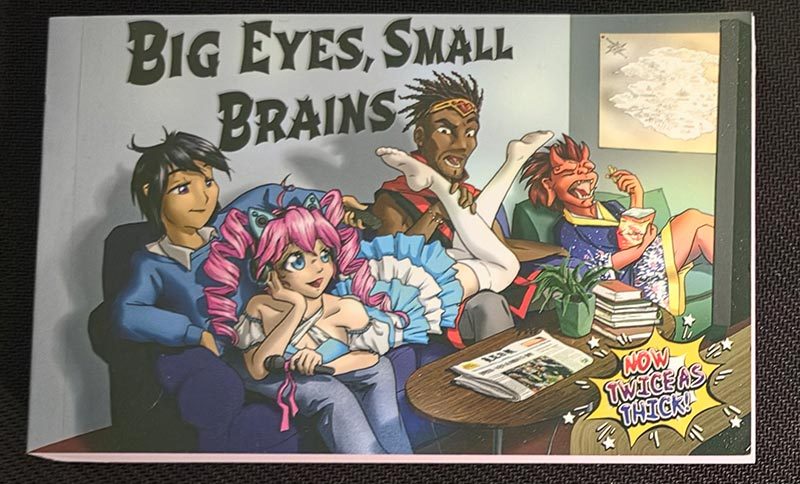
    Big Eyes, Small Brains book cover. An average guy, a pink-haired idol, a dreadlocked senshi, and a yokai-looking dude are all sitting on a couch, probably watching TV.
    Pulse pounding TV watching action

    Unlike the other two books, there’s no monolithic setting here. Big Eyes, Small Brains (BESB) is a sandbox full of tropes where you can run around doing anime-inspired buffoonery. That said, there’s still more of an established world in this game than in its namesake and obvious inspiration, Big Eyes, Small Mouth. The rules are neither as comprehensive nor as complex as BESM, yet maybe because of this, they’re better balanced in many ways.

    The guy from Chernobyl whose name I don't recall. The director guy.
    Not great, not terrible

    The book is written from the point of view of an isekai’d person from Earth who became the god of the anime world of Abika. This conceit only exists to justify the writing’s meandering, casual-weeb tone. The enormous-eyed, unnaturally-colored-haired people of Abika live their lives as best they can: running late to school with toast in their mouths, dealing with all-powerful student councils, fighting ninjas while wearing maid outfits, fighting alien catgirls at regional festivals, choosing which of six supermodels to date while being a gormless milquetoast, piloting giant space robots right out of grade school, engaging in interminable tournament arcs when the author runs out of ideas, and about anything else you’ve ever seen happen in Japanese teen/YA media.

    … Or so I thought at first. It turns out that there’s something like a plot built into the game setting, but you have to wait until page 200 to learn about it. In true BESB style, I’ll leave you in suspense until we get to that part.

    The first thing I noticed during my readthrough was how sanitized BESB is compared to the others. There’s not a single “fuck” and only one “shit.” The humor is less transgressive and more genre-focused. There’s still some edge, but it’s greatly diminished. I’d go so far as to say this is less a parody work than a lighthearted spoof of anime fandom.

    BESB adds six new Classes to the mix: Senshi (Sailor Power Moon Ranger transforming warriors), Androids (all-rounder characters with an impressive list of interchangeable parts), Combat Butlers/Maids (agile fighters with a cleaning fetish), Heroes (tank-ish swordsmen doing what Himmel would do), Ayakashi (nature yokai filling the cleric role), and Idols (dancing bards with Cyberpunk 2020 Rockerboy vibes). Again, you could port Classes from the other two games in or out if you really wanted to.

    Something new here is Traits, which are optional attributes you can apply to your character. This list includes things like Chuunibyo, Crybaby, Family Business, Loli Body (grimace), Nosebleeds, Otaku, Tragic Past, etc. The list reads like anime’s greatest trope hits. These are entirely roleplaying prompts. There’s no bonus for taking them and no penalty for leaving them alone. If they amuse you, go for it.

    Otherwise there’s the requisite list of wacky items (Magic Manga Pencil, Harem Whistle, Talking Cat Panties, Phone Charm, Demonic Contract, etc.) and weapons (surprisingly mundane, though there are things like the Bladed Serving Platter and Spiked Stilettos to spice things up).

    Talking Cat Panties
Sure, your panties might be cute but do yours talk to you and give you helpful information? Yeah, I 
didn't think so. I got the idea to drop these into the world after I remembered seeing something 
similar back in my world. Please don't use these… you know what? You're going to anyway, so just do 
what you gotta do. I should note that it is suggested that these should only be worn by girls—this 
includes all the trans girls out there!—but who am I to judge? Just know that these panties will 
probably spend a good amount of time judging you, instead.
    Yes, really

    You can buy cars, trucks, and mecha too. The vehicle and mecha rules are EXTREMELY rudimentary. Mechs are essentially big suits of armor equipped with giant versions of regular weapons. I mean, you don’t really need more than that for goofy Mobile Suit Gundam parodies, but Lancer this is very much not.

    There follows a fairly comprehensive list of Foods, like takoyaki and omurice. These can be crafted with Cooking rolls and give minor bonuses upon consumption. It may be the most “anime” thing in this here anime game, and represents a missed opportunity in other games. No rules for cooking monsters, though, which feels like an oversight.

    Now we get to the setting, which occupies almost the entire back half of the book. The world of Abika is divided into a number of realms embodying one or more sub-genres of anime. These realms are:

    Mitakihara: Rural and/or coastal Japan-alike. Suburbs, safe streets, little shrines, woods, a magic academy, an interdimensional cafe, pretty much everything you’d expect from such a bucolic setting.

    Sanzenin: The rich part of town, where most of the Combat Butlers and Maids in the world are employed. Home of the Bouran Academy, an elite school for stuck-up brats with gender confusion issues.

    Siak: The wrong side of the tracks. Siak was once the high-tech part of town until the bottom fell out of the market. The BIOME Corporation churns out androids to steal the citizens’ jobs and drive them further into poverty. Gee that doesn’t feel frickin’ prophetic from here in 2026, huh.

    Lancastar: The Shibuya neighborhood of Tokyo, expanded into a whole region. Idols and Senshi are thick on the ground here. Home to multiple rival rock’n’roll high schools.

    Valis: Where the heroic fantasy happens. Castles, colosseums, adventurer’s guilds, barroom brawls, kidnapped princesses, rampaging dragons. A Hero’s paradise.

    Vulkanus: All future war, all the time. This place is lousy with mecha, gleaming postmodernism, and overt fascistic vibes. Lots of ghosts in those machines, if you get my drift. Plenty of crises involving bubblegum, if you know’m sayin’.

    Washinomiya: Shinto-land. Big shrines, cherry blossoms, shrine maidens, new years’ festivals, gurus muttering mantras along the side of the road, that kind of thing. The Abika version of the UN is housed here. Ayakashi feel right at home.

    Yotsuya: The spoooooky yokai-infested zone. Superstition city. It’d be scarier if the descriptions of the stuff there didn’t remind me of the Ghost Stories English dub.

    Fukusaku: Here we finally learn the “plot” of BESB. Years ago, a rogue Senshi named Tack planted himself on top of the tallest mountain in remote Fukusaku and declared war on anyone who wouldn’t bow down to him. In the ensuing struggle, thousands perished. When Tack was finally defeated, his death set off a dead man’s switch. A forbidden spell reduced Fukusaku to a radiation-ravaged hellscape. The rest of Abika abandoned Fukusaku and mages lifted the entire region into the sky. The few survivors there dwindle each day and horrible mutant monsters wander the land.

    … Welcome to our fun wacky parody game. Geez. Note that the Fukushima nuclear power plant disaster had happened eight years before this was published. This is so on the nose, it crushed my septum. Every other joke is cartoony clownhammer stuff, then you run into this big clump of dethbludgore. You got your Dorohedoro in my Konosuba.

    A still from the old 1970's Reeses Peanut Butter Cups commercial where a guy runs into a girl and gets his chocolate in her peanut butter like a moron.
    Hey!

    Luckily the whole war stuff is only mentioned in passing in the other areas, though Fukusaku is still a place characters can visit if they want something other than sunshine and rainbows.

    The book ends with over 70 pages of the enemies found in each area. Standouts include the Sadistic Student Council President, Motorcycle Gang Members, Space Pirates, Tween Witches, Kobolds, Ganguro Girls, Yuki-Onnas, and Insane Cultists. Still no intro adventure. That feels a bit weird considering how much space they had, but whatever.

    Portability: Same as the other two, just thicker. Definitely has some heft that you can feel. C.

    Legibility: They replaced the sans-serif font with a light serif, but it’s still all good. A.

    Completeness: This one oddly doesn’t feel any more complete than Laser Metal despite having three times the pages. Therefore this one gets an A- too.

    Final thoughts: At 310 pages, BESB is by far the largest pocket RPG out there. In fact we’re probably approaching the theoretical limit of pocket RPG physics. Therefore, you’d think I’d be raving about how stuffed and huge and sprawling this game is. But somehow it still feels … sparse.

    A lot of that comes from the game’s breezy writing style. Just like me, the writers of BESB do like to ramble.

    TAKING DAMAGE
Your Avatar takes damage whenever someone successfully takes a swing at them and their total roll meets or beats your Avatar’s defense rating. Your enemy will roll the appropriate dice and add damage bonuses if they have any. You subtract that damage from your Avatar’s current HP. Once their HP reaches 0, things start to grow hazy and grey. An Avatar with 0 HP can be healed, but only for a number of rounds equal to their Strength. During this period, they're considered to be dying. What happens after that? Well, I'm glad you asked! After that point, the Avatar is considered to be dead. As in doorknob. As in expired bologna. As in "toast."
    As in croaked! As in snorting dirt! As in pushing up daisies! Wait, what was I saying? Oh no, I got off track again. I’m such a silly billy. My bad. Tehe pero! Bleh!

    There’s a lot of that sort of “wacky” digression. If you picked up the book and squeezed out all those asides like a sponge, the book would lose about a third of its volume.

    That’s not necessarily a good thing, either. Without the extra verbiage, you’d start to notice that everything is underbaked. The whole game has a mish-mash feel. Each area in Abika has only three or four landmarks and about four unique enemy types. I’ve reviewed less wordy games with more variety.

    And yes, you need to be a weeb to get much enjoyment. Otherwise nearly all the jokes will fly freely, joyfully even, over your head.

    If you are a weeb, well, here’s a game. It’s loose and unfocused and imperfect, but you can play it maybe. You and your friends may get a chuckle out of it. With a little work, you could even make it shine. As is, though, it’s a fine start. Just … fine.


    Finally final thoughts: The Attention Span Games pocket series is a mixed bag, to say the least. Conceptually, DnDizzle is too narrow to fill a whole book, while BESB is too broad even despite its relative enormity. Laser Metal strikes the best balance between scope and vision. It’s juuust right.

    Three Charmin bears.
    And they all shit in the woods. The end.

    Are any of them worth owning? That’s very subjective. I’d say DnDizzle requires you to be both REALLY into its subject matter and be easy to please. Laser Metal has a decent universe to play around in, isn’t full of impenetrable in-jokes, and, as it will constantly remind you, is pretty fuckin’ metal. BESB is cute and “for the fans,” but doesn’t have much of a skeleton, so it just flops around. BESB is BYOPlot.

    It’s probably telling that only Laser Metal has a published adventure, Too Broke to Rock, that you can nab for a buck off DTRPG. That’s all the support you’re getting. Now go to that ledge and hang off it.

    In total? Half a thumb up on one hand, half a thumb down on the other. Focus wherever you want.
  • Pocket TTRPG Roundup: Attention Span Games Spotlight, Part 2

    Pocket TTRPG Roundup: Attention Span Games Spotlight, Part 2

    The second of three reviews of pocket games from the same publisher. See Part 1 for info about the gameplay, and maybe stay for the review. If you dare.

    Laser Metal

    Writer: Ron Leota
    Year: 2015
    Dimensions: 6¼” x 4″ x ¼”
    Metalheads: 2+
    Term for GM: Metal Master
    Term for PC: PC (how disappointing)
    Page count: 116
    “Laser” count: 72
    “Metal” count: 252
    Comparable media: Metalstorm: The Destruction of Jared-Syn, Mad Max Beyond Thunderdome, Judge Dredd (1995), KISS Meets the Phantom of the Park

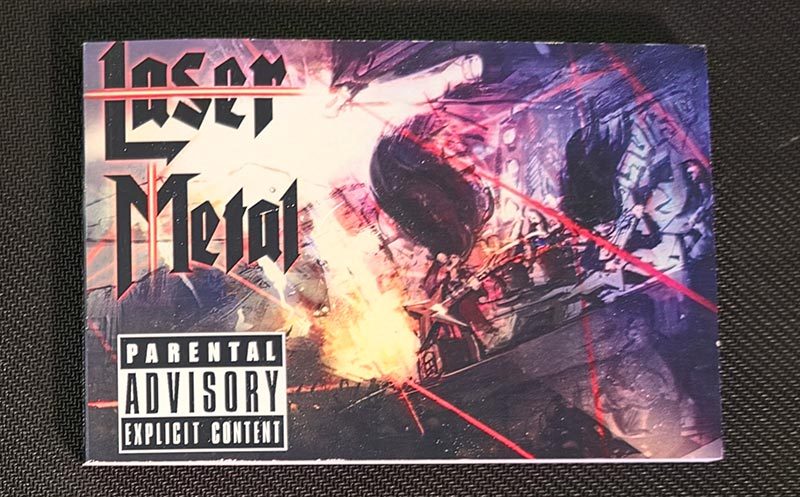
    Laser Metal cover, depicting a bunch of things exploding and lasers flying around almost incomprehensibly
    It’s metal! It doesn’t have to make sense!

    Millennia ago, humanity left a dying Earth to colonize other planets, including the small barren planet of Brutalia. Life on Brutalia was, to coin a phrase, brutal. Humans scrabbling out a life there built fortified cities and skirmished with each other to increase their pieces of the pie. One of these city-states built a giant orbital laser and threatened its neighbors with it. The other city-states didn’t care for this and tried to invade. Half the planet was scorched in the aftermath, and the surviving cities made ready to go to war and finish off the rest of it.

    However! A metal band called The Saints of Thrash foresaw that the world was about to end, bought a tract of empty land, hired a bunch of science types who were tired of making WMDs, and built a gigantic dome. When the final war did finally happen, this dome, later known as Arena 66, was about the only thing on the planet that survived.

    Then they discovered … The Metal (squealing guitar riff). Somehow, living on the planet Brutalia was changing humanity, giving them powers like telekinesis, raising the dead, shooting lightning from their hands, and otherwise twisting reality. Not everyone can use The Metal, but those who can are practically superheroes. Or at least super-metalheads.

    Now, 20 years after the apocalypse, people are emerging from Arena 66 and learning what’s going on out there in the wastelands of Brutalia. Nothing good, generally speaking. But people go out there anyway, mostly to train their combat skills for the biennial Laser Metal Tournament, a literal battle of the bands, to win the right to rule Arena 66 and ride eternal, shiny and chr — whoops, wrong franchise. The players are assumed to be members of one such band, building up life experience to take on the Tournament themselves.

    The game proper starts with the Laser Metal Classes: Doom Wailer (screaming bard with a connection to The Metal), Fat Bottom (tank, almost literally), Gun Witch (sneaky gun-fu fighter), Order of Metal Monk (Jedi wielding the power of The Metal, complete with laser swords), and Shred Master (master of destruction, and also pilot for some reason). The Classes are compatible with DnDizzle, in case you wanted to muddle your metal sci-fi with hip-hop fantasy.

    Several powers from The Metal are then enumerated, allowing characters to put enemies to sleep, turn blood to ink, steal the life force from everyone around them, and tear open a hole in the sky and rain down hellfire. You know, Tuesday.

    Next come lists of equipment, including Guitar Scythes, Rocket Propelled Knives, Jet-Powered Flight Suits, and Ruff the Cyberdog, followed by descriptions of all the internal areas of Arena 66, plus outside places like Arena 69 (giggity), the Church of Gas, Death Row, the Irradiated Wastes, and beyond. Then we get a bunch of adversaries (Cannibal Mutants, Company Men, Deth [sic] Bots, Gas Hunters, Posers, Sellouts, Zombie Pop Fans, etc.). Sadly there’s no adventure included.

    So right off the bat, this game world is miles better. If you told me this was the plot of a backup feature in 2000 AD, I wouldn’t question it. The writing has a middling dose of punk attitude, but it’s not insanely annoying. Typefaces are readable, the writing isn’t constantly punching you in the face, and the world is silly but in a far less grating way. It’s a relief.

    It’s not perfect, though. For one thing, the game tries too hard to convince us how totally hardcore it is. The author often breaks in to say “now THAT’s fucking METAL” like he’s not entirely sure of it himself. It doesn’t happen all the time, so it’s not as salt-in-your-eyes irritating as DnDizzle got, but it’s a stone drag when it shows up.

    Through the Fire and Flames: Sometimes you just gotta go fast! Like really crazy fast. Play fast, fight fast, fuck fast, it don't mater! Just go fast! All the speed baby, and we will "CARRY ON!!!"
    Yeah! Fuck yeah! I’m hyped! :slams chest repeatedly: Are you hyped? I’m totally hyped!

    Portability: Same size and caveats as DnDizzle. B.

    Legibility: Yes. 12-point-ish sans serif for body text, a Gothic-wannabe font for chapter headers, and a thin handwriting font for subheads. Every word is legible. That’s metal as fuck. A.

    Completeness: This has lots more world-building than DnDizzle, but at the expense of an intro adventure. That tips this one slightly to the negative. Still a full-fledged game though. A-.

    Final thoughts: I’m sure you’ve picked up that I like this one more than its older brother, even though it has the same author. I’m guessing he got some feedback on the first game and actually took it to heart. It’s nice seeing people improve.

    There’s also more variety in this one. Laser Metal isn’t just about stretching the One Joke until it disintegrates, it has a living, varied, colorful, semi-cohesive setting. It’s certainly very trope-y, but there are flashes of cleverness in how they fit together. It’s not just random metal gags thrown in a bag and shaken. These random metal gags have been meticulously curated, damn it.

    Of these three parody games, I think this one works the best. (Oh, spoilers for the next review, I guess.)

    Next time: Big ass, small butts

  • Pocket TTRPG Roundup: Attention Span Games Spotlight, Part 1

    Pocket TTRPG Roundup: Attention Span Games Spotlight, Part 1

    To finish up my series of pocket TTRPG reviews, I was originally going to write one big review of three similar games. As I dug in, it turned into a monster, since apparently I can’t shut my yap for two seconds. So I’m breaking it into three regular reviews instead. Please! … Enjoy.

    In this series we’ll highlight three pocket-sized RPGs, all ostensibly parodies, from the same publisher, Attention Span Games. All the books in this review use similar rules, differing mostly in classes, campaign structure, and tone. Such as it is. You’ll see what I mean.

    DnDizzle: Dragons in the Hood; Laser Metal; Big Eyes, Small Brains (BESB)

    All three of the abovementioned games
    Print is dead, and we are its killers

    Other pocket games deal with their small form factor by being innovative in their construction, packaging, and organization. These games, meanwhile, are just … books. Small, flimsy, soft-cover, perfect-bound books, printed in black-and-white on thin matte paper. The sort of books that merely opening them cracks the cover. Being actual books, they have far less need to be economical with their content. Their size fits our format, but it still feels like cheating.

    Gameplay: All three games use the same basic rules. Characters have four Stats: Might (or “Strength” in BESB), Agility (“Speed” in BESB), Intelligence (“Brains” in DnDizzle), and a fourth metaphysical stat (“Soul” in DnDizzle, “Metal” in Laser Metal, and “Luck” in BESB, all doing roughly equivalent things). Players divvy up 7 points between these, with a minimum of 1 and a maximum of 3. Most Classes have a preferred Stat, so you probably shouldn’t take, say, the Combat Butler Class if your Speed were too low.

    Each book has wildly varying names for their Classes, but they all generally fill classic party roles: the healer, the tank, the mage, the marksman, etc. A character’s beginning Skills (or “Skillz” … yes, thank you, DnDizzle, very droll) are determined by their Class. All Skills/z begin at rank 1, and the character has a number of extra points equal to their INT/Brains score to add to that.

    Characters then gain one Ability based on their Class, like the Trigger Man’s Accurate Shot (+1 to hit for all ranged weapons), the Shred Master’s This Cut was the Deepest (+2 damage to melee and laser attacks), or the Idol’s Hypersonic Tune (a damaging sonic blast that can potentially push enemies away from you). You get more Abilities as you level up. Your Class also determines your initial equipment, plus a small amount of the coin of the realm (gold, credits, or Ryo) for accessorizing.

    When attempting an action with a chance of failure, players roll 2d6 and add the relevant Stat plus Skill. If they don’t have the right Skill, they just add the Stat -1. Snake eyes is an automatic failure and boxcars is an automatic success. For non-contested rolls, the GM sets the difficulty. If it’s a contested roll, ties go to the defender.

    This is a very simple, neat, easy dice resolution method, which also happens to be almost exactly the same as the classic Japanese RPG Sword World. Now I’m not saying the designer lifted the system wholesale, but I’m not not saying it either. (In 2013-ish, when this system was in development, /tg/ was already flogging around partial translations of SW 2.0. However, the rest of this system doesn’t resemble SW that much. I’m willing to give it the benefit of a doubt and chalk this up to some sort of 2d6 carcinization theory.)

    When combat breaks out, everyone rolls 2d6 + Agility/Speed + Awareness and acts in descending order. Rounds are 5 seconds long, and characters can move up to 25 feet and perform one item from a pretty standard action list: attack, cast a spell, use a skill or ability, draw a weapon, stand up/lie down, grab something, or take a second 25-foot move. There are no “held actions;” if you do nothing on your turn, you miss out.

    Each character has a Defense Rating equal to 5 + their Agility/Speed + any armor bonus (up to +5). A character’s DR defends against every type of attack from guns to spells to laser swords. If an enemy rolls an attack above this number, the character takes damage somewhere between 1d6 and 2d6 + some number, depending on the attack type. At 0 HP, they pass out and will die if they don’t get treatment within as many rounds as their Might/Strength score. Even after all that, they can be revived by anyone with a resurrection-type Ability, but only within the next hour.

    Then there are items that affect blah blah, nobody cares, get to the actual games already, you cry. These are parody games, how to roll the dice is secondary. Just tell us about the funny stuff.

    Well okay. You asked for it.


    DnDizzle: Dragons in the Hood

    Writer: Ron Leota
    Year: 2014
    Dimensions: 6¼” x 4” x ¼”
    Playas: 2+
    Term for GM: The Big Pimp (BP)
    Term for PC: OG
    Page count: 112
    “Motherfucker” count: 79
    Comparable media: Don’t Be a Menace to South Central While Drinking Your Juice in the Hood, Leprechaun: Back 2 tha Hood, Bright (non-laudatory)

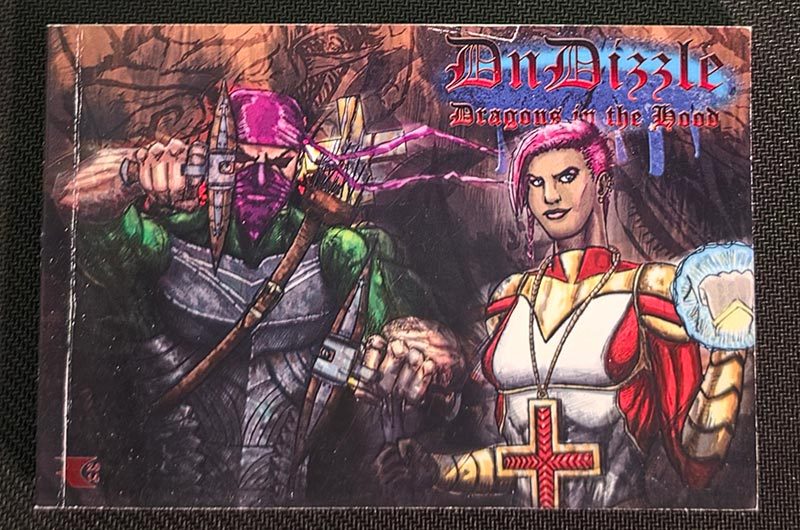
    DnDizzle book cover, depicting two sketchy characters with tough grimaces on their faces
    They’re squinting because they can’t read the logo

    In the ancient hood known as Comptonia —

    Okay, yeah. That’s the level we’re on. Soak that in a second. Now let’s continue.

    In Comptonia, all was chill under the enlightened rule of King Pimperton, the illest motherfucker in all the land. Everyone loved him and his fly honey of a daughter, Princess Fabula. Then one night, a big-ass snake motherfucker called the Black Dragon pulled up, straight wrecked Comptonia, and flew off with hella dolla dolla bills y’all, and, weaker still, the princess.

    The king put out a hit on the Black Dragon, offering his daughter’s hand in marriage to whatever smooth OG could lock her down back home. All the big ballas of the kingdom turned out to punk the Black Dragon’s ass. Just when it looked like they were going to win, the Dragon called up his homies and everyone bailed before a flood of wack-ass monsters.

    Meanwhile, the princess, hella mad that her daddy offered her up to the first golddigger to come along, went thug and dipped into the Big Ass Forest.

    Now Comptonia’s all kinds of fucked up, and only the hardest OGs will be able to regulate the monsters, take back the hood, and bring the pain to that Black Dragon motherfucker once and for all.

    I shall now present a direct quote from the book:

    “Now it’s time for you to go forth! Cry, ‘thug life!’ and let slip the gats of war; just don’t be caught trippin’.”

    All right. So. How did the previous section make you feel? A little second-hand embarrassment, maybe? Like you’re looking through a twisted portal at the thinnest veneer of 1990s-era hip-hop culture? About as hard as Vanilla Ice?

    That’s this book’s one single joke.

    The actual rules are presented in a clear straightforward style. But everything, and I mean every pig-friggin’ thing, is accompanied by running commentary by a character called “Fat Warrior” who uses thick wannabe gangsta speak. I’d estimate half the text in this book is Fat Warrior’s incessant, pointless fronting. I mean look at this shit:

    BOW, LONG
For all tha' playas, shooting shit with arrows.
COMPTONIA SLUGGER
A big-ass wooden bat for knocking bitches out. Swing for the fences or a monster's grill.
GATBOW, SMALL
A small-ass arrow gat, to shoot in style.
GATBOW, LARGE
If you don't mind lugging around a big ass weapon, this is the shit when it comes to ranged motherfuckers.
KNUCKLE DUSTERS
Brass knucks, for when you gotta knock a motherfucker out with yo fist.
MACHETE
It's like the big old choppin' blade from yo weed garden.
MANHOLE COVER
Not that kind of man hole... But seriously a heavy ass shield.
NAIL BAT
It's a motherfuckin' bat with a nail in it. Bam!
PIG STICKER
Too short to be a sword and too long to be a knife. It's like some kinda crazy short sword and shit.
PIMP CANE
Yo, that pimp cane ain't just fo' sweet ass crip walkin', it's for regulating.
    SHUT UPPPPP

    I’ll get to that awful font later. But gee Zeus. There are whole entire chapters that are nothing but Fat Warrior rambling on (and on and on) in this tone. It’s not even creatively done; by about the fortieth “motherfucker” the word had lost all meaning. The lack of chill, as they say on the streets, is palpable as all fuck.

    This ragged cloak of hip-hop sensibility has been draped over the whole game, from its Classes (Doc [cleric], Freestyler [bard], Jacker [rogue], Street Magician [mage], Thug [fighter], Trigger Man [ranger]) to its equipment (Low-Rider Carriage, Sack of Holding Shit, Pimp Cane of Control) to its monsters (Crazy Ho, Weak-Ass Goblin, Ghetto Leprechaun, Medusafarian … okay that one’s funny). There’s a history of Comptonia which is essentially “we had a great pimp king, then a bad stoner king, and now it’s today,” a list of “interesting” citizen stereotypes, and a sample adventure, “King Smokey’s Secret Stash.” Then the book ends, which is my favorite part.

    Portability: It actually fits the pocket quite well, even when you add 2d6, some copies of the character sheet, and a pencil. The book is a bit fragile, so don’t run a marathon with it in your pocket. B.

    Legibility: The regular rules are easy to read, in a decently sized sans-serif font, with excellent spacing. Fat Warrior’s narrative text, on the other hand, is beyond awful. It’s some kind of bizarre cursive (?) typeface with enormous ascenders and descenders and horrible kerning that makes letters tend to blend together. Even that wouldn’t be a complete deal-breaker if there weren’t whole chapters of this shit. Honestly. D.

    Completeness: It is at least a whole game. With as much space as they have, it would be weird not to be. This is the one thing I can’t complain about. A.

    Final thoughts: Who is this game for? Well, I’d expect people who love (and I mean loooove) West Coast urban culture would get a kick out of the slang, repetitive though it may be. Obsessive collectors (raises hand sheepishly) would feel bad not having it. Cultural and linguistic anthropologists might get something out of it. People who really like fucking mothers, maybe? I’m kinda stretching here.

    You may be thinking that my objection to this game is that I don’t like hip-hop (extremely untrue) or I’m clutching my pearls at the content (somewhat untrue; there’s some bits that feel like it’s making fun of the culture instead of having fun with it. But shit, man, I’ve been on the internet for 35 years, you think I’m gonna balk at tone?). No, my absolute, overriding objection is that this is a comedy game that stops being funny around page 5. Unforgivable. Off with its head.

    Big-ass motherfuckin’ nope from me, homies. Peace out.

    Next time: You’re killin’ me, Smalls