Tag: Pocket Odyssey

  • Pocket TTRPG Roundup, Part One

    Pocket TTRPG Roundup, Part One

    Let’s get small

    In this series, I’m going to indulge a peculiar fixation of mine: pocket TTRPGs, a.k.a. physical RPGs which fit entirely within a pants pocket. These are essentially the RPG equivalent of Micro Machines, Polly Pocket/Mighty Max, Gameboy Micro, Tech Deck, Z scale trains, bonsai, and anything else made unfeasibly tiny.

    Here are the ground rules:

    • Games have to be more than an interesting dice mechanic and a sentence or two suggesting a setting. This eliminates nearly all business-card RPGs and things like 36-word game jams.
    • The games have to fit in my pocket. Specifically, the entire game should fit within the front right pocket of my “good pair” of jeans, without folding/crushing the game or straining the fabric. This pocket is approximately 7” wide and 7” deep when empty. Being able to sit down while the game is in there is preferred, but optional.

      These arbitrary constraints disqualify most one-pagers, digests, and trifolds. They also eliminate most pocket versions of bigger RPGs, since they’re often dependent on having a full-sized book for reference.
    • Games must be small by design, and not be just a larger RPG shrunk to fit. They also need to be legible at printed size. Otherwise I’d just be reviewing Pathfinder on microfiche.
    • It’s gotta be a real physical game. Phone games are cheating.

    I’ll rate these games on gameplay, pocket fit, legibility, and completeness. (“Completeness” is a nebulous metric, but generally includes stuff like monster listings, character creation rules, spell lists, adventures, a campaign setting … pretty much any QoL improvement beyond the bare mechanics. The more the better.)


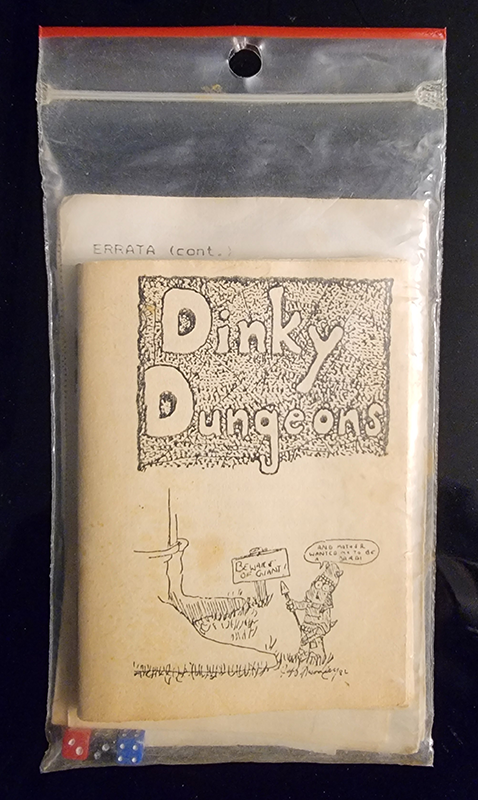
    Dinky Dungeons

    Publisher: Doc’s Games/Uncle Morty Productions
    Year: 1985
    Dimensions: 3½” x 5” x about ⅜”
    Players: 2-5

    A dime bag of adventure

    Dinky Dungeons is what got me into tiny RPGs to begin with. I bought my copy, unknown and unreviewed, at a skeevy little table at a sci-fi convention in 1985, and discovered a goofy parody OSR-like that’s still surprisingly playable. (Though can you really call it “OSR” if it came out when “OS” was, you know, S? Let me know in the comments below. And don’t forget to like, subscribe, and smash that notification bell!)

    So what did you get for your hard-earned one American dollar back in 1985?

    The whole schmegeggi
    • A 32-page saddle-stitched rulepamphlet that looks like a Xerox copy from the era when Xerox was the only company that made copiers
    • Two blank character sheets, double-sided
    • A wee little Gamemaster Screen, printed on a 3×5 card folded in half
    • A sample adventure: Goblin Cave, complete with cardstock hex map
    • A relatively large “errata” sheet which is mostly just a continuation of the main rules
    • Two 5mm d6’s (I acquired the third one from a different game; I don’t remember which two are original)
    • The Doc’s Games/Uncle Morty catalog, featuring several adventures and comics available for between 50 cents and a dollar, plus SASE

    Gameplay: Characters have two stats, PHY(sical) and MEN(tal); players roll 2d6 and apply one die to each. There are three classes, Warrior, Wizard, and Bard, and four races, Human, Elf, Dwarf, and Fuzzy Winker, a cowardly 1’ tall rodent that takes -1 to all stats and can’t wear armor or carry weapons. This is for all those players who want to be annoyingly useless, a much neglected demographic.

    For most activity checks, each character has Muscle (equal to their PHY) and Idea (equaling MEN) Points, which is the number of times per day they can attempt a significant action. Each time they try something strenuous, they roll 2d6. On a 7 exactly, they succeed and don’t spend a point. On doubles, they succeed but also spend a point. On any other result, they fail and spend a point. This gives only a 1 out of 3 probability of succeeding at any action, 83% of that time losing one daily try in the process. The only bonus you get for having high stats is being able to try more often.

    Saving throws work similarly, shrugging off effects on 7’s and taking half effect on doubles.

    Combat, on the other hand, compares the attacker’s and defender’s relevant stats on a combat table. The attacker rolls under the table score on 2d6 to hit, doing damage equal to the difference between the roll and the target, plus a bonus die. Damage is taken directly off the target’s PHY or MEN stats, and you have to roll to heal each day.

    Roll to kill

    By these rules, even strong or smart characters will be mostly ineffective at anything besides combat. With the cartoony parody vibe of the rules, it’s somewhat forgivable, but can still be frustrating unless the players let go and get silly with their failures.

    The remaining rules are actually quite extensive, with equipment and spell lists and a bestiary and XP/leveling up rules and all that. You can check them out at the charmingly Web 1.0 page http://dinkydungeons.com/origrules.asp. Despite its size, the system is only “rules-light” in comparison to the popular games of the day.

    Pocket fit: A+. Immaculate. It’s like I’m carrying nothing at all!

    Nothing at all … nothing at all …

    Legibility: Middling. The text is a small, clean, readable OCR-style font (or maybe IBM Selectric, considering the era). Everything is stark black-and-white. Sadly, perhaps to cram everything in, paragraphs are at an all-time premium. Illustrations are also cramped, but at least not so small as to be smudgy. This won’t win any awards for layout, that’s for sure. That nets it a C- grade and a mandatory grammar refresher.

    By this time my lungs were aching for air

    Completeness: It has full rules, character sheets, a sample adventure, and a usable GM screen. I mean, jeez Louise.

    I must dock it a little bit, though, since the players also need pencils. (I know that may seem petty, but wait ‘til the next review.) So I’ll downgrade my original A+++ rating to a simple A. Tough but fair.

    Final thoughts: Dinky Dungeons has created a very high bar for me in the pocket RPG space. As far as I‘ve found, there’s never been another TTRPG so cheap, complete, and petite. About the only thing I truly dislike is that its ziploc bag is almost too small, and you kinda have to bend everything to take stuff out. Back when I first got the game, that was no big deal. Now that it’s a precious 40-year-old gaming artifact, it’s a bit white-knuckle.

    I want to send a message back to my 1985 self to send Uncle Morty $10 for the supplements. Even with its heavy rules jank, this thing is absolutely the best gaming buck I’ve ever laid out.

    Extra note: Just for grins, I tried to find a copy of DD for sale on Google Marketplace. All I could find is a single character sheet, used, which somebody is trying to sell on eBay for thirty fucking dollars. Holy cripes. I’ll just, uh, take my copy and put it in this safe deposit box. Nothing to see here.


    Tinny Dungeons

    Publisher: Archmage Arispen
    Year: 2022
    Dimensions: 4” x 2½” x ⅞”
    Players: 2-8

    These mints taste terrible

    Archmage Arispen is a Polish game designer who’s pushing pretty deep into the tiny RPG market right now. Besides Tinny Dungeons, they have such games as Tinny Apocalypse (same format, but in a Fallout-esque world) and a couple of business-card RPGs. They also have an expansion pack for Tinny Dungeons called Journey Through Sands & Frost, which looks to expand this game’s world.

    But I’m getting ahead of myself. Let’s talk basic components. All the cards are mini-playing-card-sized.

    • Six illustrated, pre-generated character cards, with stats and abilities on the front and game rules on the back
    • One blank character card, with the same game rules on the back
    • One GM Guide card
    • One card showing a map of the Dawnmoon Woods region, with places of interest on the back
    • One card with a map of the town of High Farm, with people/places of interest on the back
    • One card with a map of the city of Waycross, with people/places of interest on the back
    • Three adventure cards, each with a dungeon map on the front and descriptions of rooms, monsters, traps, etc. on the back
    • Two 12mm d6’s
    • A pencil! Ha! Take that, Dinky Dungeons!

    Everything comes in an Altoids-sized tin with a removable lid, which you can use as a clattery dice tray.

    Gameplay: The six pregen characters all have three stats, STR, DEX, and MIND, with two stats set to 1 and one stat of 2. The PCs also have an AC score between 3 and 5 (higher is better), either 3 or 4 HP, a weapon or two, and a special skill, like the elf wizard’s Fireball or the halfling thief’s Sneak Attack.

    To attack an enemy, the attacker rolls a number of dice equal to the relevant stat of the weapon they’re using (STR for melee weapons, DEX for ranged attacks, and MIND for spells). If the die, or either of the dice for stats of 2, are equal to or greater than the AC of the target, you do 1 point of damage. The target straight up dies when HP reaches 0.

    Though death is but a door, time is but a window

    When a character faces a challenge tough enough to require a roll, the GM sets a difficulty from 4 to 6 and the player rolls (stat) number of dice to meet or beat it.

    Though there’s a blank character card, there aren’t any enumerated character generation rules. It should be fairly simple to use the other characters as a template to make something up, but that requires thought. Like, gross.

    No leveling up rules are provided either. Normally I’d say that tracks for a package this simple, but the remainder of the game feels semi-campaign-oriented. The adventure cards are mostly standard dungeon crawls, but the setting cards have more setpieces, adventure hooks, and local personalities to interact with. These cards elevate what would normally be a handful of quickie one-shots into something that a bright young GM could use to craft a continuing story.

    Ah, look at all the lonely people

    The adventure cards have nice (but tiny) color maps printed on one side, and descriptions on the other. This makes it awkward to show players the map and read the back at the same time. Maybe just give the players graph paper and make ‘em map it out old school. If it was good enough for their grandfathers, it’s good enough for them.

     As mentioned, there’s an expansion pack (which I haven’t picked up) that promises to add new adventures, territories, and cities. Plenty of room in the box for more cards.

    Pocket fit: If you can carry breath mints, you can dodge a ball carry Tinny Dungeons, no problemo. Might be awkward if you wanted to put your phone in the same pocket, though. Solid B.

    Legibility: Ssssort of. There’s a lot of text on these cards, printed in seven- or eight-point serif font. If you can squint hard enough to read that, it’s decent. If not, you may need to go get a stronger prescription before you pick this up. C for eagle-eyes, D otherwise.

    Completeness: It’s got all the pieces, simple but adequate rules, several mini-adventures, and even something like a campaign structure. No chargen and no way to level up knocks it down a couple pegs though. B minus.

    Final thoughts: Tinny Dungeons is a cute diversion, best for pickup games. It’s several steps up from business-card RPGs but I wouldn’t call it “full-featured.” It works okay as a game and it has the potential to have legs if you put the work into it.

    It’s also €30 (almost $35) for the physical version. It’s very much not worth that price. The digital print-your-own version is still $10, and even that feels high. Based on that alone, I can’t recommend this game unless your house is littered with Altoids tins and you’re desperate to put something in them.


    Pocket Odyssey (Standard Edition)

    Publisher: KaijuKraft
    Year: 2014
    Dimensions: 5½” x 3½” x 1”
    Players: 2-4

    Hmm, feels familiar somehow

    I’ve already reviewed this game’s big brother, so I’ll make this quick. The Standard Edition gives up a few things (Flow of Battle, hidden powers, item tokens, monster/power/map variety, and two players) to deliver a limited edition of the same gameplay. More importantly, it lives up to its name and fits in a damn pocket. Finally.

    Pocket fit: Tight. Not stretched beyond imagining, but you certainly know it’s there. I wouldn’t recommend walking around with it in your day-to-day life. C-.

    Legibility: No issues. The cards are bright and low contrast, and the font is a bold sans-serif at around 14 point. Easy A.

    Completeness: The Standard Edition still does the low-prep, three-act thing. A game session is essentially a full campaign, with two level-ups, in the space of an hour and a half. It’s not what you’d call a full, tell-your-own-story type of system. But for what it does, it has everything you need. Slightly reluctant A there.

    Note that the Standard Edition only accommodates 3 PC’s; if you have more friends, or just want more maps’n’stuff, the Collector’s Edition is still the way to go.

    Final thoughts: Oddly, I may prefer the Standard Edition for its brevity. The bits added to the Collector’s Edition are mostly gravy, and the game stands on its own without them. Otherwise, I feel about the same about both versions: a fun way to roleplay away an hour or two, but don’t hope for more.

    The Standard Edition is available from the distributer, Outland Entertainment, for $25. I’d say it’s barely worth that. You can also find it cheaper if you look; at $20 or less, it’s much more interesting.


    Next time: More little things, hitting each other
  • RPG Review: Pocket Odyssey (Collector’s Edition)

    RPG Review: Pocket Odyssey (Collector’s Edition)

    Give a cheer for all the broken

    Prologue: So. Know how you get weird Facebook ads sometimes? I kept seeing this one for a travel TTRPG product Kickstarter with drop-in maps and dry-erase tiles and magnetic map pieces and thought it looked sorta interesting until I learned it was $99 at the rock-bottom tier. But then someone in the comments said, “This is just an updated version of Pocket Odyssey” which sent me on a half-hour journey from Google, to rpg.net, to BoardGameGeek, to an ill-advised online impulse buy. So now I have this thing and I’m gonna review it. All aboard. Choo choo.

    Pocket Odyssey is a mostly-card, sometimes-dice, TTRPG-adjacent, 2-4 (2-6 for collector’s edition) player game by Anthony Sato, who as far as I can tell designed this game, another game called Dice Odyssey which never came out, and nothing since. Card artwork is by Xavier Saulter. The basic version was published in 2014 after a successful Kickstarter; the Collector’s Edition came out the next year. For a while this game was practically impossible to find except for people selling their used KS reward copies. Outland Entertainment picked this up for publishing in 2022; that’s where I got my copy, new in box. So it may no longer be the eBay rarity it once was.

    Let’s check out the game’s description on BGG: “Pocket Odyssey is a micro dungeon crawling game inspired by traditional table top RPG games. It takes place in the Dungeonfell, also known as the buried plane, with all but one player acting as a group of adventurers on a quest.”

    Not the most original setting, I guess, but still intriguing. What is this Dungeonfell? Why is it called the “buried plane”? Where are we? Why are we here?

    As it turns out, absolutely nothing about that exists in the game itself. No mention of dungeons, fells, or planes, buried or otherwise. All you get is cards, pieces, the basic rules, and a hearty “Figure it out yourself.”

    But I’m getting ahead of myself. Let’s take a look at:

    What’s in the Box

    Insert Se7en meme here

    The Collector’s Edition comes in a sturdy laminated cardboard “Box of Holding.”

    Full disclosure: I dusted the countertop just before this photo shoot. Good job, huh?

    Though the standard version comes in an actual pocket-sized 3” x 5” package, this box is around 5” x 10” and stands about an inch and a half tall. So right away the game’s name is wrong and the whole concept is ruined. Ruined!

    However, despite now having to wear cargo pants to maintain the theme, the bigger box is necessary to hold all the stuff you get.

    Let’s unpack all this

    Big thick cards (3 ½” x 5 ½”):

    • 28 map tiles (double sided)
    • 1 Rules Reference
    • 1 Name Card
    • 1 Newb Card

    Regular cards (about 3 ½” x 1 ½”):

    • 24 Background Cards
    • 10 Stat Cards
    • 39 Power Cards
    • 36 Baddy Cards (yes, the game calls enemies “baddies”)
    • 10 Flow of Battle Cards
    • 25 Hidden Power Cards
    • 18 Quest Cards

    Half-size cardlets (about 1” x 1 ½”):

    • 16 Personal Goal Cards
    • 20 Flaw Cards
    • 35 Loot Cards
    • 15 Marker Cards

    The cardboard tokens:

    • 40 Item Tokens
    • 80 Counters (printed “1” on one side and “2” on the other)
    • 20 Special Counters (exclamation point on one side and lightning bolt on the other)

    Everything else:

    • 1 six-sided die
    • 20 pawns (5 player meeples and 15 monster markers of various shapes and colors)

    Opening the box led to Game Niggle #1: When you first break into the shrink-wrapped card packs, you quickly discover that all the cards are shuffled together. Not even stacked by type but separable, but actively all mixed up. Note that while playing the game, you don’t mix the various card types. So prepare for a rousing 15-minute card sorting session before you even begin.

    While sorting, I quickly ran into Game Niggle #2: The cards are quite slick. The merest brush scattered my nice neat piles all over the place. The worst were the half-size cards, which aren’t heavy enough to hold themselves down to begin with. The game also doesn’t provide any way to keep the cards secure in the box, so a quick shake will undo all your hard work unless you hold each pile together with rubber bands or something.

    Because of the slippery cards, I definitely recommend playing on a surface other than a polished tabletop. A felt poker surface, place mats, even laying down a piece of cardboard, would make it much less likely to have your game suffer a sneeze disaster.

    So far, you’re probably saying to yourself, “Self,” you say, “this sounds more like the setup for a prestige card game. Chris must be hopped up on goofballs and posted this in the wrong section. Is this really a TTRPG?”

    First of all, right now I’m only high on Corn Nuts and Sprite Zero. And secondly, the answer is yes, this is 100% a TTRPG.

    … In a sense.

    Setup, Part One: The Storyteller

    There are a million random stories in the naked random city

    One player takes up the mantle of “the Storyteller.” This Storyteller deals themselves four random Quest Cards, chooses one to discard, and quickly gins up a three-act adventure outline using the remainder. This adventure doesn’t have to be particularly detailed, and the Storyteller is encouraged to worry more about setups than resolutions.

    Sure, I’ll get right on that, Chief

    Despite being what is essentially the cornerstone of the entire session, the rules for Storytelling make up two pages of the 32-page rulebook, one page of which is an example. The Storyteller is fully expected to vibe something together and then run with what the players do. It’s not quite zero prep but it’s a very close cousin.

    Pocket Odyssey came out four years after Apocalypse World. However, there’s not a lot of indication that Anthony was influenced by AW, or even much aware of zero-prep as a game style. I get the feeling that if he knew more about it, he would have couched his tips better for how to run a collaborative role-playing game session. As written, it’s more of a “toss you in the deep end” kind of thing. “Here’s some random prompts. Now make a story. Byeee!”

    Funnily enough, this lack of guidelines has little to do with the size of the rulebook. The full-color, 32-page saddle-stitched 4” x 8” pamphlet has a surprising amount of filler, including six pages of example gameplay, several half-page illustrations, a blank inside back cover, and a full-page ad for the designer-publisher’s website which has (according to archive.org) been dead since 2017. You’d think he coulda maybe thrown us an extra bone here.

    Of course, some GMs can run this sort of loosey-goosey game just fine. I dunno how easy it would be for a group of complete RPG naifs who found this weird card game and wanted to see what it’s about, though. As with most RPGs, it’s pretty clear the Storyteller has to have at least some experience and/or creative chops, or nobody will have much fun.

    Setup, Part Two: The Players

    Luck be a lady

    Player setup is more involved. First, each player is dealt two Background Cards and chooses one to keep. Background Cards have a generic title, like “Aelfen Blood” or “Charmer,” and a list of two to four special skills which that character can use at any time. For instance, the “Swindler King” card has “Burglary: You are a master thief picking both locks & pockets”, “Trick: Bending the truth for you is as easy as breathing air”, and “Street Smart: You grew up on the streets and know its ways.” Any time your character needs to perform an action, and as long as the player can make a case that the skill is applicable, their special skill makes things easier.

    Next, each player receives three Power Cards. Each card gives their character a one-time-use super ability, like Lightning Bolt or Entrapping Spores, which can change the tide of battle. The player can keep all three Power Cards and use each one once, or discard one or two of them to increase the number of times they can use one of the others. Power Card uses regenerate between acts.

    The players use chits to distribute three Stat Points between their three stats: Attack, Defense, and Special. Points in Attack are added to the player’s die rolls when attacking a monster. Defense increases the player’s Dodge Points, which we’ll explain in a bit. Special points increase the efficacy of Power Cards and other non-standard abilities. (If the powers on their cards don’t require a roll to activate, the player may not need to worry about their Special stat at all.)

    Players then draw one each of (deep breath) a Flaw Card, a Personal Goal Card, a Hidden Power Card, a Loot Card, and an item token. By the end, a typical player’s loadout will look something like this:

    Hey! It’s our old pal, Grim Freezy Mushroom Hypnotist Spellsword

    Flaws include things like Pyromaniac, Prankster, Overconfident, etc. The rules state that “this is how others would describe your character,” to give you an out in case you drew something you don’t want to play (and would rather spend the game going “I’m not narcoleptic, I don’t know where people get that idzzzzzzz”).

    Personal Goals and Hidden Powers stay hidden from the rest of the table until you triumphantly reveal them in the heat of the moment. A Personal Goal is a secret victory condition that every player is expected to achieve at some point during the game. These cards have a brief phrase like “Save a Life” or “Start a Fight.” The rules don’t mention what happens if a player doesn’t achieve their Personal Goal, other than this line: “In order to win the game, you must complete both the party quest AND Personal Goal Card.” So I guess if you don’t you just lose, like a losing loser who loses.

    Hidden Powers are a bit like regular Power Cards, but have a singularly OP effect that you can only bust out once per game. These are major things like “Life Pulse: You may revive a dead creature” or “Time Break: Freeze time for 3 rounds. You may act normally during this time. Frozen beings are invulnerable and you can only move items that aren’t being held.” How you can perform such miracles is up to you to explain. Or not.

    Loot Cards are, well, loot, like a Magic Wand or a Jump Potion. Some of them give extra abilities that you can use at any time, others are useful once per combat, and potions are always consumed upon use. Each player also has a 50% chance of drawing another Loot Card after each successful combat.

    Item tokens are cardboard chits with one-liners like “Bag of Keeping” or “Candle of 1000 Smells” on them. The player and the Storyteller discuss what exactly each item does and how often you can use them.

    Some item tokens are more esoteric than others

    Finally, players decide their characters’ melee and ranged weapons (which don’t have stats, so just choose whatever fits your concept) and pick a name. There’s even a handy Name Card which you can use to select something suitable, provided you have no imagination at all.

    What name means “uncreative dingus”?

    Sometimes you get a player who is either above drawing cards, only playing under protest, or is someone’s hyperactive little sister who will turn on the waterworks if they don’t get to play but would take longer to teach the game than everyone’s patience will allow. That player can take the Newb Card, which is a map-sized card with a selection of skills and powers already printed on it. Strictly speaking, the character printed on the Newb Card is overpowered, with 6 Dodge Points and a unique Luminary power which gives them Advantage on all die rolls. In practice, whoever gets this card is probably going to make a lot of bad decisions, so it all balances out.

    The first thing you may have noticed is that character generation is VERY random. Of its nine steps, only three involve meaningful player decisions. I found an old video review of Pocket Odyssey where the reviewer particularly hated the chargen, and suggested players should be able to go through the cards and choose whatever they liked the best.

    This is, of course, a terrible idea.

    Players play these characters for an hour and a half, tops, in what is essentially a pickup game. Minmaxing characters feels against the game’s spirit. Enjoy playing your Generic Merchant of Death, I’ll be over here having fun with my acrophobic half-elf with X-ray vision and the power to summon flaming monkeys.

    You thought I was joking

    Playing the Game: How to Do It

    Thanks, Jackie. That was great!

    Once you have all your cards and chits arrayed out in front of you, it’s time to play. Generally, the Storyteller will drop the party straight into the first act. The amount of exposition and background information is entirely up to the Storyteller, or they can rely on the players’ imaginations to fill that in for them. “The party wakes up in a prison cell. Considering your characters, how do you think you all got here?”

    As the players suggest actions, the Storyteller determines whether what they are trying to do is Normal, Hard, or Impossible. Normal actions, like climbing a ladder or opening an unlocked door, automatically succeed. Hard actions require a 1d6 roll and only succeed on a 4, 5, or 6, unless the character has a skill which covers the requested action, in which case they automatically succeed. Impossible actions automatically fail unless the character has a relevant skill, in which case they succeed on a 4-6 roll.

    This game also steals the concept of has Advantage and Disadvantage, which plays exactly like the D&D 5e mechanic: roll twice and take the high roll if the Storyteller says you have Advantage, or the low roll with Disadvantage. Usually a character will gain Dis/Adv based on narrative circumstances, like climbing a wall if you picked up a grappling hook in an earlier scene. Some special conditions can give a character blanket Dis/Adv, too, like being Blinded or Exhausted by items or monster powers.

    There’s no set turn order outside of combat. It’s all discussion, and it’s all up to the Storyteller to keep everyone engaged and prevent one person from monopolizing the narrative. You know the one. Why do we keep inviting that guy.

    Playing the Game: How to Do MURDERS

    Faster, pussycat

    Combat is slightly more formalized:

    The Storyteller chooses Map Cards and arranges them in the middle of the table. Most maps are meant to be set up in square groups of four cards, which creates a combat surface about 7” x 11”. The Storyteller also puts together a team of “Baddies.” Each Baddy has a level, and the Storyteller chooses (number of characters x 3) levels worth of opposition. That multiplier increases to 5 for the second fight and 7 for the climax. The collector’s edition has a healthy selection of 36 Baddy Cards. They’re mostly a generic mix of “we have D&D monsters at home.”

    Baddies prepare to do no-nos and owies to our heroes

    All the players roll a die, high roller going first, and play passes to the left. Each player also chooses a meeple color. The Storyteller divides the Baddies (ugh) into as many groups as there are players, and places markers on the map using the same colors as the players’ meeples.

    A wild geometric shape appears! Command?

    On their turn, players can make a short move and attack, a normal move and nothing else, prepare their ranged weapon to fire next turn, use a Power or Loot Card, Fortify (hunker down, gaining two temporary Dodge points until their next turn), or anything else that takes about 10 seconds.

    Movement is measured using the regular-sized cards. The short edge is a Short Move; the long edge is a Normal Move. Area effects are also measured using a card’s short edge from the epicenter. It’s a pretty clever piece of game design.

    You paid for the whole card, but you’ll only need the edge

    Attacking is a simple matter of rolling 1d6 and adding your Attack stat. Compare that number to the baddy’s Dodge + Buffer Health number. If you roll higher, the baddy is instantly slain. If you don’t, the baddy loses one point of Buffer Health. This combat attrition continues until the foe is defeated or they run out of Buffer Health, in which case they continue to use their base Dodge score until someone can roll high enough to put them out of their misery.

    After a player’s turn, the Storyteller attacks with all the Baddies that have the same color marker as that player’s meeple. Baddy combat flips the script, making the PCs roll 1d6 plus their current Dodge Points versus the Baddy’s Attack score. The PC’s Dodge Points go down one if the opponent misses, and they gain the Wounded condition if it hits. A Wounded PC can only act every other turn and will die if hit again. The Storyteller is encouraged to ignore Wounded players unless a Baddy is particularly cruel or the player does something to antagonize them. The Wounded state goes away at the end of combat.

    PCs can heal using items or skills, though this only restores Dodge Points.

    If anyone rolls a 6 in combat, the Storyteller flips over the top Flow of Combat card and applies its effect immediately. Some Flow cards are minor boosts to the PCs, while others benefit Baddies or could go either way. It’s a nice little way to keep fights from getting too predictable.

    GRRRARRGH

    Once combat ends, surviving PCs regain all their Dodge points and Power uses, roll a die to receive another Loot Card on a 4-6, and gain one more Stat point to use as they wish. Players also choose an MVP, who gets an extra Power use for the next fight.

    Dead PCs are out for good. The player deals another character and levels up to match the rest of the party.

    Conclusion

    What do you think, sirs?

    I started this review describing Pocket Odyssey as “RPG-adjacent.” And that’s pretty much what it is: the TTRPG Experience, the equivalent of a Vegas revue full of celebrity lookalikes. It’s sort of a lot of things: sort of a microgame, sort of a role-playing exercise, sort of a tactical combat system. And it’s a pen-and-paper-style TTRPG that uses neither pen nor paper. Talk amongst yourselves.

    Pocket Odyssey is also not a lot of things. You’d never ever attempt to run a serious game with this. It isn’t campaign-ready or even capable of such. The rules are barely a skeleton. It’s not as lo-fi as Lasers & Feelings but it occupies a similar space.

    It’s rather fiddly as well. There are lots of cards and pieces and tokens to keep track of. But all those bits exist to give options to the players and the Storyteller. They may not always be the options you want, but that’s life, hey? Each option serves to spur creativity, which is what roleplaying is ultimately all about.

    In essence, it’s a game to pull out when you have an hour to waste, use it to waste that time, then put it away, with little lasting consequence. In that sense, it’s more of a board game than anything. But while you’re playing, you’re telling a story and breathing life into characters and fighting Baddies and everything you do in a regular TTRPG. Just pared down to the bone.

    Anyway. Sketchy rules, bare-bones rulebook that isn’t very clear sometimes, neat ideas, fast play, nice (but slick) cards and components, bit of a “thrown to the wolves” feeling for Storytellers, requires everyone to be willing to improv a little.

    I like it, though more as a palate cleanser than a regular thing. Whether you’d like it depends on the kind of people you have on hand to play with.

    Two (provisional) thumbs up.